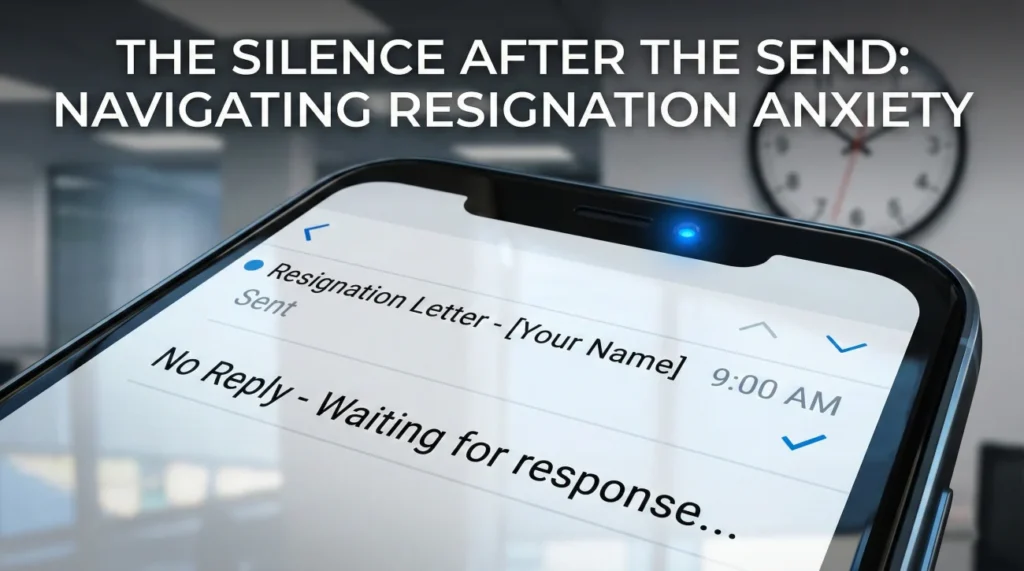
- What is happening: Silence after a resignation email is common and usually comes from overwhelm, HR process, or avoidance.
- When to act: 0 to 48 hours is normal, 72+ hours needs a follow up, 1 week means escalate to HR.
- How to follow up: Match tone to the situation with a gentle nudge, a logistics-focused check, or an urgent confirmation for a new employer.
- Key truth: You do not need “acceptance” for your resignation to be valid, your notice period starts when you send it.
- Protect yourself: Keep a paper trail, confirm handoff logistics, and stay polite but firm so your exit stays clean.
For the full structure, wording, and examples, see our guide on how to write a resignation email.
Sending a follow up on resignation email shouldn’t be necessary. In an ideal world, your manager would reply immediately with a professional acknowledgment and a clear transition plan. But in the real world, radio silence after a resignation is surprisingly common – and incredibly stressful. It leaves you in a professional limbo: Are you free to go? Are they mad? Did the email even go through?
You have done the hard part. You drafted the letter, checked the notice period, and hit “Send.” Now, days have passed, and your inbox is empty. The uncertainty is maddening because your exit logistics – from your final paycheck to your start date at the new job – depend on official confirmation. This silence can trigger a cascade of anxieties: Am I being punished? Is this a power play? Will this affect my reference?
This comprehensive guide is your roadmap through the silence. We will deconstruct why managers “ghost” resigning employees (it is rarely personal), exactly when to worry, and provide you with assertive, polite scripts to get the answer you need. Whether you are sending a gentle nudge or a firm checking on resignation status email, we have the strategy to help you close this chapter with confidence and professionalism.
Decoding the Silence: Why Managers Don’t Reply
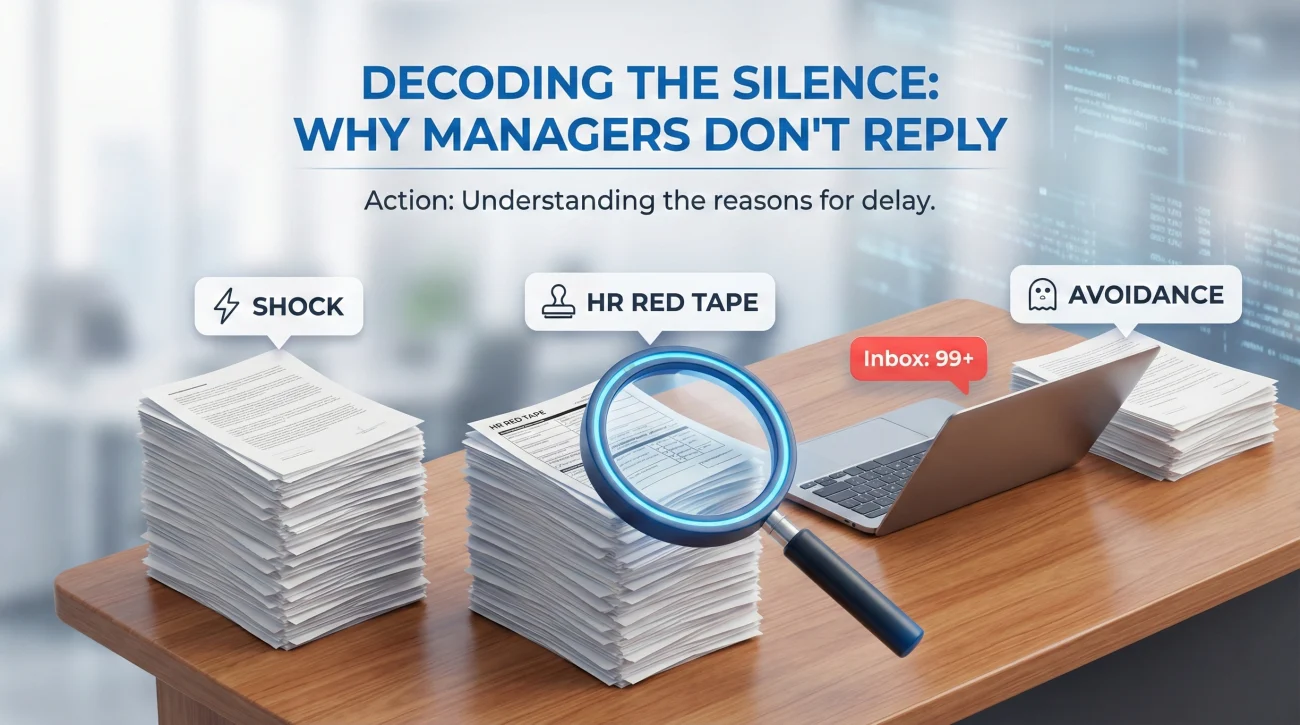
Before you spiral into panic, it is crucial to understand why the silence is happening. In 90% of cases, it is incompetence, overwhelm, or bureaucracy, not malice. Understanding the root cause helps you choose the right tone for your follow-up.
1. The “Shock Absorber” Effect
If you are a high performer, your resignation might have blindsided your manager. They aren’t ignoring you to be mean; they are processing the five stages of grief. They need a moment to figure out how to tell their boss, how to cover your workload, or even if they can make a counter-offer before they reply to you. Your email effectively dropped a bomb on their week; they are likely scrambling to contain the blast radius before acknowledging the explosion.
2. The HR Approval Chain
In large corporations, a manager often cannot accept a resignation officially until HR processes it. They might be waiting for a generic script from Legal, checking if you owe training costs, or calculating if they can offer you a retention package. The silence is often just red tape. They may have been instructed by HR not to reply until the official exit paperwork is ready.
3. Conflict Avoidance
Some managers are simply poor leaders. They view resignation as a conflict or a personal rejection and choose to hide from it, hoping you will just “fade away” or that HR will handle the awkward conversation. This is unprofessional, but it requires you to be the adult in the room. You cannot force them to be professional, but you can force the administrative process to move forward.
The Timeline: When to Panic vs. When to Wait
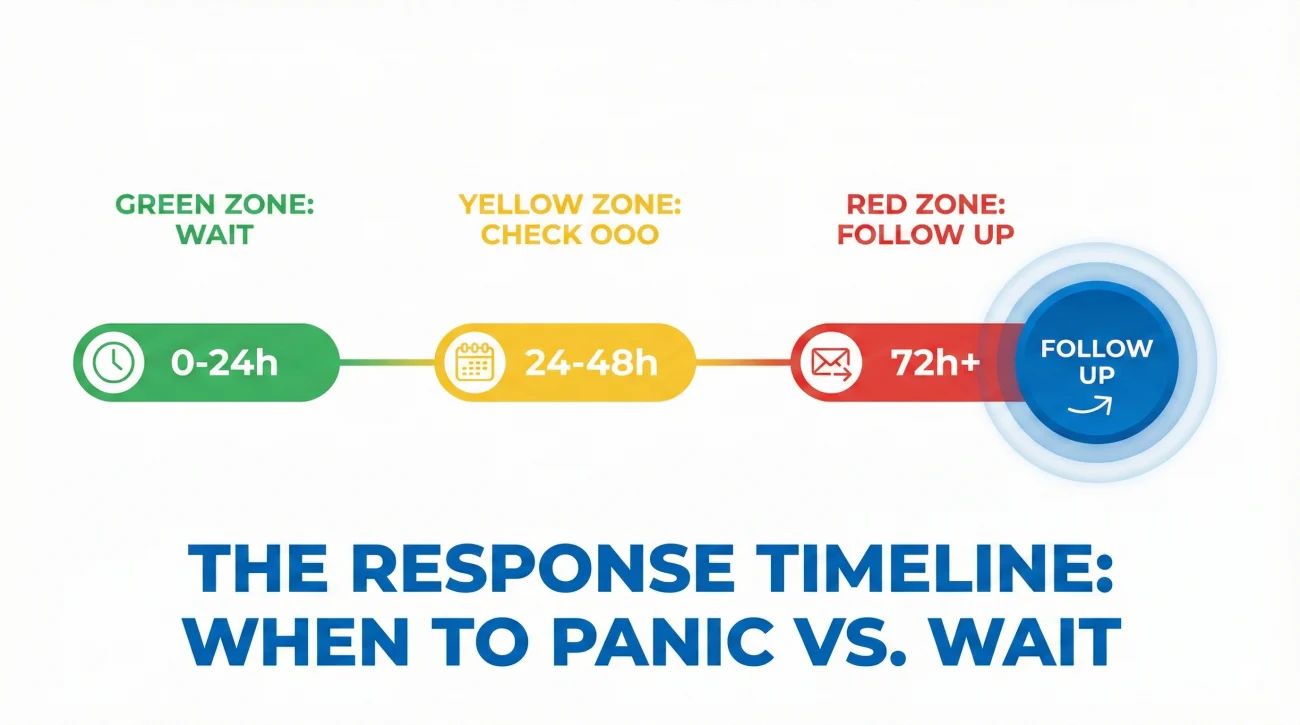
There is a fine line between being proactive and being annoying. Jumping the gun can make you look insecure, while waiting too long can jeopardize your exit logistics. Use this timeline to gauge your response.
| Time Since Sending | Status | Action Required |
|---|---|---|
| 0–24 Hours | Normal Processing | Do nothing. They might be busy, in meetings, or consulting HR. Assume positive intent. |
| 24–48 Hours | The “Grey Zone” | Check if they are out of office (OOO). Prepare a draft. Mention it casually if you see them. |
| 72+ Hours | Red Flag | Send a follow-up email immediately. At this point, the silence is interfering with your transition planning. |
| 1 Week | Unacceptable | Escalate to HR directly. This is now a compliance issue, not just a communication one. |
Pro Tip: If your resignation was sent on a Friday afternoon, do not expect a reply until Tuesday morning. Monday is often consumed by “putting out fires” and weekend catch-up.
Master Templates: How to Get a Reply
Choose the template that matches your current anxiety level, the urgency of your exit, and your relationship with your boss.

Scenario 1: The “Did You See This?” (Gentle Nudge)
Use this resignation response follow up if you have a good relationship and suspect the email just got buried in a busy inbox. Keep it light and non-accusatory. This is your first step before assuming the worst.
Subject: Following up: Resignation Letter – [Your Name]
Hi [Manager Name],
I wanted to quickly bump this to the top of your inbox to ensure you received my resignation email sent on [Day/Date].
I know it’s a busy week, but I would love to confirm that the timeline works for you so I can begin finalizing my transition documents and handover checklist. Please let me know when you have a moment to connect briefly.
Thanks,
[Your Name]
Scenario 2: The “Logistics Check” (Professional & Firm)
If 48 hours have passed without a peep, you need to be more direct. This confirming resignation email focuses on the work, shifting the conversation from “feelings” to “business continuity.” This forces them to engage because ignoring logistics creates liability for them.
Subject: Resignation Next Steps & Transition Plan
Dear [Manager Name],
I am writing to follow up on my resignation notice submitted on [Date].
Given that my final day is approaching on [Final Date], I want to ensure we have enough time to handle the administrative handoff effectively. Specifically, I need to coordinate:
- The transfer of my current project files and client contacts.
- Return of company equipment (laptop, badge, keys).
- Confirmation of my final payroll details and benefits termination.
Could you please confirm receipt of my resignation so I can proceed with these steps? I want to ensure I leave the team in a strong position.
Best regards,
[Your Name]
Scenario 3: The “New Employer is Asking” (Urgent)
Use this has my resignation been accepted email when you need proof of exit for your new background check or start date confirmation. It externalizes the pressure (“My new company needs this”) so you don’t look pushy, you look like a professional trying to manage a schedule.
Subject: Urgent: Confirmation of Resignation Needed – [Your Name]
Hi [Manager Name],
I hope you are having a good week. I am following up on the resignation letter I sent on [Date] regarding my departure on [Final Date].
I need to confirm my official end date to finalize the onboarding schedule and background check with my new employer. Could you please reply to acknowledge receipt of my notice?
If I don’t hear back by [Time/Day], I will assume the [Final Date] is confirmed and will proceed with my exit checklist accordingly to ensure a timely departure.
Thank you for your help with this.
[Your Name]
Scenario 4: The “Technical Glitch” (Face-Saving)
Sometimes giving them an excuse (“maybe it went to spam”) helps them reply without losing face. It removes the blame from them and places it on “technology.” This is a diplomatic way to prompt a reply without accusing them of ignoring you.
Subject: Re-sending: Resignation Notice – [Your Name]
Dear [Manager Name],
I haven’t heard back regarding my email below from [Date], so I wanted to re-send it in case it was caught in a spam filter or buried in your inbox during the busy start of the week.
To reiterate, I am resigning from my position as [Job Title], effective [Final Date]. I am eager to discuss how I can make my remaining time as productive as possible for the team.
Please confirm receipt when you get a chance.
Best,
[Your Name]
Scenario 5: The “HR Escalation” (The Nuclear Option)
If it has been 4+ days and your manager is ghosting you, go to HR. You don’t need permission to quit. This email creates a formal record that you did your due diligence and that the lack of communication is not on your end.
To: [HR Contact Name]
Cc: [Manager Name]
Subject: Formal Resignation Notice – [Your Name]
Dear Human Resources Team,
I submitted my formal resignation to [Manager Name] on [Date] (see attached email) but have not yet received an acknowledgment. I am looping you in to ensure my departure is officially recorded in the company system and that my notice period is honored.
My final day of employment will be [Final Date].
Please let me know what the standard offboarding procedure is regarding benefits continuation, final pay, and asset return. I want to ensure I am fully compliant with company policy before I leave.
Regards,
[Your Name]
Reality Check: Do You Need “Acceptance”?
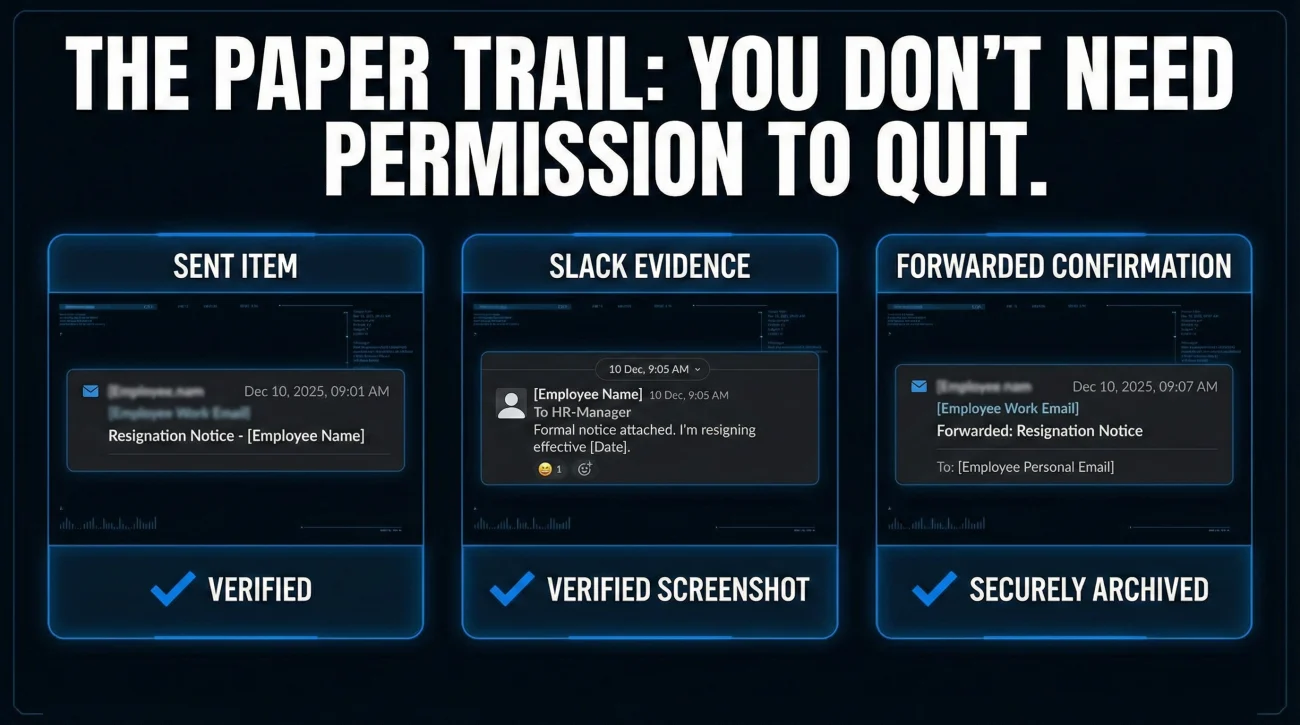
This is the most common misconception in the workforce. You do not need your resignation to be “accepted” for it to be valid.
1. The Power of “At-Will”
In almost all US states (and many Western jurisdictions), employment is “at-will.” This means you can terminate the relationship at any time. Resignation is a unilateral notification, not a negotiated request. Once you send the email, the clock starts on your notice period. Their silence does not pause the clock. You are not a hostage; you are an employee exercising your rights.
2. Creating the Paper Trail
If you are worried they will claim “job abandonment” or try to fire you for “no-call no-show,” protect yourself. Forward your sent email to your personal address immediately. Take a screenshot of the timestamp showing it in your “Sent” folder. If you use Slack or Teams, send a message: “Hey, sent you an important email regarding my resignation, let me know when you see it.” Take a screenshot of that too. This evidence is your insurance policy.
❓ FAQ: Dealing with the Ghosting Boss
📅 Does my notice period start when I send the email or when they reply?
📞 Should I call them if they don’t reply?
😰 What if they pretend they never got it to keep me longer?
🚶 Can I just leave if they don’t reply?
💼 Will this affect my reference?
Final Thoughts
Silence is uncomfortable, but do not let it intimidate you. By sending a clear, timely follow up on resignation email, you are taking control of the narrative and demonstrating professionalism even when your leadership fails to do so.
Remember: You have fired your boss. They don’t have to like it, and they don’t even have to reply to it, but they do have to accept it. Keep your receipts, stay polite but firm, and focus on your next adventure. Your exit is valid the moment you decide it is.
For more guides on handling tricky exit scenarios, check our resignation email examples or visit the homepage for comprehensive career advice.
⚠️ Legal Disclaimer: ResignSmartly provides general informational guidance about resignation, workplace communication, notice periods, handovers, and career transitions. Content does not constitute individualized legal advice. Employment laws, contracts, workplace policies, and individual circumstances vary, so review the requirements that apply to your situation and consult an appropriate qualified professional when needed.