- Use it only for real emergencies: Health crisis, unsafe or abusive environment, family emergency, or an ethical line you cannot cross.
- Legal check: At-will usually allows quitting without notice, but contracts can still bite via clawbacks, fixed-term terms, benefits cutoffs, and restrictive clauses.
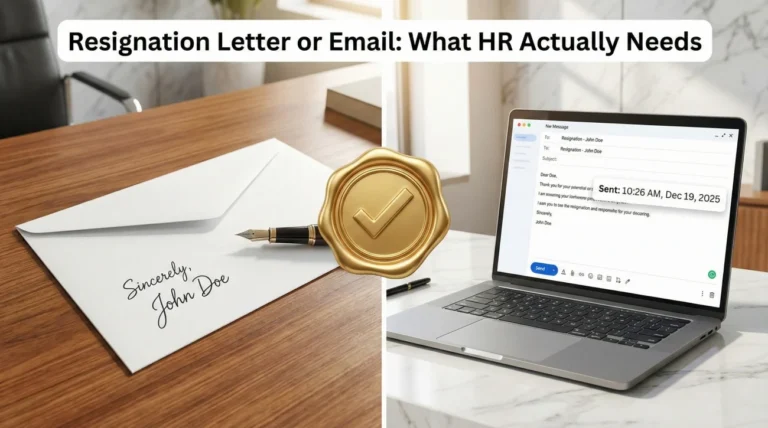
- Email rules: Short, firm, polite; state resignation is effective immediately (today is the last day) and include a clean plan to return equipment.
- Before you hit send: Assume access will be cut fast; remove personal data, secure allowed work samples, copy key contacts without bulk exporting, and pack personal items.
- Aftermath and interviews: Return assets quickly, confirm final pay and PTO policy, do not expect unemployment unless “good cause,” and use a calm “pivot and protect” explanation.
The Nuclear Option: Mastering the Immediate Resignation
Resigning immediately is the career equivalent of pulling the emergency brake on a high-speed train. It is jarring, it creates friction, and it is not a decision to be taken lightly. However, in specific, high-stakes scenarios – such as severe health crises, toxic abuse, or unsafe environments – it is not just an option; it is a necessary act of self-preservation.
The standard corporate etiquette dictates a two-week notice period. This buffer allows for knowledge transfer, project handoffs, and a graceful exit. Violating this norm by sending an immediate resignation email sends a shockwave through your professional network. It signals that something has gone fundamentally wrong, either in your personal life or within the organization itself.
While the risks to your reputation are real, they are often overstated by fear-mongering career advice. If executed with surgical precision, a resignation email without notice can protect your legal standing and mental health without completely detonating your career bridges. This guide is your crisis management playbook. We will move beyond the basic “how-to” and dive deep into the strategy, psychology, and legal realities of quitting on the spot.
For a broader understanding of standard exit protocols, you should review our foundational guide on how to write a resignation email. But if you are in a crisis mode and need to leave today, read on.
Can You Quit a Job Immediately via Email? The Legal Landscape

Before you hit send, you need to strip away the emotion and look at the cold, hard legal facts. The fear of being sued keeps many employees trapped in untenable situations, but for the vast majority of workers, the law is on your side. However, understanding the nuance between “legal right” and “contractual obligation” is critical.
The “At-Will” Shield
In the United States, 49 out of 50 states (Montana being the exception) operate under “at-will” employment doctrines. This legal framework is a double-edged sword: just as your employer can terminate you at any moment without cause, you have the absolute legal right to quit a job immediately via email without providing two weeks’ notice.
Unless you are a C-level executive or a highly specialized professional with a specific employment contract that mandates a notice period, “two weeks” is a professional courtesy, not a legal requirement. It is a social contract, not a binding one.
When You Should Worry (The “Fine Print”)
There are specific scenarios where an immediate resignation carries genuine legal or financial risk. Before taking action, pull out your employment contract and look for these specific clauses:
- 📜 Clawback Clauses: This is the most common financial trap. Some contracts state that if you leave within a certain period (e.g., 12 months) or without specific notice, you must repay signing bonuses, relocation assistance, or tuition reimbursement.
- ⚖️ Term Contracts: If you are a teacher, union worker, or executive on a fixed-term contract (e.g., “1-year term”), breaking it early can lead to breach of contract lawsuits. This is rare in general corporate roles but common in education and healthcare.
- 💊 Health Insurance Gaps: In many companies, benefits terminate on the last day of employment. Quitting immediately might leave you uninsured tomorrow. If you have a planned medical procedure, check your policy first.
- 🔒 Non-Compete & Non-Solicit: Leaving abruptly often triggers an aggressive response from employers regarding these clauses. Ensure you haven’t downloaded client lists or trade secrets, as an immediate exit raises suspicion of data theft.
Strategic Decision: Should You Send a Resignation Email Without Notice?
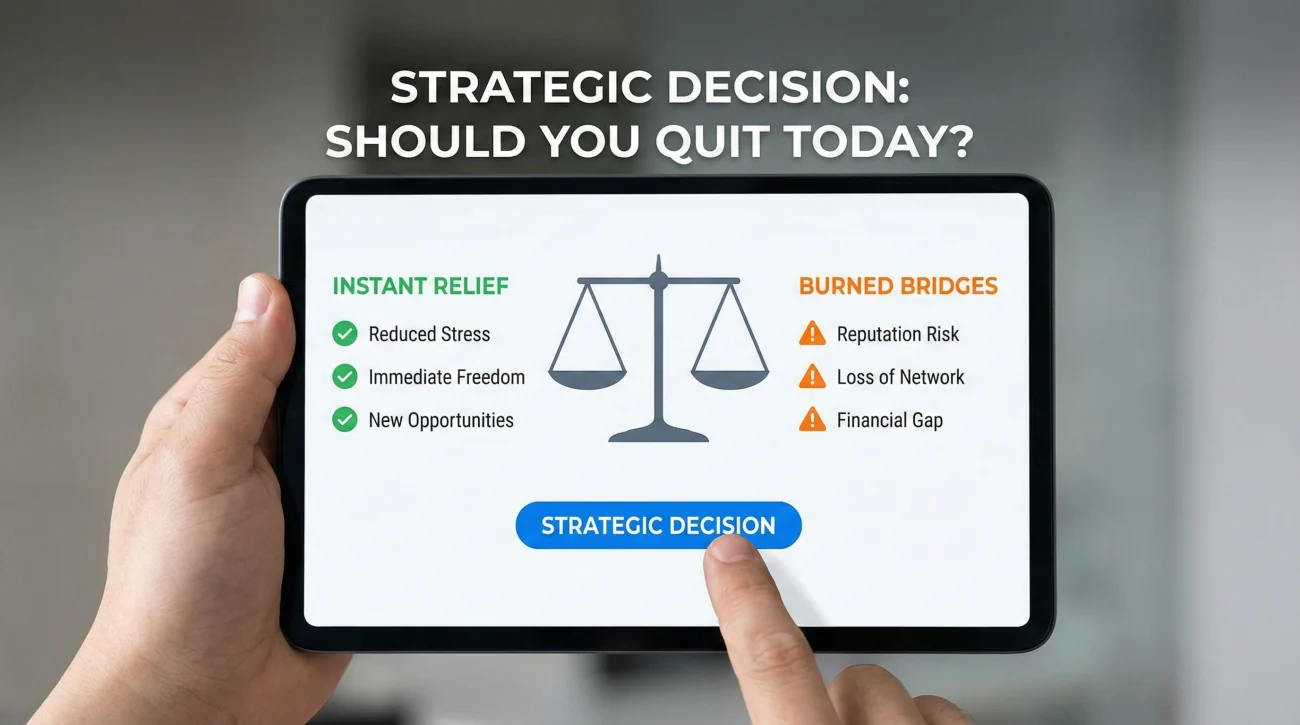
Just because you can doesn’t mean you should. Strategic career management is about weighing immediate relief against long-term capital. We need to assess whether your reason for leaving a job immediately justifies the potential reputational cost.
| Pros of Immediate Resignation | Cons of Immediate Resignation |
|---|---|
| ✅ Instant Mental Relief: Immediate removal from a toxic or abusive stressor protects your mental health. | ❌ Burned Bridges: You will almost certainly lose your manager as a future reference. |
| ✅ Safety Protocol: Essential if the workplace poses a physical danger or harassment risk. | ❌ “Do Not Rehire” List: You may be permanently blacklisted by the company and its subsidiaries. |
| ✅ Immediate Availability: Allows you to handle a sudden family crisis without work distractions. | ❌ Team Resentment: Your former colleagues, who must pick up your slack instantly, may resent you. |
| ✅ Crisis Management: Prevents a situation (like a mental breakdown) from escalating publicly in the office. | ❌ Financial Hit: Potential loss of accrued PTO payout (depending on state law) or bonuses. |
Valid Scenarios for Immediate Departure
Recruiters and future hiring managers are humans. They understand that life happens. If you have a legitimate emergency resignation scenario, the damage to your reputation will be minimal – provided you articulate it professionally.
- 🚑 Medical Emergency: A sudden diagnosis, hospitalization, or severe mental health crisis that makes working impossible. This is unassailable; no reasonable employer argues with a hospital admission.
- 👨👩👧 Family Crisis: The death of a loved one, or a family member requiring urgent, full-time caregiving.
- ☣️ Toxic/Unsafe Environment: Harassment, wage theft, request to perform illegal acts, or physical safety threats. In legal terms, leaving due to these reasons may be considered “Constructive Discharge.”
- 🔄 Ethical Breach: Being asked to do something that violates your professional ethics or the law (e.g., cooking the books, lying to regulators).
Reasons That Will Damage Your Reputation
Conversely, using an immediate resignation email for minor inconveniences screams “unprofessional.” Avoid quitting on the spot for:
- ❌ General Boredom: “I’m just not feeling it anymore.”
- ❌ Minor Conflicts: A disagreement with a coworker that could be mediated.
- ❌ A New Job Offer: Unless the new employer demands an immediate start (which is a huge red flag regarding their own culture), negotiate a start date that allows for notice.
Crafting the Perfect Resignation Email with Immediate Effect
When you have zero notice to give, your email must be flawless. You are already creating a logistical headache for your boss; do not compound it with emotional dumping or ambiguity. The goal of a no notice resignation email is to be surgical: state the fact, provide the necessary logistics, and exit.
Tone Calibration: Cold vs. Professional
There is a misconception that you need to over-apologize. While you should express regret for the timing, you must remain firm. If you sound too guilty, you invite negotiation or guilt-tripping. If you sound too cold, you validate their anger.
The Golden Rule: Be brief, be firm, but be polite.
Essential Components
Your email must answer three questions immediately:
- What is happening? (You are resigning).
- When? (Effectively immediately/Today).
- What next? (How you will return equipment).
⚠️ Critical Warning: Never include grievances in an immediate resignation email. If you are leaving because of a toxic boss, writing “I am quitting because John is a bully” puts you at risk of defamation claims or simply looking like a “problem employee” to HR. Save the feedback for an exit interview, or keep it to yourself to protect your legal “Teflon” coating.
5+ Resignation Letter Effective Immediately Email Templates
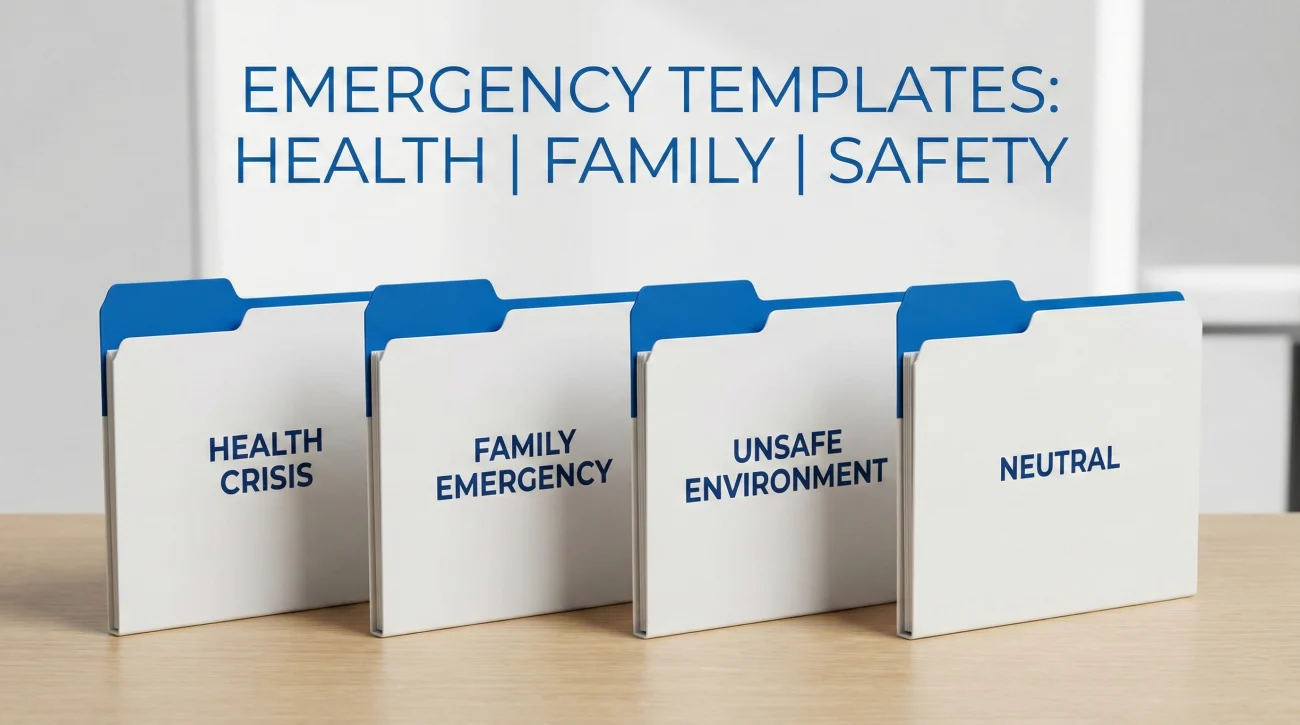
These templates are designed to cover the most common crisis scenarios. Choose the one that matches your reality, fill in the bracketed information, and send it. For more standard scenarios, you can browse our full library of resignation email examples.
1. The Health Crisis (The “Unquestionable” Reason)
Use this when a medical issue (mental or physical) forces you out. HR departments treat health issues with extreme caution and will rarely push back.
Subject: Resignation – Effective Immediately – [Your Name]
Dear [Manager’s Name],
Please accept this email as formal notification that I am resigning from my position as [Job Title], effective immediately. Today, [Date], will be my final day of employment.
Regrettably, a sudden personal health matter has arisen that requires my immediate and full attention, making it impossible for me to continue my duties or provide the standard notice period. I apologize for the abruptness of this departure and the inconvenience it causes the team.
I will arrange to return my laptop and badge by [Day] via [Method, e.g., courier or drop-off].
Sincerely,
[Your Name]
2. The Family Emergency
Similar to health, family emergencies are generally respected as valid reasons for an emergency resignation email.
Subject: Resignation – [Your Name]
Dear [Manager’s Name],
I am writing to inform you of my resignation from [Company Name], effective immediately.
Due to an urgent family emergency, I am unable to fulfill the standard notice period requirements. I need to direct my full focus to my family at this time.
I have uploaded my current project status files to the shared drive under the folder “[Folder Name]” to assist with the handover. I will follow up regarding the return of company property.
Thank you for your understanding during this difficult time.
Best regards,
[Your Name]
3. The “Unsafe Environment” (Protective Documentation)
Use this carefully. This creates a paper trail that you left due to safety concerns, which can be crucial for unemployment claims or future lawsuits.
Subject: Resignation – Effective Immediately – [Your Name]
Dear [Manager’s Name],
Please accept this letter as my resignation from my position as [Job Title], effective immediately today, [Date].
Due to the ongoing [safety concerns / working conditions] that I have previously brought to management’s attention, I feel I can no longer remain in this environment safely. Therefore, I am terminating my employment effective immediately.
Please let me know the procedure for returning my company ID and equipment.
Regards,
[Your Name]
4. The “No Reason Given” (Maximum Privacy)
If you don’t want to lie, but don’t want to explain. This is professional, cold, and legally safe.
Subject: Resignation Notice – [Your Name]
Dear [Manager’s Name],
I am writing to formally resign from my position as [Job Title]. My resignation is effective immediately, and today, [Date], is my last day.
While I understand that resigning without notice is unconventional, personal circumstances necessitate this decision. I appreciate the opportunities I have had at [Company Name].
I will ensure all company property is returned by [Date].
Sincerely,
[Your Name]
5. The New Hire (During Probation)
If you’ve been there less than 3 months, a “two weeks notice” is often unnecessary as you aren’t fully trained yet.
Subject: Resignation – [Your Name]
Dear [Manager’s Name],
Please accept this email as my resignation from the position of [Job Title], effective immediately.
After my time here, I have realized that this role is not the right fit for my career goals, and I believe it is best to part ways now so the company can find a suitable replacement immediately. I apologize for the disruption.
Thank you for the opportunity.
Best,
[Your Name]
The “60-Minute Countdown”: What to Do Before Sending
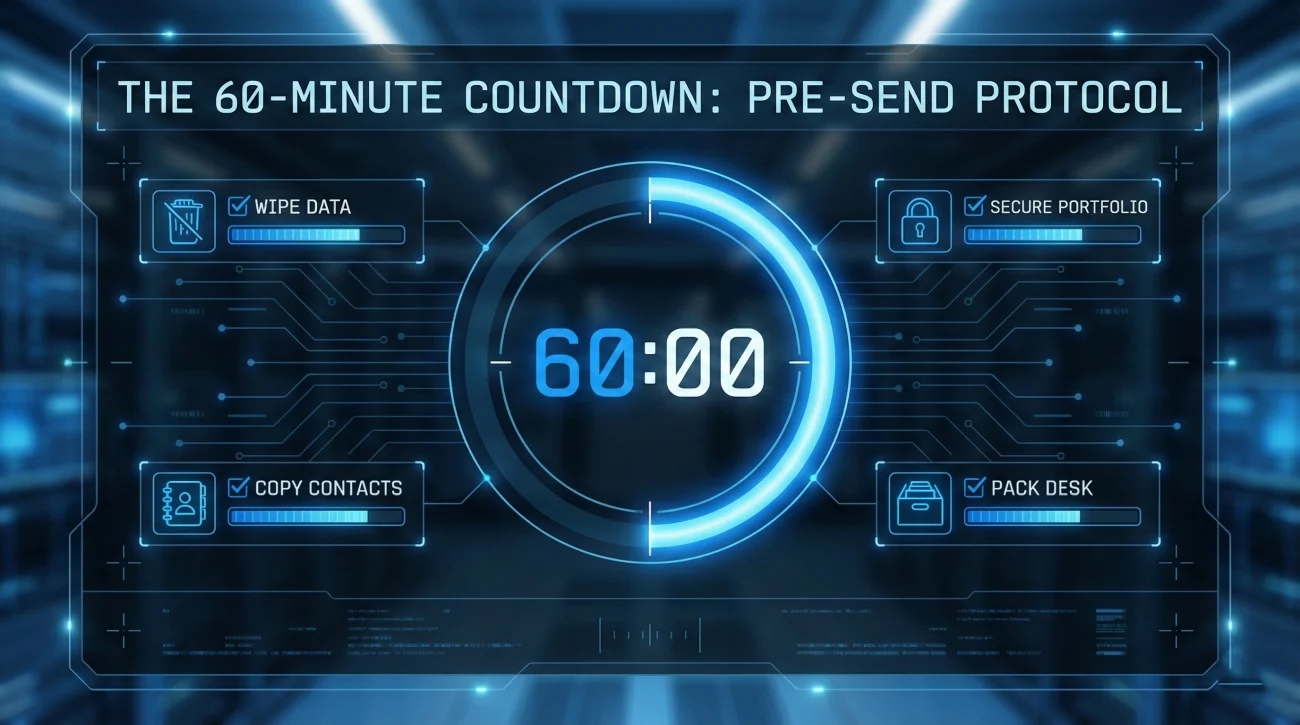
Once you hit send, your access to company systems will likely be cut off within minutes. In high-security industries (finance, tech), this happens instantaneously. Do not be caught unprepared. Follow this 60-minute protocol before sending your resignation email.
- 🛑 Remove Personal Data: Clear your browser history, log out of personal email/accounts on work devices, and delete personal files from the desktop.
- 📂 Secure Portfolio Samples: If you have work that you are legally allowed to keep (and doesn’t violate NDA), make sure you have copies. You won’t be able to get them later.
- 📞 Copy Contacts: Manually write down or sync the contact info of clients or colleagues you want to stay in touch with. Do not export the entire company directory (this is data theft).
- 📦 Pack Your Desk: If you are in the office, discreetly pack your personal belongings. It is humiliating to have to pack a box while security watches you.
- ✉️ Draft the Email in Word: Do not draft it in your email client where you might accidentally hit send too early. Write it externally, then paste it.
Damage Control: Interviewing After a Sudden Exit
One of the biggest fears about immediate resignation is: “How do I explain this to my next employer?” This is a valid concern, but it is manageable with the right script.
When asked, “Why did you leave your last job without notice?” or “Why is there a gap?”, use the “Pivot and Protect” technique. Briefly acknowledge the situation without badmouthing the former employer, then pivot to the future.
Script Example 1 (Health/Family):
“I had to step away to handle an urgent family medical situation that required my full attention. That issue has been fully resolved, and I am now excited to refocus entirely on my career.”
Script Example 2 (Toxic Environment – The Diplomatic Approach):
“I realized that the company’s direction and values were no longer aligned with my own. I decided it was most professional to resign so they could find someone better suited for that specific environment, while I sought a role where I could contribute more effectively, like this one.”
The Aftermath: Managing the Fallout
Once you hit send on that resignation email immediate effect, you are no longer an employee. However, you still have logistical hurdles to clear to ensure you get paid and avoid theft accusations.
1. The Asset Lockdown
Companies can be vindictive. If you keep a laptop or phone for weeks after quitting immediately, they may deduct the cost from your paycheck or threaten legal action for theft.
Strategy: Pack everything up before you send the email. If you are remote, ask for a shipping label immediately. If you are in the office, leave the items on your desk, take a photo as proof, and walk out.
2. Your Money
Do not let guilt cost you money. Even if you quit without notice, you are legally entitled to be paid for every hour you worked.
State Laws: In some states (like California), if you quit without notice, the employer has 72 hours to pay you. In others, they can wait until the next scheduled payday. Know your local labor laws so you don’t get shortchanged.
3. Unemployment Eligibility
Generally, quitting voluntarily disqualifies you from unemployment benefits. However, there is a “Good Cause” exception. If you resigned immediately due to verifiable domestic violence, unsafe working conditions, or medical necessity, you might still qualify. This is why using the correct template (like Template 3 or 1) is vital for your paper trail.
❓ FAQ: Expert Answers on Immediate Resignation
⚖️ Can a company sue me for quitting without notice?
📞 Should I call my boss before sending the email?
📄 What if they refuse to accept my resignation?
🤐 Should I give specific details about my health emergency?
💸 Will I lose my unused vacation pay?
Final Thoughts
Sending an immediate resignation email is a decisive, irreversible career move. It effectively burns a bridge, but sometimes, burning a bridge is the only way to stop the enemy from following you. Whether you are prioritizing your mental health, responding to a family crisis, or escaping a toxic environment, you have the right to leave.
The key is to execute this departure with dignity. By keeping your communication brief, professional, and devoid of drama, you preserve your own narrative. You are not “rage quitting”; you are making a difficult executive decision for your own life.
If you have more time to plan your exit, we highly recommend reading our strategy guide on how to write a resignation email properly. For more templates covering every possible scenario, visit our resignation email examples hub or head to our homepage.
⚠️ Legal Disclaimer: ResignSmartly provides general informational guidance about resignation, workplace communication, notice periods, handovers, and career transitions. Content does not constitute individualized legal advice. Employment laws, contracts, workplace policies, and individual circumstances vary, so review the requirements that apply to your situation and consult an appropriate qualified professional when needed.