
- Shift: The “company man” era is over, and staying too long can cost you money through the loyalty tax.
- Math: Retention raises are usually small, while strategic moves often bring market-level jumps if you can keep trust.
- Tenure: Under 12 months looks risky, 18 months to 3 years is the modern sweet spot, and 5+ years without growth can signal stagnation.
- Resume: Fix choppy history by grouping short roles, writing bullets that show completion, and framing your story in the summary.
- Interview: Defend moves with responsibility and impact, tailor the story by industry tolerance, and prove you can commit long-term.
The Death of the “Company Man”
For nearly a century, the golden rule of career management was stability. You found a good company, kept your head down, climbed the internal ladder, and retired with a pension and a gold watch. Leaving too soon – or too often – branded you as unreliable, flaky, or “unemployable.” This was the classic job hopping stigma.
But the corporate landscape of 2026 looks nothing like 1995. Pensions are gone. Layoffs are routine. And most importantly, the financial reward structure has inverted. We are now living in the era of the “Loyalty Tax,” where staying at a company for too long often punishes your bank account.
However, simply quitting every 12 months is not a strategy; it is career suicide. While recruiters are more forgiving than in the past, there is a fine line between a “dynamic career strategist” and a “flight risk.” Knowing exactly where that line is – and how to spin your story – is the difference between landing a Director role and getting your resume tossed in the trash.
The Math: Why “Loyalty” is Costing You Millions
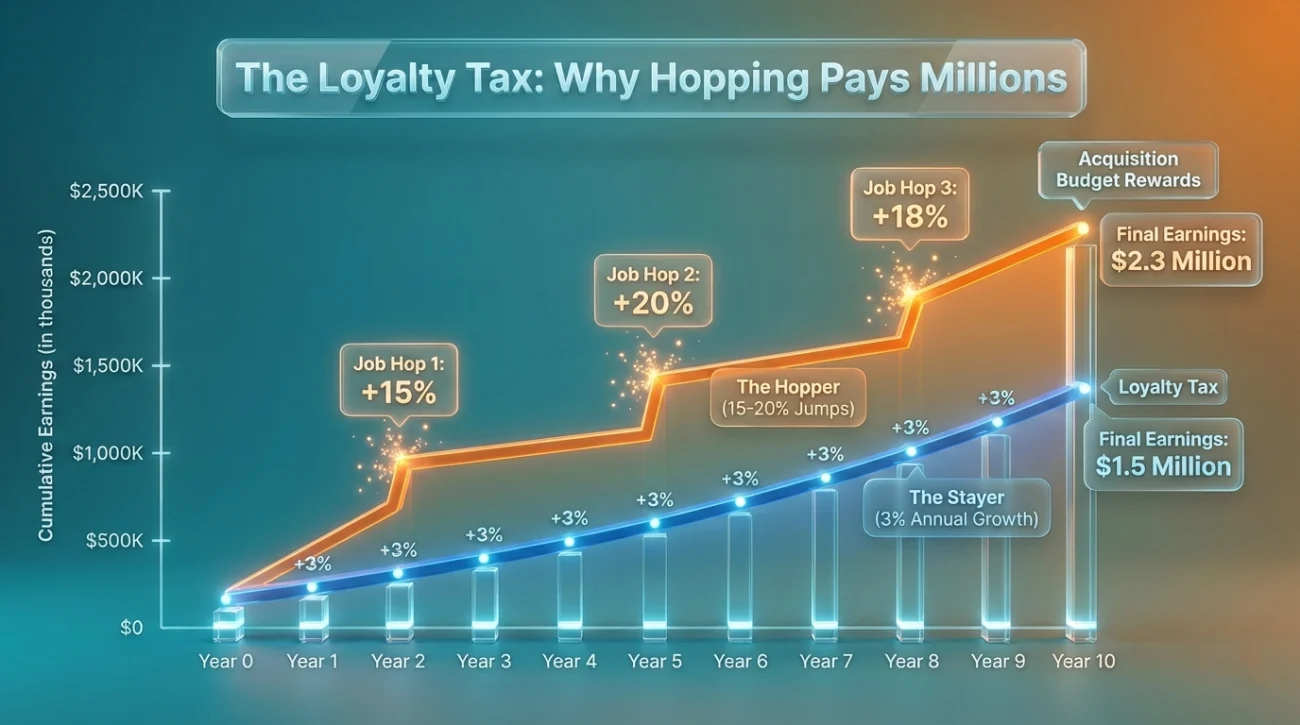
Before you worry about is job hopping bad, you need to look at the cold, hard data regarding your lifetime earnings. The modern corporate structure has a massive flaw: budget allocation.
Companies typically have strict caps on “retention raises” (usually 3-5% to match inflation), but they have flexible budgets for “acquisition” (hiring new talent). This creates a disparity known as the Loyalty Tax.
| Metric | The Stayer (Loyal Employee) | The Hopper (Strategic Mover) |
|---|---|---|
| Average Annual Raise | 3% (Cost of Living Adjustment) | 15% – 20% (Market Adjustment) |
| Salary at Year 10 (Start $60k) | ~$80,000 | ~$125,000+ |
| Skill Acquisition | Deep knowledge of 1 company’s outdated systems. | Broad knowledge of 4-5 different tech stacks and methodologies. |
| Network | Limited to one building. | Spans across the entire industry. |
The Verdict: Financially, job hopping is superior. But professionally, it comes with a cost: trust. You must balance the “Money Graph” with the “Trust Graph.”
The “Sweet Spot”: How Long is Long Enough?
So, how long to stay at a job to get the raise without the stigma? Recruiters look for specific patterns. One short stint is a mistake; three is a habit.

1. The “Danger Zone” (< 12 Months)
Leaving in under a year is universally seen as a negative. It suggests you either failed probation, couldn’t handle the culture, or lack grit. Unless you were laid off, try to stick it out to the 12-month mark.
2. The “Sweet Spot” (18 Months – 3 Years)
This is the new gold standard in tech, marketing, and modern industries.
Why: 18 months is enough time to onboard (3 months), execute a major project (9 months), and measure the results (6 months). Leaving after delivering a win is not quitting; it is “graduating.”
3. The “Stagnation Zone” (5+ Years without Promotion)
Ironically, staying too long without upward movement can also hurt you. It signals that you are complacent or risk-averse. If you have been a “Junior Manager” for 7 years, recruiters wonder why nobody promoted you.
Resume Rehab: Fixing the “Choppy” History
You cannot change your past, but you can control the narrative. When explaining job hopping on resume documents, visual formatting is your best weapon.

Strategy A: The “Stacking” Technique
If you had several short-term roles (e.g., 6 months, 8 months, 5 months) due to contracting or freelancing, do not list them as separate entries. It looks chaotic.
Do This Instead: Group them under one umbrella.
Strategic Marketing Consultant | Various Companies
Jan 2020 – Dec 2022
Executed high-impact projects for 3 major clients including [Company A] and [Company B]. Key achievements included…
Strategy B: Focus on “Project Completion”
In your bullet points, use language that implies finality. Do not say “Worked on X.” Say “Led Project X from inception to full launch.” This subtly tells the reader: “I didn’t quit halfway; I finished the job.”
Strategy C: The Summary Statement
Use your professional summary at the top of the resume to frame your background.
“Agile Project Manager with a diverse background transforming processes for 4 different startups in the fintech space…” -> This turns “hopping” into “diverse experience.”
Defending Your Resume in the Interview
If you get the interview, they will ask: “Why have you moved around so much?” Your answer determines if you get the offer.
Scenario 1: You Left for Money (But Can’t Say That)
Don’t Say: “They didn’t pay enough.”
Do Say: “I’ve been fortunate to be headhunted for roles that offered significant jumps in responsibility. For example, moving from Company A to B allowed me to manage a budget twice the size. I’m motivated by impact, and I’ve moved where I could make the biggest difference.”
Scenario 2: You Were Bored/Toxic Culture
Don’t Say: “My boss was a nightmare.”
Do Say: “I’m a builder at heart. Once the systems at [Previous Job] were built and running smoothly, I realized my strengths were better suited to a new challenge where I could build from scratch again, rather than just maintain.”
Scenario 3: The “Commitment” Check
Recruiter: “We are looking for someone long-term. Can you commit?”
You: “Absolutely. My early career was about gathering a diverse toolkit of skills. Now that I have that broad perspective, I am looking for a home where I can plant roots and apply those skills to long-term strategy. I’m ready to dig in.”
Context Matters: Tech vs. Traditional
The stigma varies wildly depending on your sector. Know your audience.
- 💻 Tech / Startups / Advertising: High tolerance. 18-month tenure is normal. Moving often is seen as staying relevant with new tech.
- 🏦 Banking / Law / Manufacturing: Low tolerance. They value institutional knowledge. Hopping every 2 years here is still a major red flag.
- 🏥 Healthcare / Education: Mixed. Stability is preferred for patient/student care, but burnout is understood as a driver for movement.
❓ FAQ
🚫 Will job hopping hurt my retirement?
Yes, if you ignore vesting schedules. Many companies require 3-5 years of service before you get to keep the employer match in your 401(k). If you leave every 2 years, you might get a higher salary but lose tens of thousands in free retirement money.
📉 Can I leave a job after 3 months if I hate it?
Yes, but you have two choices: leave it off your resume entirely (if the gap is small), or frame it as a “contract” or “misalignment.” Just don’t make a habit of it. One mulligan is allowed; two is a pattern.
📄 Should I address job hopping in my cover letter?
Yes. Control the narrative upfront. “My diverse background across three industries has given me a unique perspective on [Problem X]…” is a great hook that explains the hops before they even ask.
🤝 How do I build a network if I keep leaving?
Job hoppers actually often have stronger networks because they know more people. The key is to leave on good terms. Never burn a bridge. Your ex-colleagues are your future referral sources.
🛑 When does job hopping become “unhirable”?
Usually, if you have 3 or more jobs in a row that lasted less than 12 months without a clear reason (like a layoff), recruiters will block you. At that point, you need to “hunker down” and stay somewhere for 2+ years to reset your reputation.
Final Thoughts

The job hopping stigma hasn’t disappeared, but it has evolved into a “competence filter.” Employers don’t mind if you move; they mind if you move without delivering value.
If you hop jobs and leave a trail of success, you are a high-value asset. If you hop jobs and leave a trail of chaos, you are a liability. The secret isn’t to stop hopping – it is to make sure every jump is a calculated step up, not just a lateral escape.
⚠️ Legal Disclaimer: ResignSmartly provides general informational guidance about resignation, workplace communication, notice periods, handovers, and career transitions. Content does not constitute individualized legal advice. Employment laws, contracts, workplace policies, and individual circumstances vary, so review the requirements that apply to your situation and consult an appropriate qualified professional when needed.