- Core Thesis: Your last-day email is the “final frame” people remember, so it should protect your reputation and keep bridges intact.
- Strategy: Balance logistics and warmth, aim for about 70% professional and 30% personal so you do not sound robotic or overly emotional.
- Timing: Send mid-morning around 10:00 to 11:00 on your last day, for remote teams prioritize the earliest time zone start.
- Must-Have Structure: Clear subject, direct opening that today is your last day, baton-pass handover contacts, and a simple way to stay in touch.
- Audience And Risk Control: Segment recipients by closeness, use templates that fit the situation, and avoid digs, long manifestos, or public shoutouts that create drama.
The “Legacy Seal”: Why Your Last Email Defines Your Professional Future
There is a psychological phenomenon known as the “Peak-End Rule.” It suggests that people judge an experience largely based on how it felt at its peak and at its end. Your last working day email to team is that end. It is the final frame of the movie. No matter how many late nights you pulled or how many projects you crushed, a sloppy, bitter, or forgettable final email can rewrite your entire narrative.
Most professionals treat this email as a logistical checkbox – a quick “Goodbye and good luck” sent five minutes before handing over their badge. This is a strategic error. In the modern career landscape, your network is your net worth. The people reading this email are not just “former colleagues”; they are your future hiring managers, references, business partners, and investors.
This guide is your masterclass in the art of the exit. We will move beyond the generic “I learned so much” templates. We will dissect the timing, the tone, and the tactical components of a today is my last day email that leaves a legacy of warmth, professionalism, and class. Whether you are leaving a job you loved or escaping a toxic environment, you will learn how to walk out the door with your head high and your bridges intact.
The Strategy: The “Recency Bias” Optimization
Recency Bias dictates that people remember the most recent events more clearly than older ones. Your tenure might have been a mix of highs and lows, but your exit is happening now. By crafting a meticulous farewell, you can “hack” this bias to ensure you are remembered positively.
Your final email serves two distinct masters: Logistics and Relationship Building. Understanding the balance between these two is key.
| The Logistical Goal (The Brain) | The Emotional Goal (The Heart) |
|---|---|
| Clarity: “I am gone as of 5 PM today.” No ambiguity. | Gratitude: “Thank you for the mentorship/friendship.” |
| Continuity: “Contact Sarah for Project X.” | Validation: “We achieved great things together.” |
| Access: “Here is my LinkedIn.” | Future Pacing: “I hope our paths cross again.” |
If you lean too hard on logistics, you sound like a robot. If you lean too hard on emotion, you sound like you are writing a eulogy. The “Goldilocks Zone” is 70% professional, 30% personal.
The 10 AM Rule: Precision Timing for Maximum Impact
When you send your final day at work email is just as important as what you say. Send it too early, and you are a “lame duck” all day. Send it too late, and you “ghost” your team.
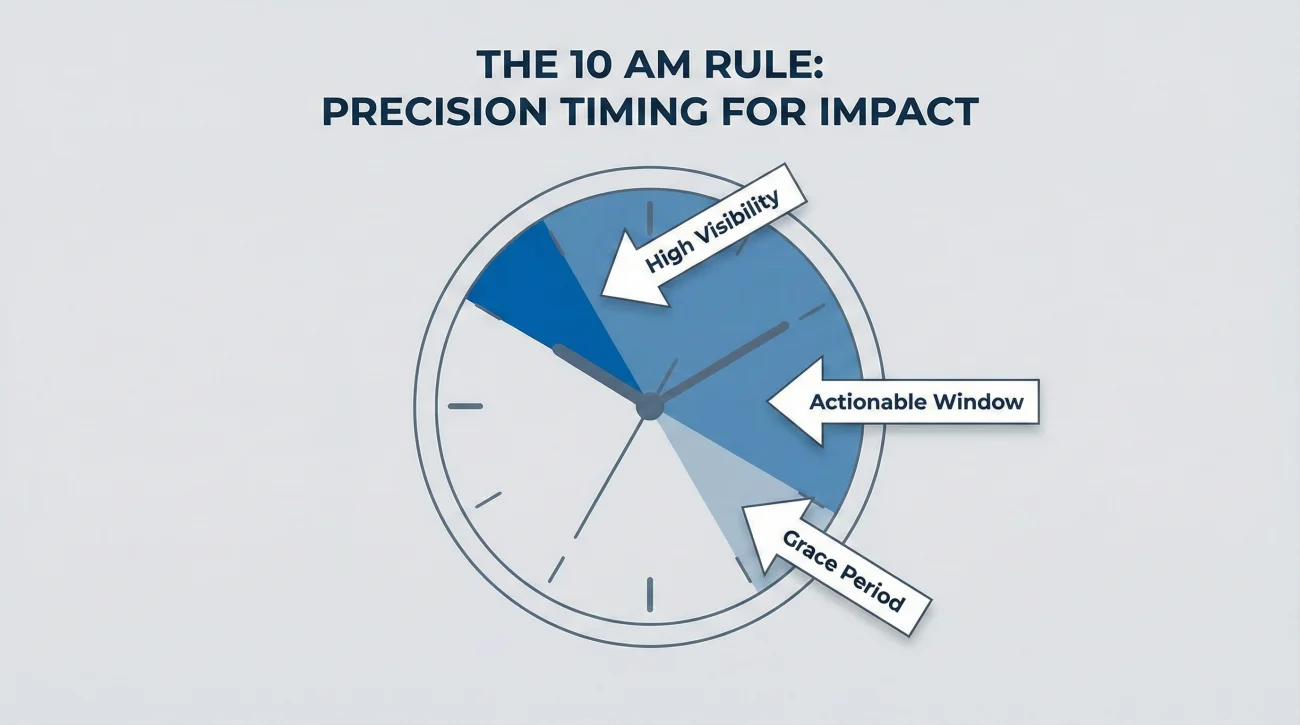
The Sweet Spot: 10:00 AM – 11:00 AM
Sending your email mid-morning on your last day is optimal for three reasons:
- Visibility: It hits inboxes after the morning rush of clearing spam, meaning it gets read.
- Actionability: It gives your colleagues roughly 6 hours to stop by your desk, reply, or grab a final coffee with you.
- Grace: It allows you to spend the afternoon responding to well-wishes without the pressure of “actual work.”
The Remote Team Exception
If you work in a distributed team across time zones, send your email at the start of the day for the earliest time zone. If your London team logs off while you are waiting for 10 AM in New York, you missed them. Prioritize global visibility over local convenience.
The Anatomy of a Perfect Farewell
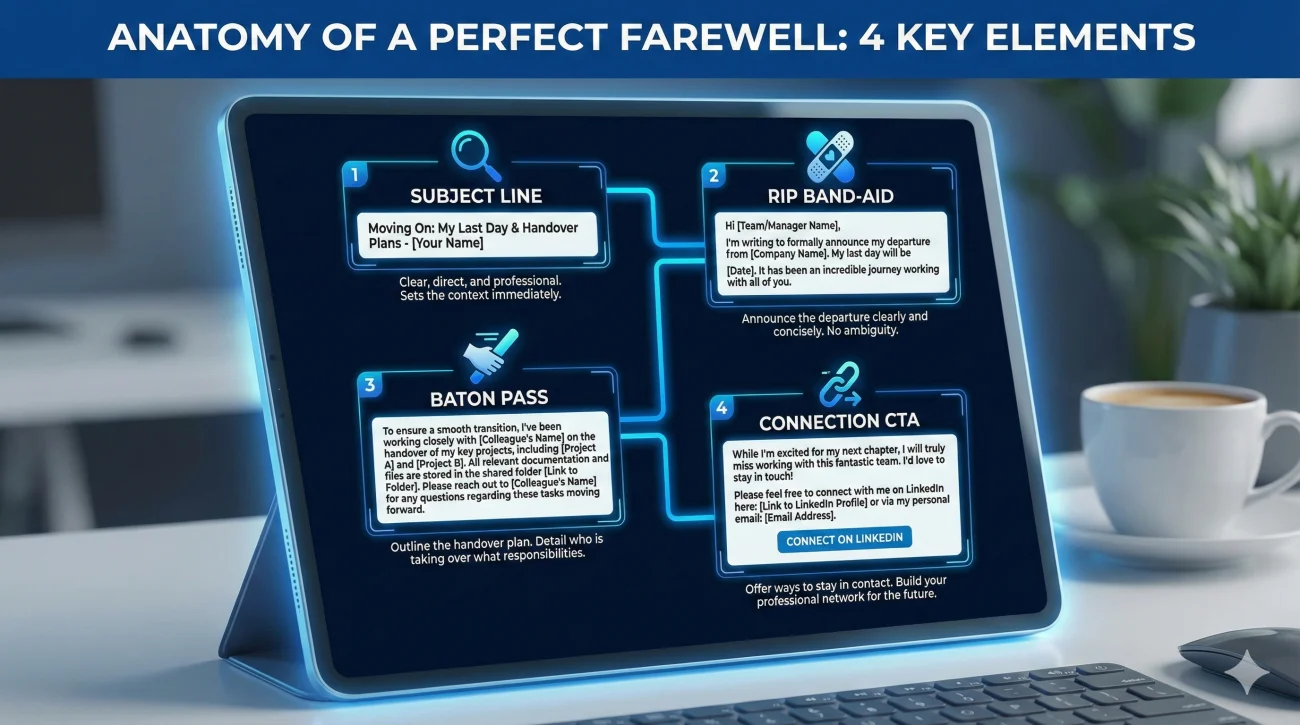
Every effective last-day email shares the same DNA. Ensure these four elements are present.
1. The Unmissable Subject Line
Do not be cryptic. “Update” or “News” are terrible subject lines. Be explicit.
- Good: “Moving On – My Last Day at [Company]”
- Better: “So Long, and Thanks for All the Fish (My Last Day)” – (If culture permits humor)
- Professional: “Farewell and Handover Information – [Your Name]”
2. The “Rip the Band-Aid” Opening
State the facts immediately. “As many of you know, today is my final day as [Role] at [Company].” This stops the rumor mill and sets the context.
3. The “Baton Pass” (The Handover)
This is where you show you are a pro. Direct traffic. “For all inquiries regarding [Project], please contact [Colleague Name] at [Email]. I have left detailed documentation in [Folder Link].” This relieves anxiety for those staying behind.
4. The “Call to Connection” (CTA)
Never leave without dropping a line. “I would love to stay in touch. Connect with me on LinkedIn [Link] or reach me at [Personal Email].” Give them a way to find you when they eventually leave too.
The “Tiered” Strategy: One Email Does Not Fit All
The biggest rookie mistake is sending one generic email to everyone. You need to segment your audience.
| Tier | Audience | Channel | Tone |
|---|---|---|---|
| Tier 1 | Company-Wide / Large Dept | BCC Email | Formal, Grateful, Short. |
| Tier 2 | Immediate Team | Direct Email / Slack | Warm, Specific, Collaborative. |
| Tier 3 | Work Besties / Mentors | 1-on-1 Email / Coffee | Personal, Emotional, “Real.” |
Templates for Every Persona
One size does not fit all. A “Lifer” leaving after 10 years needs a different tone than a contractor leaving after 6 months.
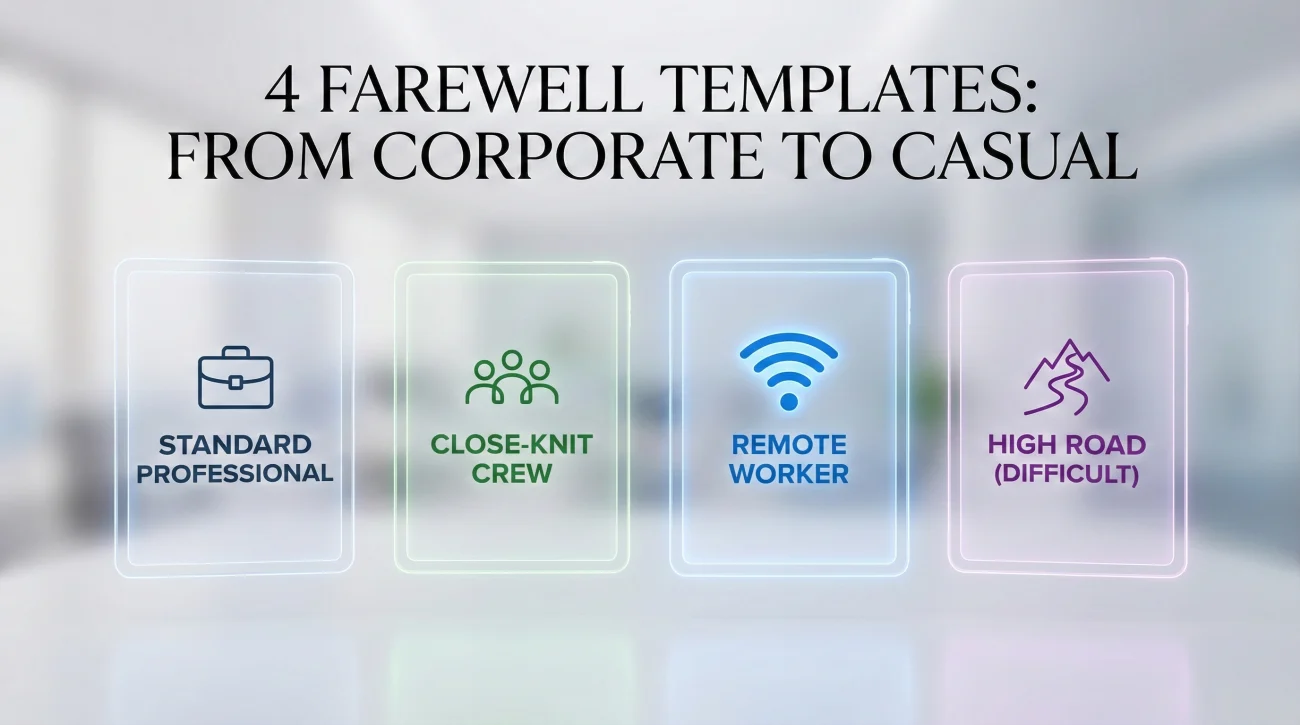
Scenario A: The “Standard Professional” (Safe for Corporate)
Use this last day email to colleagues if you want to be warm but professional, suitable for a wide distribution list.
Subject: Moving On – My Last Day at [Company]
Hi Team,
As some of you know, today is my last day with [Company].
I wanted to take a moment to say thank you. Working with this group over the past [Time Period] has been a highlight of my career. I am particularly proud of what we achieved with [Project Name], and I will miss our [Weekly Ritual/Coffee Runs].
Handover Details:
Moving forward, please direct any questions regarding [Your Function] to [Successor Name] at [Email]. They are fully briefed and ready to help.
Although I am moving on to a new adventure, I would love to stay connected. You can find me on LinkedIn here: [Link] or email me at [Personal Email].
Wishing you all continued success and a fantastic year ahead.
Best regards,
[Your Name]
Scenario B: The “Close-Knit Crew” (Emotional/Warm)
For the team you actually like. This leaving today message allows for more personality and inside jokes.
Subject: So long, farewell, etc. (Today is my last day!)
Hi Everyone,
It is bittersweet to write this, but today marks my final day as part of the [Team Name] family.
From the late nights launching [Product] to the legendary [Company Event/Party], my time here has been nothing short of amazing. Thank you for pushing me to be a better [Role] and for making the tough days easier with your humor and support.
To ensure you aren’t left scrambling, [Colleague Name] has the keys to the kingdom regarding [Project]. Treat them well!
This isn’t “goodbye,” it’s “see you later.” Please stay in touch:
- LinkedIn: [Link]
- Personal Email: [Email]
- Cell: [Number] – (For happy hour alerts only!)
Rooting for you all from the sidelines.
Cheers,
[Your Name]
Scenario C: The “Remote Worker” (Digital Only)
When you can’t say goodbye in person, your email must work harder. This template emphasizes digital connection.
Subject: Signing Off – Last Day for [Your Name]
Hi Team,
Today is my final day logging off from [Company].
While we haven’t all met in person, I have truly valued the collaboration and connection we’ve built virtually. It has been a privilege to work with such a talented distributed team.
Housekeeping:
I have transferred all ownership of the [Project] files to [Name]. My Slack will be deactivated at 5 PM EST today, so if you need anything urgent before then, please ping me.
Since we live on the internet, let’s stay connected there! I am very active on LinkedIn and would love to follow your careers: [Link].
Thank you for everything.
Best,
[Your Name]
Scenario D: The “High Road” (Leaving on Bad Terms)
If you are leaving a toxic situation or being laid off, keep it brief, classy, and vague. Do not burn the bridge.
Subject: Farewell and Best Wishes
Colleagues,
Today is my final day at [Company]. I am moving on to pursue new opportunities.
I appreciate the opportunity to have worked with you and wish the team the best in your future endeavors.
For any outstanding matters, please contact [Manager Name].
Regards,
[Your Name]
[LinkedIn Link]
The “Do Not Send” List: Career-Limiting Moves
The adrenaline of leaving can make you do impulsive things. Avoid these common traps in your last working day email to team.
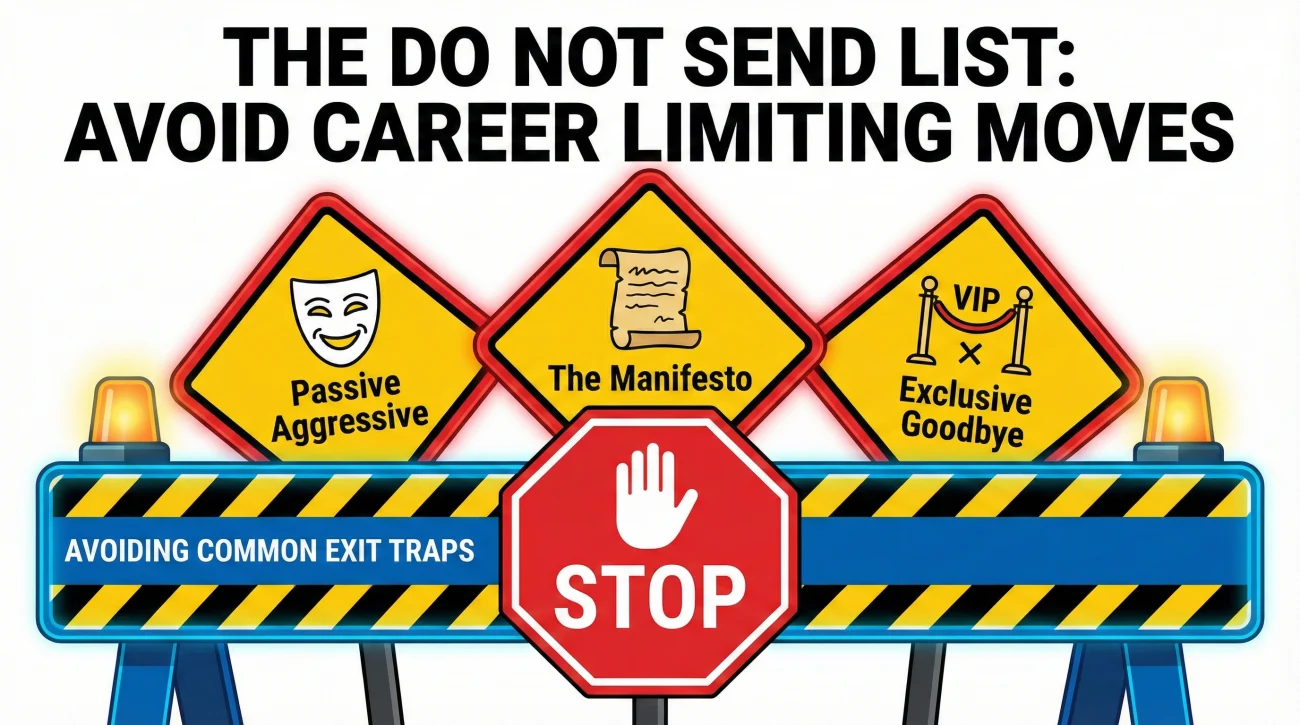
1. The Passive-Aggressive “Dig”
“I hope the team finally gets the resources they need…”
Why not: Everyone knows what you mean. It makes you look petty, not righteous. Leave with dignity.
2. The “Manifesto”
Writing a 2,000-word essay on how to fix the company culture.
Why not: Nobody will read it, and management will resent it. If you have feedback, give it in the exit interview, not the blast email.
3. The “Exclusive” Goodbyes
Thanking specific people by name in a company-wide email, while ignoring others.
Why not: It creates unnecessary drama. If you want to thank specific people, send them individual emails. Keep the group email inclusive.
❓ FAQ
📧 Should I mention where I am going next?
It depends. If you are going to a direct competitor, keep it vague (“a new opportunity”). If you are going to a partner or a non-compete role, feel free to share (“I am joining [Company] as [Role]”). Generally, it is safer to share the news on LinkedIn after you have started the new job.
⏰ What if I get fired/laid off immediately?
If you are walked out immediately, you won’t have access to email. In this case, send LinkedIn messages to your close contacts later that evening from your personal device. “Hey, as you may have heard, today was my last day. I didn’t get a chance to say goodbye…” This controls the narrative.
👥 Should I BCC everyone to hide recipients?
Yes, if the list is large (over 20 people). Sending a “Reply All” apocalypse is a terrible final impression. Use BCC for large lists, or post in the general Slack channel instead.
Final Thoughts: Your Last Act of Leadership
Your last working day email to team is not just a notification; it is an act of leadership. It signals that you are in control, that you care about the team you are leaving behind, and that you value the relationships you have built more than the job title you held.
Hit “Send,” close the laptop, and walk out with confidence. You have done your part. For more guidance on managing your professional transition, explore our goodbye and handover emails category or visit the ResignSmartly homepage to plan your next move.
⚠️ Legal Disclaimer: The resignation templates, email samples, and professional guidance provided in this guide are for informational purposes only and do not constitute legal advice. Employment laws and contract requirements vary by jurisdiction and individual circumstances. Please review your employment agreement and consult your HR department and/or a qualified attorney to ensure compliance with applicable laws and policies.