- Core idea: A final handover email is professional insurance that locks the truth in writing and protects your reputation later.
- Prep first: Run a “bus factor” audit, centralize everything into one master handover folder, and confirm access permissions.
- Make it bulletproof: Document chain of custody, list unfinished items as Status/Next step/Blocker, and flag risks with context.
- Use the right cadence: Send weekly progress updates during notice, then a final seal email on your last day with links and owners.
- Avoid traps: Skip passive-aggressive notes, data dumps, and vague promises, then confirm receipt and set boundaries after you send.
For the full transition process, use our job handover guide and checklist.
Why Your Final Email to Your Boss is Your Strongest Shield
The final days of a job are often a blur of farewell lunches, returning equipment, and tying up loose ends. In this rush, it is easy to treat your final communication with your manager as a mere formality – a quick “Thanks for everything, I’m off!” sent five minutes before you walk out the door. This is a critical error. Your handover email to boss serves a purpose far greater than courtesy; it is your professional insurance policy.
Imagine this scenario: Six months after you leave, a major project fails. The stakeholders are looking for someone to blame. Without documented proof of what you transferred and the status of the project when you left, you become the easiest target. “Oh, [Your Name] never finished that,” becomes the narrative. This guide is about preventing that narrative.
We are going to dive deep into the strategic art of the handover confirmation. This is not just about being organized; it is about creating an undeniable paper trail that protects your reputation, validates your hard work, and ensures that your legacy at the company remains untarnished long after your access badge has been deactivated.
In the corporate world, if it isn’t written down, it didn’t happen. A verbal handover over coffee is nice, but it holds no weight when a client churns or a server crashes. By mastering the handover status update to manager, you are effectively notarizing your exit, ensuring that you control the story of your departure.
The Strategy: Documentation as Defense
Corporate memory is notoriously short and selective. When you leave, you take your context with you. Your manager, overwhelmed with their own workload, will not remember the specific details of a conversation you had in the hallway three weeks ago. You need to formalize those details.
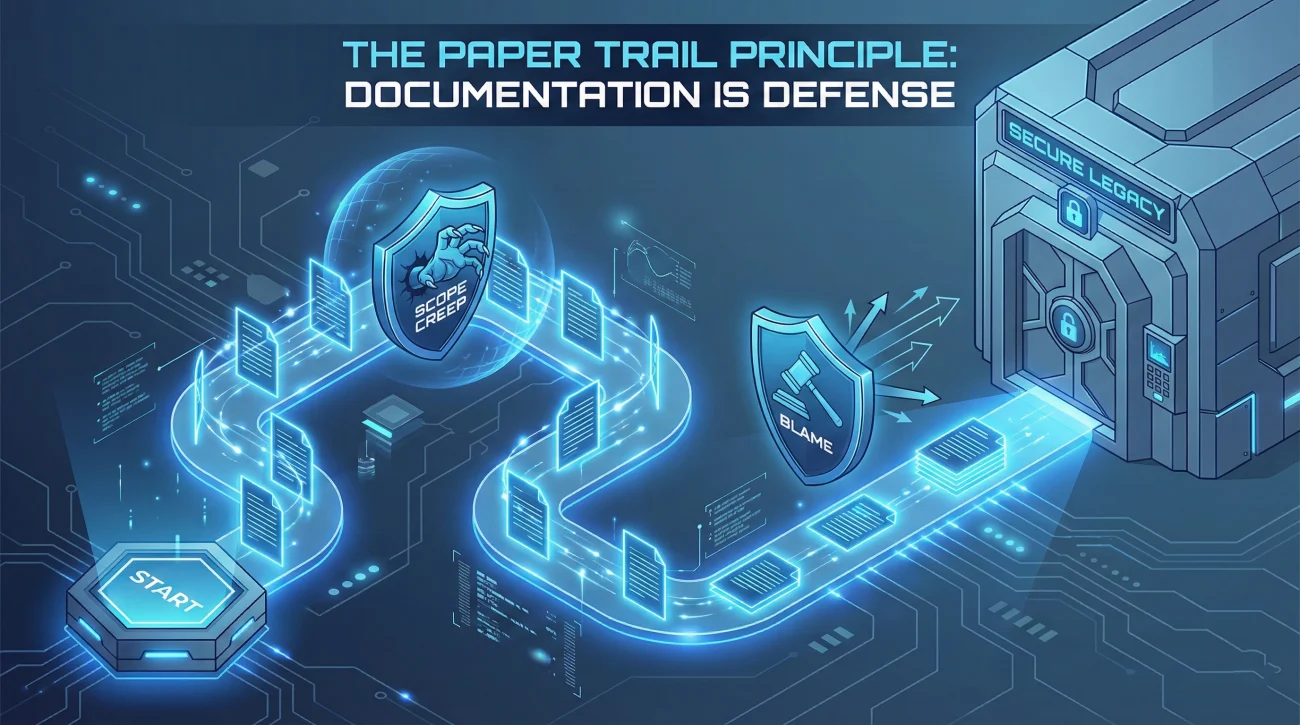
The “Paper Trail” Principle
A comprehensive handover status update to manager creates a timestamped, immutable record of truth. It answers the questions that might arise when you are not there to defend yourself:
- 🛡️ “Did they finish the Q3 report?” Yes, and here is the link to the file sent on [Date].
- 🛡️ “Who has the vendor contacts?” They were transferred to Sarah, as confirmed in the email.
- 🛡️ “Did they warn us about this risk?” Yes, it was flagged as a “Critical Action Item” in the final report.
By effectively locking down these details, you prevent “scope creep” from following you into your new job. You close the door firmly but professionally, ensuring no one can claim you left loose ends.
The Psychological Impact on Your Manager
Beyond legalistic protection, a structured handover email triggers a psychological response of “completion” in your manager’s mind. When they see a well-organized summary, their brain categorizes your tenure as “successfully concluded.” Conversely, a vague exit leaves an “open loop” in their mind, causing anxiety. When problems arise later, that anxiety converts into blame. Closing the loop effectively is the final act of reputation management.
Phase 1: The Pre-Draft Audit
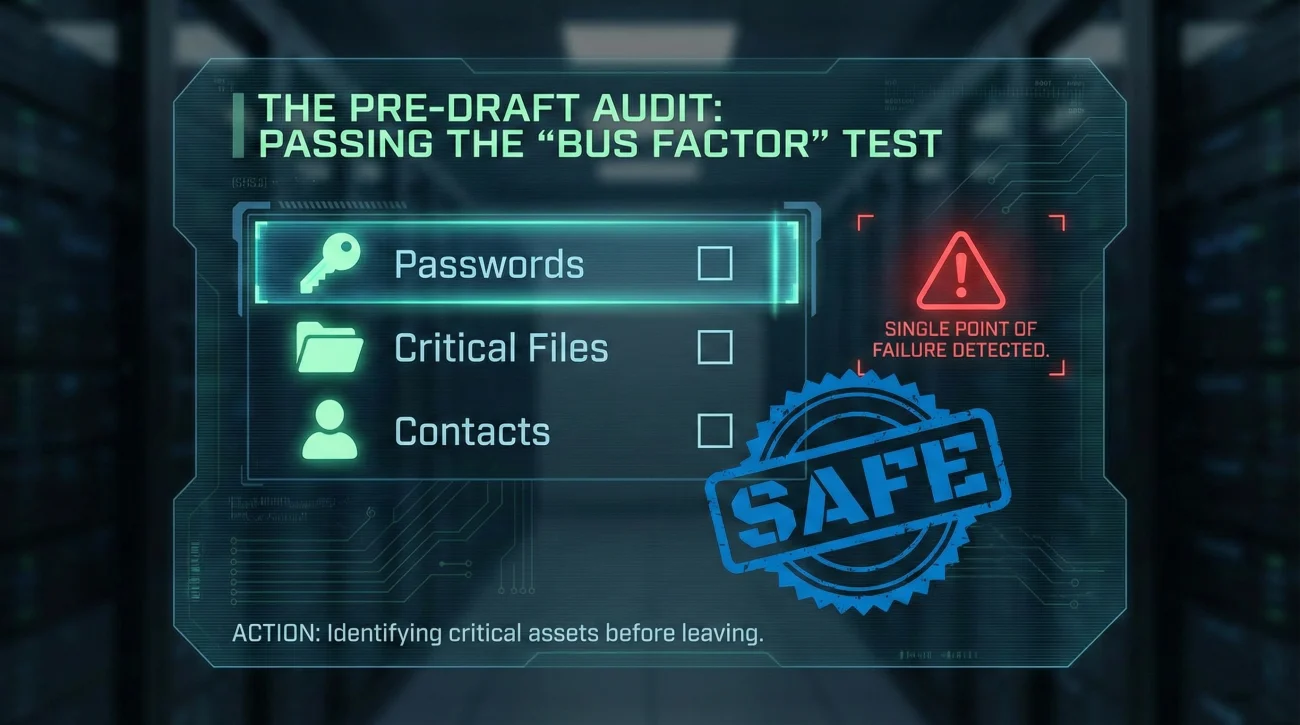
Before you write a single word of your handover completion email to boss, you must perform a “Digital Audit.” Writing the email is the final step; organizing the chaos is the real work. If your digital house is messy, your email will be confusing.
Step 1: The “Bus Factor” Test
Ask yourself: “If I was hit by a bus today, what passwords, files, or contacts would die with me?” List them out. These are your critical handover assets.
Step 2: Centralize Assets
Do not send 20 separate attachments. Create a “Master Handover Folder” on the company drive. Structure it logically:
> [Your Name] Handover > 01_Active Projects > 02_Archives > 03_Contacts > 04_SOPs (Standard Operating Procedures).
Your email will simply link to this master folder, keeping the communication clean and professional.
Step 3: Permission Check
Ensure your manager and successors actually have permission to view these folders. Nothing screams “unprofessional” like a handover link that leads to an “Access Denied” page.
The Anatomy of a Bulletproof Handover Update
To be effective, your handover completion email to boss must be structured, precise, and devoid of ambiguity. Generic statements like “I handed everything over” are legally and professionally useless. You need specifics.
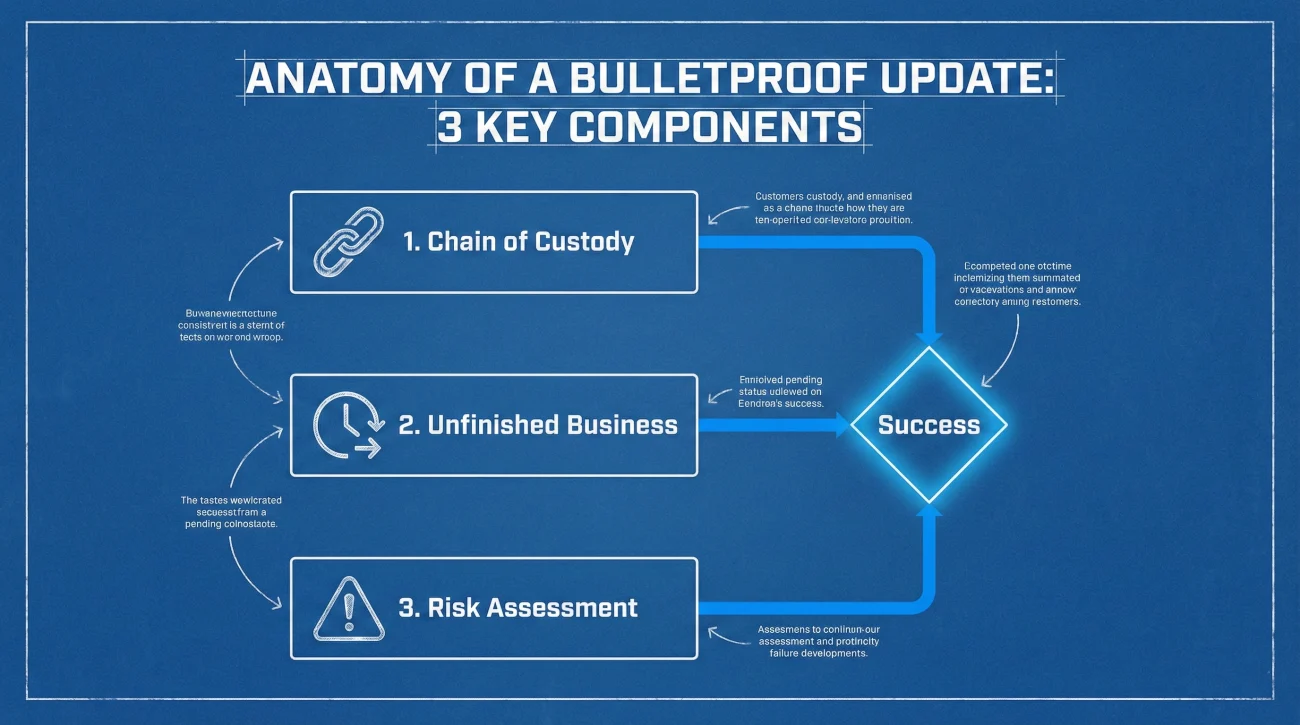
1. The “Chain of Custody” for Assets
For every major responsibility, you must identify the “Chain of Custody.” Who holds the ball now? Don’t just list the project; list the owner.
Weak: “Project X is done.”
Strong: “Project X: Phase 1 complete. All design files transferred to [Name]. [Name] has confirmed receipt and access to the folder.”
2. The “Unfinished Business” Protocol
It is rare to finish absolutely everything. That is okay, as long as you document the gap. Leaving things unfinished without admitting it looks like negligence. Admitting it and providing a plan looks like leadership.
Use a “Current Status / Next Step / Blocker” format for these items. This shows you have thought through the continuity, even if you cannot execute it yourself.
3. The Strategic Risk Assessment
This is what separates a junior employee from a senior professional. Do not just hand over tasks; hand over insights. If you know a client is unhappy, or a deadline is unrealistic, say so. This handover summary to supervisor is your opportunity to demonstrate that you are looking out for the business’s best interests until the very last second.
Example: “Note on Client Z: They are sensitive about billing cycles. Ensure the invoice is sent on the 1st, not the 5th, or they will delay payment.” This kind of nuanced advice is invaluable.
Strategic Handover Templates (Annotated)
Different stages of your departure require different communication styles. Below are templates designed for specific scenarios, from the standard exit to the high-risk departure, with notes on why they work.
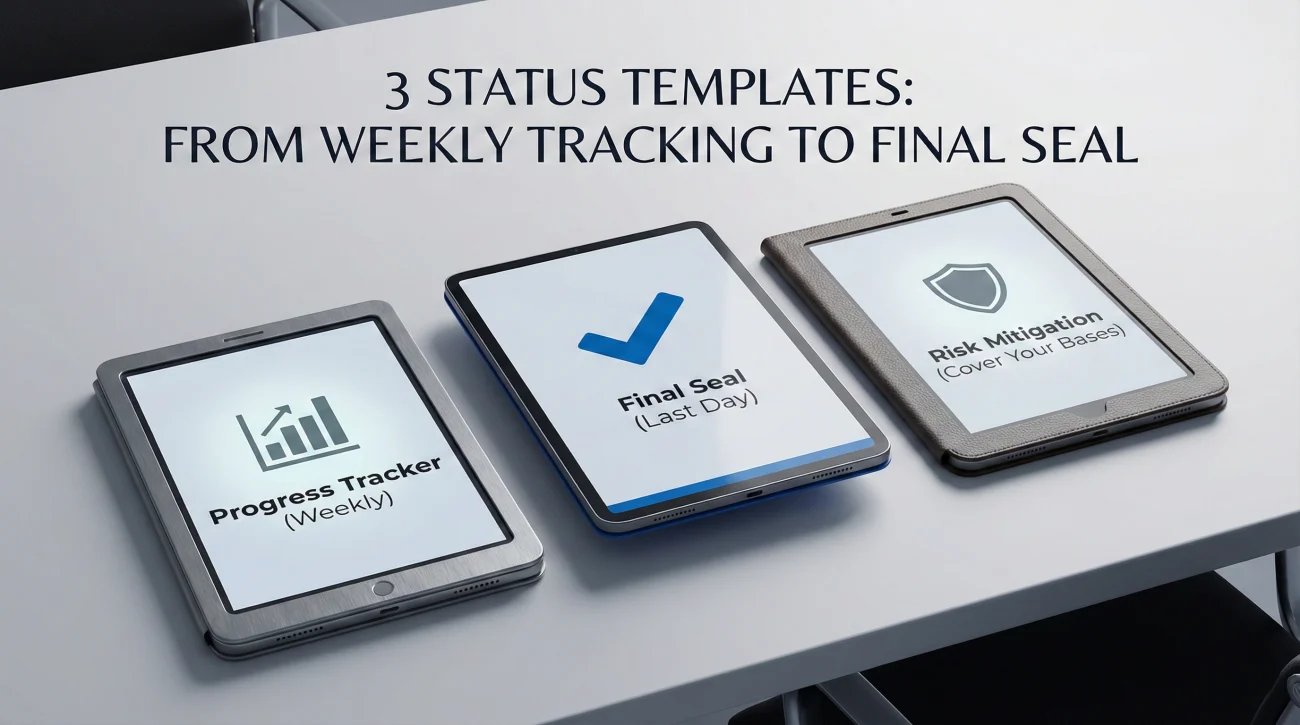
The “Progress Tracker” (During Notice Period)
Do not wait until the last day to drop a massive information bomb. If you have a long notice period, send a handover status update to manager weekly. This manages anxiety and shows steady progress.
Subject: Handover Progress Update: [Week X] – [Your Name]
Hi [Manager’s Name],
As we move through my notice period, I want to keep you aligned on the transition status to ensure nothing falls through the cracks.
✅ COMPLETED THIS WEEK
- Client A: Intro meeting with [Successor] completed. Client is aware of the change.
- CRM Database: Cleaned up leads and reassigned ownership to [Team Member].
- Training: Recorded 3 video tutorials for the reporting process (saved in Shared Drive).
🚧 IN PROGRESS (On Track)
- Q4 Budget Plan: First draft done. Waiting for Finance feedback to finalize by next Friday.
- Vendor Renewal: Negotiating terms with [Vendor]. Will hand over final contract for signature by [Date].
⚠️ FLAGS / NEEDS ATTENTION
- I need your approval on the [Project] expense report by Tuesday so I can close the account before I leave.
I am on track to wrap up all core duties by [Date]. Let me know if priorities have shifted.
Best,
[Your Name]
The “Final Seal” (Last Day Confirmation)
This is the most important email you will write. It is your final handover report email – the closing argument of your tenure. Send this after your exit interview, ideally a few hours before you log off for the last time.
Subject: FINAL HANDOVER: Project Status & Key Assets – [Your Name]
Hi [Manager’s Name],
As I wrap up my final day, I am confirming that the handover process is complete. Below is the summary of where everything stands and who is now holding the keys.
📂 MASTER DOCUMENTATION
I have consolidated all transition docs, cheat sheets, and contact lists into this master folder:
[Link to Shared Drive/SharePoint]
🔄 RESPONSIBILITY TRANSFER
- Project Alpha: 100% Transferred to [Name]. Status: Live. No immediate action needed.
- Project Beta: Transferred to [Name]. Status: Pending Approval. [Name] knows to follow up next Tuesday.
- Admin Duties: [Name] has the keys to the supply cabinet and admin passwords.
🔐 ACCESS & EQUIPMENT
- Laptop and badge returned to IT (Receipt #12345).
- Cloud accounts: Ownership transferred to [Manager/Successor].
- Personal files deleted; only business-critical data remains on the drive.
🔮 FUTURE CONTEXT
The “Strategic Roadmap” doc in the master folder contains my notes on the upcoming Q1 challenges. I wanted to make sure those insights weren’t lost.
Thank you for your support during my time here. It has been a pleasure working with the team.
Best regards,
[Your Name]
The “Cover Your Bases” (High Risk / Incomplete)
Sometimes, you are forced to leave before you are ready, or the workload was too high to finish. In this case, your email must protect you from claims of negligence.
Subject: Transition Status: Outstanding Items & Critical Risks – [Your Name]
Hi [Manager’s Name],
Given the timeline of my departure, I have prioritized the most critical tasks. However, there are several items that remain in progress that will need immediate attention from the team.
🚨 CRITICAL ACTION ITEMS (Next 48 Hours)
- The Server Migration: This is mid-process. [Name] needs to manually check the backups tomorrow morning. If this is missed, data could be lost.
- Client Z: They are expecting a call on Monday. No one has been assigned to this yet. I strongly recommend assigning [Name] as they have prior context.
📉 WHAT COULD NOT BE COMPLETED
Due to the shortened notice period, I was unable to complete the [Project Name] audit. The raw data is saved in [Location], but it will require analysis.
I have done my best to document the state of play here: [Link].
Best,
[Your Name]
Common Traps: What NOT to Include
A poorly written handover email can undo years of good work. Avoid these emotional and tactical errors.
| The Mistake | Why It Hurts You |
|---|---|
| ❌ The “Passive-Aggressive” Note “Maybe now that I’m gone, X will finally get done.” | It paints you as bitter and unprofessional. Keep the tone strictly factual and forward-looking. |
| ❌ The “Data Dump” “Here is a zip file with everything.” | This is not a handover; it is laziness. It forces your manager to dig for answers, creating frustration. |
| ❌ Hiding Bad News Pretending a project is “green” when it is “red.” | When it blows up (and it will), the timestamp on your email will prove you lied. Always flag risks honestly. |
| ❌ Vague “Open Door” Policy “Call me anytime!” | You are setting yourself up for free labor. Set clear boundaries about your availability post-exit. |
After You Send: The Rules of Engagement
Sending the email is not the absolute end. How you handle the 48 hours after the email defines your legacy.
1. Verify Receipt
Do not assume they read it. If you do not get a reply within a few hours, send a quick ping on Slack/Teams: “Hey [Boss], just sent over the final handover summary. Let me know if you need clarification on any points before I log off.”
2. Enforce the Boundaries You Set
If you said you are available for “critical questions only,” do not reply to routine questions about where to find a file. If you answer one non-critical email, you teach them that your time is still theirs. Direct them back to your documentation: “Hi [Name], that is detailed in the ‘SOPs’ folder I linked in my handover email. Best of luck!”
❓ FAQ
📧 Who should I CC on the handover email to my boss?
Keep the distribution list tight. Definitely CC your personal email (BCC if external emails are blocked) so you have a copy. You might CC HR if required by policy, but generally, this is a direct report to your manager. Do not CC the whole team; send them a separate, lighter farewell note.
⏰ What if I am asked to leave immediately?
If you are walked out, you may not have access to email. However, if you have a moment, send a quick “Current Status” email to your manager. If not, try to send a professional follow-up from your personal email stating, “Since I could not complete a formal handover, here are the critical passwords/locations you need.” This shows high integrity.
💼 My boss is ignoring my handover updates. What do I do?
Keep sending them. The goal is the existence of the documentation, not necessarily their engagement with it. If they ignore your warnings and a project fails, your sent folder proves you did your job. You cannot force them to read, but you can force the record to exist.
📂 Should I include passwords in the email?
Never. This is a massive security violation. Instead, use a tool like LastPass, 1Password, or even a password-protected Excel sheet where you send the file in one email and the password in another (or via text). Document that you transferred access, not the credentials themselves.
📉 What if I didn’t finish a project?
Honesty is your best policy. Use the status “Incomplete – Halted at Phase 2.” Explain why (e.g., waiting for vendor, ran out of time) and list the immediate next step for your successor. This turns a failure into a “pending task.”
Final Thoughts: The Art of the Clean Break
The difference between a good employee and a great professional often comes down to how they leave the room. A chaotic exit leaves a vacuum of stress. A structured exit leaves a legacy of competence. Your handover email to boss is the tool that ensures you are remembered for the latter.
By creating clear, accessible, and honest documentation, you free yourself from the mental burden of your old job. You can walk into your new opportunity with a clear head, knowing you closed the chapter with integrity. Remember, the world is small. The bridge you protect today is the one you might need to cross again tomorrow.
For more details on the logistics of leaving, check out our guide on handover email best practices. If you are still drafting your initial announcement, our resignation templates can help you start the process as professionally as you finish it. Browse our full category for more exit strategies.
⚠️ Legal Disclaimer: ResignSmartly provides general informational guidance about resignation, workplace communication, notice periods, handovers, and career transitions. Content does not constitute individualized legal advice. Employment laws, contracts, workplace policies, and individual circumstances vary, so review the requirements that apply to your situation and consult an appropriate qualified professional when needed.