
- Core idea: A commute resignation is a logistics decision based on time, cost, and sustainability, not attitude or effort.
- Commute tax: Long commutes create hidden financial loss, major opportunity cost, and real health strain that adds up fast.
- Best move first: Try a remote or hybrid trial with a simple business case before you resign, then decide.
- Template choice: Pick the scenario that fits your truth, long commute, office relocation, personal move, cost spike, transit failure, or health impact.
- Exit execution: Negotiate remote wrap-up if needed, return assets in one clean handoff, and keep the exit interview focused on location flexibility.
Writing a Resignation Email Due to Commute: The Strategic Guide to Reclaiming Your Life
In the modern narrative of career success, we are often told to “go the extra mile.” But for many professionals, that extra mile has become a literal sixty miles of gridlock, delayed trains, and lost time. Drafting a resignation email due to commute is rarely an impulsive decision. It is usually the result of a slow, grinding realization: the math of your life no longer adds up.
Commuting is often dismissed as a minor inconvenience, but it is actually a significant economic and physiological tax. A two-hour daily commute is not just “driving”; it is 500 hours of unpaid labor per year – the equivalent of sitting in a car for 21 full days, day and night. It is time stolen from your health, your family, and your professional development.
This guide is not just a collection of templates. It is a strategic playbook for professionals who have crunched the numbers and decided to stop bleeding time. We will explore the deep economics of commuting, how to use your resignation to potentially negotiate a remote role, and how to exit gracefully when geography simply puts you out of range.
The “Commute Tax”: The Hard Economics of Leaving
Many employees feel guilty citing “commute” as a reason for resignation, fearing it sounds “lazy” compared to reasons like “career growth.” This is a misconception. Employers respect data. To write a convincing resignation, you must first understand – and perhaps articulate – the true cost you are paying.
1. The Financial Hemorrhage
The cost of commuting is often hidden in small daily transactions. It isn’t just the gas pump. It involves:
- 💸 Vehicle Depreciation: Every mile devalues your asset. The IRS estimates the true cost of driving at roughly 67 cents per mile. A 50-mile daily round trip costs you ~$33/day, or ~$8,000/year in real asset value.
- 💸 The Inflation Factor: When gas prices spike, a job that was profitable in 2021 might be a financial loss in 2024. Citing the financial unsustainability of the commute is an objective, unarguable fact.
- 💸 The “Last Mile” Costs: For public transit users, it’s the Uber to the station, the parking permit, and the rising train fares.
2. The Opportunity Cost Calculation
The most expensive thing you spend on your commute is not money; it is opportunity. Time spent steering a wheel is time not spent billing clients, learning a new skill, or exercising.
| Metric | Short Commute (15 mins) | Long Commute (60 mins) | Annual Cost of Long Commute |
|---|---|---|---|
| Unpaid Hours/Day | 0.5 Hours | 2.0 Hours | 500+ Hours (12.5 work weeks) |
| Sleep Loss | Minimal | Significant | Chronic sleep deprivation links to burnout. |
| Retention Risk | Low | Critical | Studies show long commuters are 40% more likely to quit. |
The Biological Toll: “The Drive Is Making Me Sick”

Beyond money, there is biology. Research consistently links commutes longer than 45 minutes to specific health outcomes: elevated cortisol (stress hormone), higher blood pressure, and chronic back pain. This is the “Cortisol Corridor.”
When you resign due to commute, you are often making a preventative healthcare decision. It is perfectly professional to frame your exit around “wellbeing” and “long-term sustainability.” You aren’t complaining about traffic; you are prioritizing your capacity to perform at a high level, which you cannot do while exhausted.
The “Hybrid Pivot”: Don’t Resign… Negotiate

Before you hand in your notice, realize that you hold a unique leverage point. Unlike resigning for a higher salary (which requires budget approval), solving a commute problem costs the company nothing – in fact, it saves them office overhead.
The Strategy: Use your resignation letter as a “Plan B.” Your “Plan A” should be a proposal for Remote or Hybrid work.
How to Pitch the Remote Pivot
Don’t just ask for a favor. Pitch a business case.
The Script: “I love my role here, but the 2-hour daily transit is becoming unsustainable for my long-term health. Before I consider other options, I want to propose a trial: transitioning my role to 3 days remote. This would reclaim 6 hours of peak productivity for me each week – time I currently spend in traffic. Can we test this for 30 days before I make any final decisions?”
If they say yes, you win back your life without losing your job. If they say no, you can submit your resignation knowing you tried everything. This makes your exit feel inevitable rather than voluntary.
Resignation Templates for Every Commute Scenario
When you must resign, clarity is kindness. You do not need to over-apologize for where you live or where the office is located. Use these templates to frame the logistics professionally.
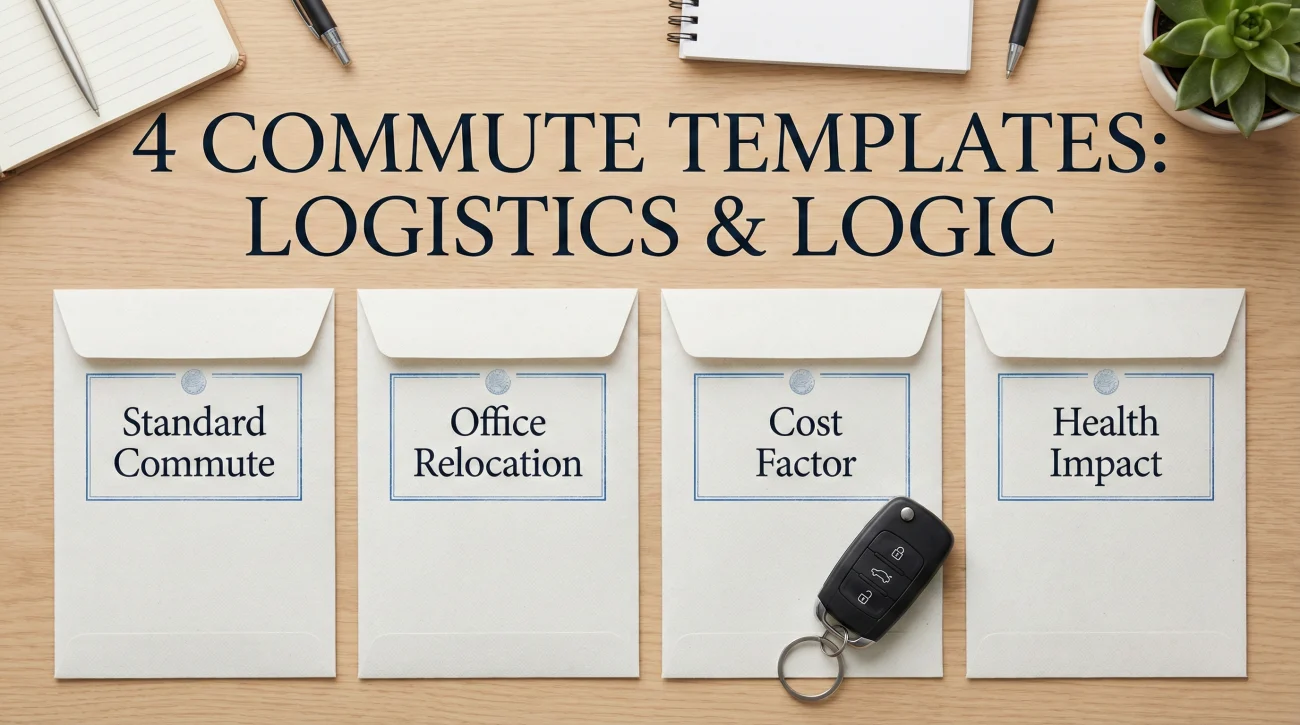
1. The “Breaking Point” (Standard Long Commute)
Use this long commute resignation email when the daily grind has simply become too much to handle after a period of trying to make it work. It emphasizes that you tried, but the logistics failed.
Subject: Resignation – [Your Name] – Commute Logistics
Dear [Manager’s Name],
Please accept this letter as my formal resignation from my position as [Job Title] at [Company Name]. My final day will be [Date].
This was not an easy decision, as I have truly valued my time with the team and the work we have accomplished. However, over the past year, the reality of my daily travel time has taken a significant toll on my work-life balance. Despite my best efforts to manage the schedule, I have realized that sustaining a [Number]-hour daily commute is no longer feasible for me long-term.
I have decided to pursue a local opportunity that allows me to reclaim those hours for my family and personal health. I want to emphasize that this decision is purely based on geography and logistics, not dissatisfaction with the role itself.
I am committed to ensuring a smooth handover of my projects before I depart. I have already drafted a transition plan for the [Project Name].
Thank you for your understanding.
Sincerely,
[Your Name]
2. The “Forced” Resignation (Office Relocation)
If the company moved the office further away, you are not quitting; the job left you. This relocation of office resignation email puts the onus objectively on the change in circumstances, protecting your reputation.
Subject: Resignation Due to Office Relocation – [Your Name]
Dear [Manager’s Name],
I am writing to formally resign from my position, effective [Date].
Since the announcement of the office move to [New Location], I have attempted to calculate the impact on my schedule. Unfortunately, the new location increases my travel time by [Time] each way. This additional distance makes the role unsustainable for my current family obligations and schedule.
I have loved working here and would have happily stayed had the location remained unchanged. I hope you understand that this is a logistical necessity for me, rather than a desire to leave the team.
I will work diligently during my notice period to train [Colleague] on my key responsibilities.
Best regards,
[Your Name]
3. The “I Moved” Scenario (Taking Ownership)
When you are the one who moved (for buying a house, spouse’s job, etc.), use this travel distance resignation email. It takes ownership of the change while remaining professional.
Subject: Resignation Notice – [Your Name]
Dear [Manager’s Name],
Please accept this email as my resignation from [Company Name], effective [Date].
As you may know, my family recently relocated to [New City/Area]. While I had hoped to manage the commute, the reality of the distance has proven difficult to sustain while maintaining the high standard of work I hold myself to. The time spent in transit is impacting my ability to perform at the level I expect of myself.
I have accepted a position closer to my new home that eliminates this travel burden. I am incredibly grateful for the opportunities I have had here and will miss the team.
I will ensure all my files are organized and accessible before my departure.
Sincerely,
[Your Name]
4. The Financial “Hard Truth” (Inflation/Gas)
When gas, tolls, and wear-and-tear eat your paycheck. This quitting due to driving distance email highlights the economic reality without complaining. It works well for roles with tighter margins.
Subject: Resignation – [Your Name]
Dear [Manager’s Name],
I am writing to resign from my role as [Job Title], with my last day being [Date].
This decision is largely driven by financial logistics. With recent changes in transportation costs, the expense associated with my daily commute has become prohibitive relative to my compensation. After reviewing my household finances, I need to transition to a role that is either remote or significantly closer to my residence to make the numbers work.
I appreciate the professional growth I have experienced here and want to ensure I leave the team in a strong position. I am happy to assist in finding and training my replacement.
Thank you for understanding.
Best regards,
[Your Name]
5. The “Transit Failure” (No Car/Unreliable)
For city dwellers reliant on unreliable trains or buses. This transport issues resignation email focuses on the anxiety of unpredictability.
Subject: Resignation Notice – [Your Name]
Dear [Manager’s Name],
I am writing to provide formal notice of my resignation, effective [Date].
Due to ongoing reliability issues with the public transit route I rely on to reach the office, I am finding it increasingly stressful to guarantee my punctuality and presence. The commute has become a significant source of daily anxiety, and I have decided to pursue opportunities that are accessible via different transit lines or are fully remote.
I value the work we do here and regret that external logistics have necessitated this change.
Sincerely,
[Your Name]
6. The Health & Wellness Focus
Use this when the commute is causing physical or mental health issues. It is direct but professional about prioritizing health.
Subject: Resignation – [Your Name]
Dear [Manager’s Name],
I am writing to formally resign from my position at [Company Name], effective [Date].
After consulting with my doctor regarding recent health challenges, I have been advised to reduce the physical stress associated with my daily routine. The 3-hour daily commute is unfortunately a major contributing factor that I can no longer sustain while prioritizing my recovery and long-term health.
I have enjoyed my time here immensely and this is a difficult step to take. However, I must prioritize my wellbeing at this time.
I will ensure a complete handover of my responsibilities over the next two weeks.
Sincerely,
[Your Name]
The “Commuter’s Exit Strategy”: Logistics to Manage
Once the email is sent, the clock starts ticking. But for a commuter, the “notice period” can be awkward. Do you really want to drive 2 hours a day for a job you’ve already quit? Here is how to handle the logistics.
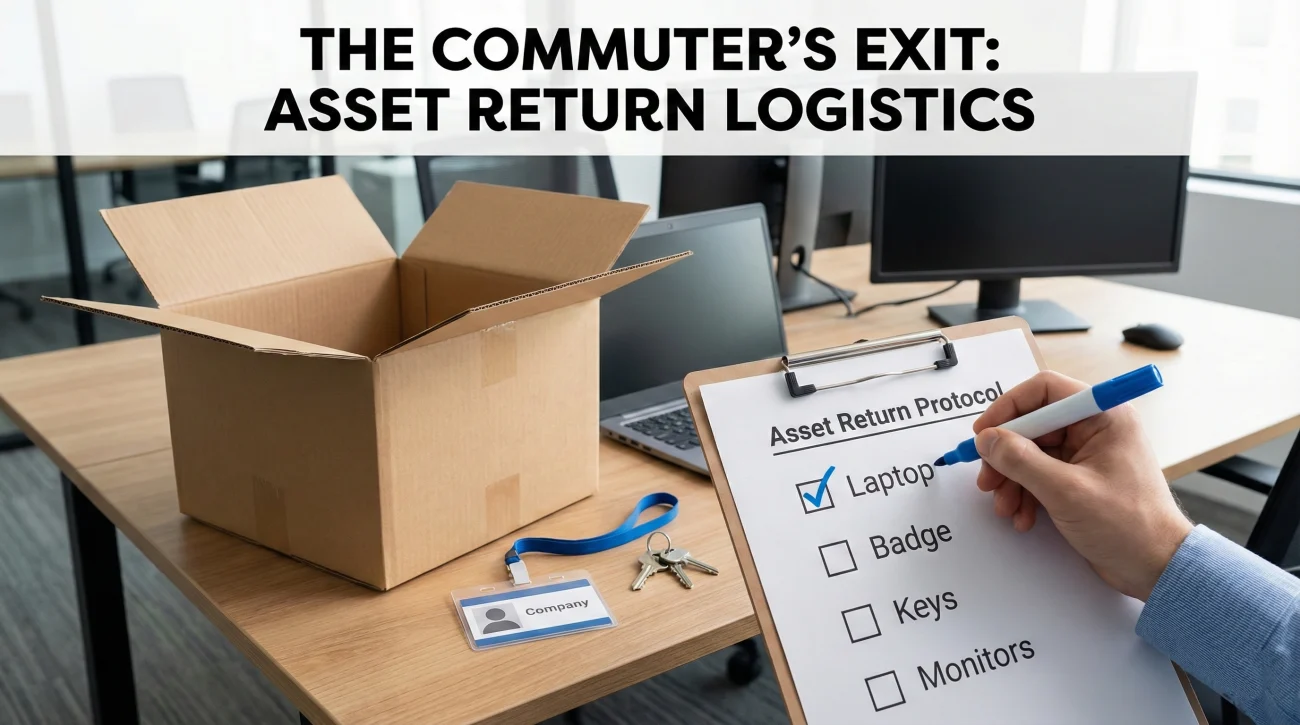
Negotiating the “Remote Wrap-Up”
If your commute is truly agonizing, working out a full two-week notice in the office can feel like a prison sentence. It is acceptable to negotiate:
Script: “I am committed to a full two-week notice to ensure a smooth transition. However, to maximize my efficiency in documenting my work, I request to work my final week remotely. This allows me to focus entirely on documentation rather than losing 10 hours to travel.”
Most managers will agree to this, as they want your knowledge transfer more than your physical presence.
The Logistics of Returning Assets
Do not make a special trip just to return a laptop and badge. That is a final insult to your time.
- The Last Day Protocol: Bring everything on your last physical day. Monitors, dongles, keys, corporate cards. Get a receipt signed by HR.
- The Remote Return: If you are working your notice remotely, request a pre-paid shipping label from HR or IT. Do not offer to drive it in unless you have a final goodbye lunch planned.
The Exit Interview: Truth to Power
The exit interview is your chance to help the colleagues you leave behind. If the company’s “Return to Office” (RTO) mandate is what drove you away, tell them.
What to say: “I want to be clear that I loved the role and the team. The only reason I am leaving is the lack of flexibility regarding location. If this role had been hybrid or remote, I would not be resigning today.”
Data points like this are the only thing that changes corporate policy. You are doing a service to your former team by being honest about the “Commute Tax.”
❓ FAQ: The Logistics of Leaving
🚗 Is “commute” really a professional reason to quit?
🗣️ What if they offer me more money to stay?
🔙 Can I ask for my job back if I move closer later?
💻 Should I propose remote work in the resignation letter?
📉 Can I resign immediately (no notice) due to commute?
Final Thoughts: Reclaiming Your Map
Writing a resignation email due to commute is an act of reclaiming your life’s map. It is easy to fall into the trap of thinking, “It’s just a drive, everyone does it.” But chronic commuting is a slow leak in your quality of life. Plugging that leak is one of the most proactive career decisions you can make.
By framing your resignation around logistics, efficiency, and sustainability, you maintain your professional reputation. You are not quitting because you are weak; you are quitting because you are smart enough to know the value of your time. Your career is a marathon, and you cannot run a marathon if you spend all your energy getting to the starting line.
For further reading on career transitions, check out our resignation email examples library. If you need a refresher on the basics, our guide on how to write a resignation email covers the essential formatting rules.
⚠️ Legal Disclaimer: ResignSmartly provides general informational guidance about resignation, workplace communication, notice periods, handovers, and career transitions. Content does not constitute individualized legal advice. Employment laws, contracts, workplace policies, and individual circumstances vary, so review the requirements that apply to your situation and consult an appropriate qualified professional when needed.