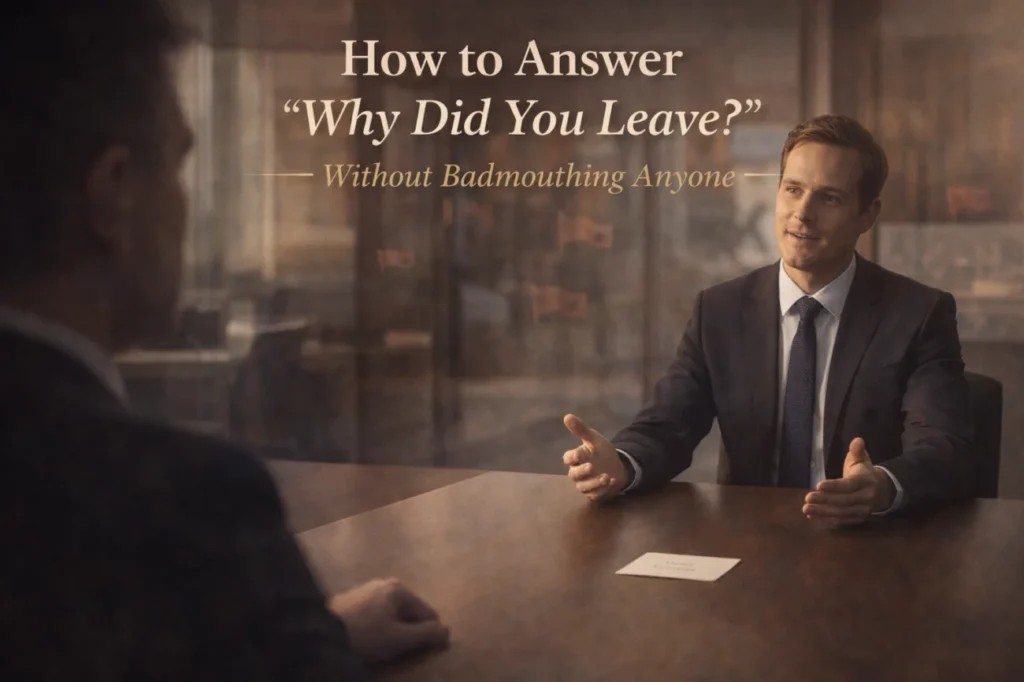
- What they are testing: “Why did you leave?” is a risk scan for instability, conflict, and whether your story will repeat.
- Golden rule: Never badmouth anyone, even if you were right, because the interview is not a courtroom.
- Best framework: Past → Pivot → Future, one neutral fact, one lesson, then why this role fits.
- Safe reasons: Growth, role shift, company changes, career direction, relocation or logistics, all phrased calm and specific.
- Follow-ups and mistakes: Answer in one sentence then pivot, avoid complaint lists, keep it 10–20 seconds and future-focused.
This One Interview Question Can Quietly Decide the Offer
The interview question why left feels simple. But it’s one of those questions that isn’t really about the past. It’s about risk. Recruiters are listening for instability, conflict, entitlement, or a story that sounds like it will repeat at their company.
The trap is that people answer it like a confession. They overshare. They vent. They try to “prove” they were right. And the interviewer hears a different message: “This person might be hard to manage.”
The goal of your answer is not to win your old argument. The goal is to sound like someone who makes clean decisions, learns fast, and moves forward without drama.
What Interviewers Are Actually Trying to Learn
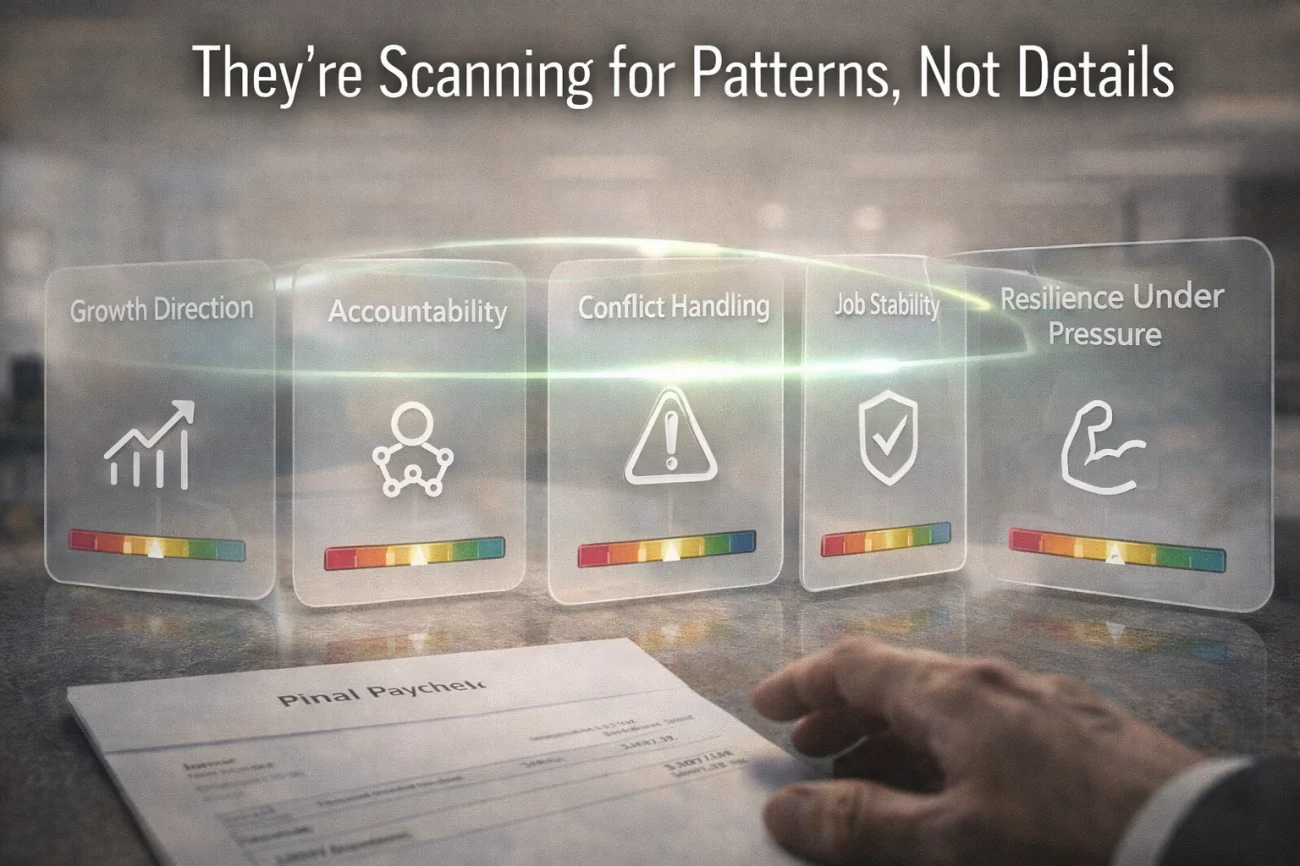
When someone asks “Why did you leave?”, they’re scanning for patterns. Not the details. Patterns.
- Are you running away from problems or moving toward growth?
- Do you take accountability or blame everyone else?
- Will you handle conflict professionally?
- Are you leaving every job after six months?
- Will you leave us the moment it gets hard?
A good answer lowers perceived risk and raises confidence. A bad answer makes them imagine future headaches.
The Golden Rule: Never Badmouth, Never Sound Bitter

You can be honest without being harsh. You can describe misalignment without describing villains. The moment you insult a manager, mock the company, or narrate office politics, you force the interviewer to ask: “What will you say about us later?”
Even if your old workplace was toxic. Even if you were treated unfairly. Even if you were right. The interview isn’t the courtroom. It’s a risk assessment.
The Best Simple Framework: Past → Pivot → Future
If you freeze under pressure, memorize this structure. It keeps you concise and professional.
| Part | What you say | What it signals |
|---|---|---|
| Past | A neutral, factual reason | Stability, maturity |
| Pivot | What you learned / what you want next | Self-awareness |
| Future | Why this role fits | Intentional decision-making |
This format prevents rambling. It also prevents the two most damaging vibes: bitterness and desperation.
“Safe Reasons” That Usually Work (If You Phrase Them Well)
“Safe” doesn’t mean fake. It means your reason doesn’t create new red flags. Here are reasons that are broadly acceptable when you keep them calm and specific.
Growth and scope
You outgrew the role, you want broader ownership, you want a different type of challenge. This is one of the best categories because it’s forward-looking.
Role mismatch
The job turned into something different than expected (shift in priorities, responsibilities changed, role narrowed). Keep it factual: “The role shifted,” not “They bait-and-switched me.”
Company changes
Re-org, leadership change, budget changes, layoffs, restructuring. These are believable and not personal – if you don’t sound like you’re blaming.
Career direction shift
You want to move industries, functions, or focus areas. The key is to connect it to this role so it doesn’t sound random.
Relocation or life logistics
Move to a new city, commute change, schedule constraints. Keep it clean and non-emotional.
Reasons That Are True but Risky (and How to Say Them Safely)
Some reasons are valid but can backfire if phrased poorly. If you must use them, convert them into neutral language.
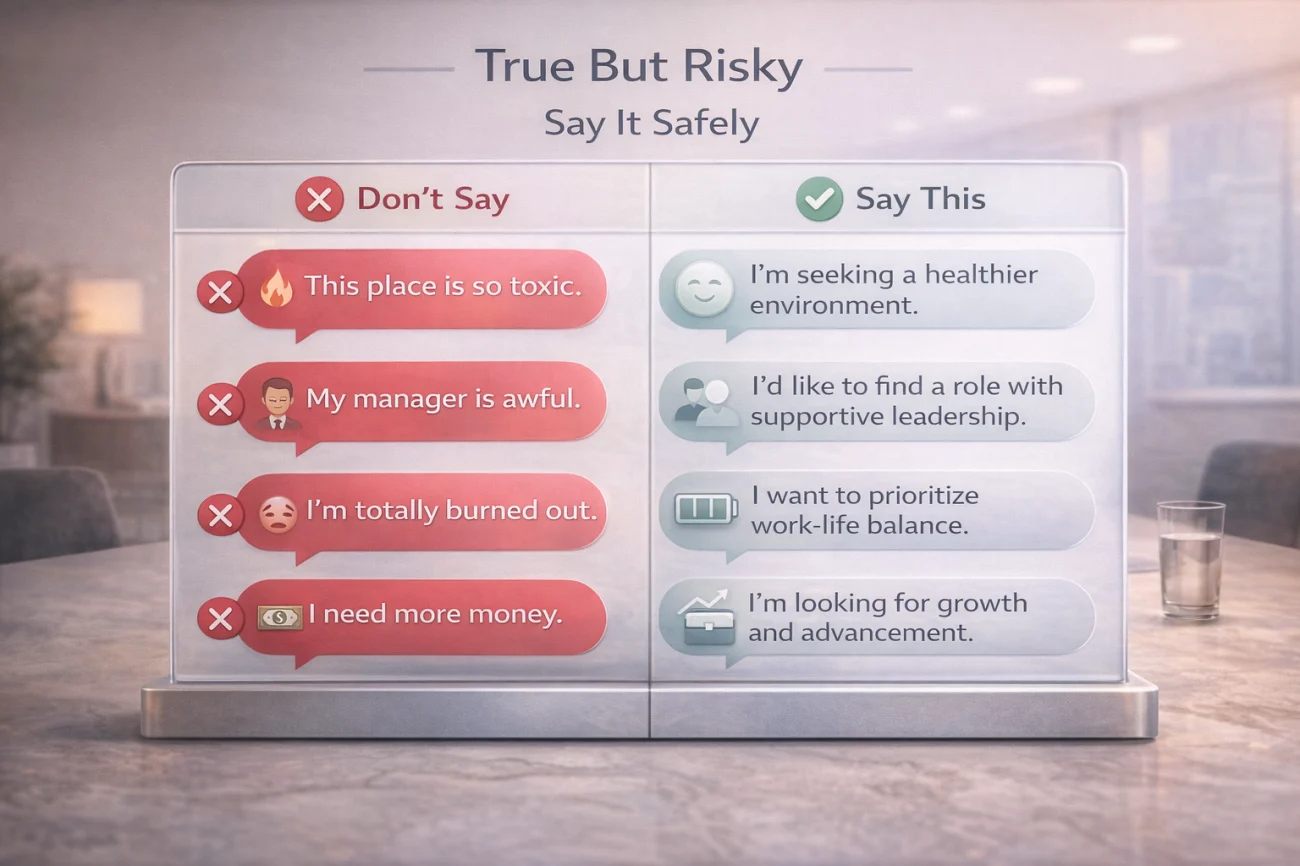
Toxic workplace
Don’t say “toxic.” Don’t list offenses. Say “I’m looking for a more collaborative environment with clearer expectations,” then pivot to what you’re seeking and why you’re excited about this company.
Bad manager
Never attack the person. Say “I realized I work best with [style], and the environment wasn’t the right fit long-term.” Then future-focus.
Burnout
Avoid sounding fragile. You can say “The role had a sustained intensity that wasn’t sustainable long-term, and I’m looking for a healthier, high-performance environment.” Keep it strong, not wounded.
Money
Saying “I left for more money” can sound transactional. If compensation is part of it, frame it as “market alignment” and scope: “I’m looking for a role with scope and compensation aligned to the level of responsibility.”
Copy-Paste Answers for Common Scenarios
These answers are intentionally short. You can add one sentence of detail if asked, but your default should be clean and controlled.
Scenario 1: Growth / bigger scope
I learned a lot in my last role, but the scope was becoming limited and I’m ready for broader ownership. I’m looking for a role where I can drive projects end-to-end, and this position stands out because it emphasizes impact and cross-functional work.
Scenario 2: Role changed after you joined
The role evolved in a direction that wasn’t the best long-term fit for my strengths. I want to focus on [skill area], and I’m targeting roles like this one where that’s a core part of the job.
Scenario 3: Re-org / layoffs / team changes
The company went through a restructuring and my team’s direction changed significantly. It felt like the right time to pursue a role with a stable focus where I can contribute long-term, and this role aligns well with that.
Scenario 4: You left a toxic environment (safe phrasing)
I’m looking for an environment with clear expectations and strong collaboration. In my last role, the setup wasn’t the right fit long-term. I’m excited about this opportunity because the team structure and goals sound much more aligned with how I do my best work.
Scenario 5: You were fired (without spiraling)
The role ended, and I took time to reflect on what I learned and what I’m looking for next. Since then I’ve focused on sharpening [skill] and targeting roles like this one where expectations and fit are clearer.
Scenario 6: You quit without a backup plan
I chose to leave because I wanted to be intentional about my next step. I used the time to clarify what I’m targeting, strengthen my skills in [area], and now I’m focused on roles like this where I can contribute quickly.
How to Handle Follow-Up Questions Without Digging a Hole

A strong interviewer will often ask a follow-up like “What exactly wasn’t working?” or “What would your manager say?” Your goal is to stay calm, stay factual, and keep the scope small.
Rule 1: Answer the question in one sentence, then pivot
Example: “The priorities changed and my core work narrowed.” Then pivot: “That’s why I’m excited about this role’s emphasis on [X].”
Rule 2: Don’t provide a list of complaints
Complaints feel satisfying in the moment. They don’t feel safe to the person evaluating you.
Rule 3: Use neutral facts when pressed
“There was a re-org.” “The role scope shifted.” “The team’s direction changed.” Neutral facts are harder to argue with and don’t make you sound emotional.
Common Mistakes That Make a Good Candidate Sound Risky
- Talking too long. The longer you talk, the more likely you’ll say something that creates doubt.
- Sounding like a victim. Even if you were wronged, the interview isn’t where you prove it.
- Badmouthing people. It poisons trust instantly.
- Making it about money only. It can sound like you’ll leave the moment someone offers $1 more.
- No “future” connection. If you don’t tie it back to why you want this role, your answer feels unfinished.
Checklist: A “Pass” Answer in 15 Seconds
If you want a fast self-check, your answer should hit these boxes. If you can’t, rewrite it.
| Checklist Item | What it sounds like | Why it works |
|---|---|---|
| Neutral reason | Facts, not blame | Reduces drama risk |
| One lesson | What you learned / clarified | Shows maturity |
| Future fit | Why this role/company | Shows intention |
| Short delivery | 10–20 seconds | Prevents oversharing |
| Calm tone | No bitterness | Signals stability |
The Best Answer Is the One That Makes Them Relax
Interviewers don’t need your full story. They need to believe you make decisions like a professional and you won’t bring chaos with you. That’s what this question is really testing.
Keep it neutral. Keep it short. Pivot to the future. If you do that, the interview question why left stops being a trap and becomes a quick proof point that you’re easy to hire.
❓ FAQ
✅ What is the best answer to “Why did you leave your last job?”
A neutral reason, one sentence of learning, and a clear connection to the role you’re interviewing for. Keep it calm and short so you don’t drift into badmouthing or oversharing.
📅 Should I mention a toxic workplace in an interview?
Usually, no. You can describe what you’re seeking instead: clearer expectations, stronger collaboration, better structure. That communicates the point without creating a bitter tone.
💬 What if I was fired?
Keep it short and forward-looking. Don’t spiral into explanations. Acknowledge the role ended, share what you learned, and pivot to why you’re a good fit now.
🧾 How long should my answer be?
Aim for 10–20 seconds. You can add one extra sentence if asked, but your default should be concise: neutral reason, pivot, future fit.
🔒 What should I avoid saying?
Avoid blaming your manager, listing complaints, or sounding bitter. Also avoid making it only about money. The safest approach is professional neutrality with a clear forward-looking reason.
⚠️ Legal Disclaimer: The resignation templates, email samples, and professional guidance provided in this guide are for informational purposes only and do not constitute legal advice. Employment laws and contract requirements vary by jurisdiction and individual circumstances. Please review your employment agreement and consult your HR department and/or a qualified attorney to ensure compliance with applicable laws and policies.