
- Core risk: Your stock options can expire fast after you leave because of a post-termination exercise window.
- What you actually own: A right to buy shares later, not shares, until you exercise.
- What to confirm before resigning: Vested count, strike price, exact deadline date, option type, and the step-by-step exercise process in writing.
- The two real traps: Cash and taxes can be bigger than expected, and you can still lose money if the company never becomes liquid.
- Decision framework: Exercise, walk away, or seek clarity or extension, then resign cleanly so admin delays do not burn your window.
Your Equity Can Expire Faster Than Your Notice Period
Most people think the risky part of quitting is the resignation email. For startup employees, the risk is often hidden in one line of legal text: Your exercise stock options deadline.
Here’s the painful pattern: you leave a company, you assume you “still own” your options, and then you realize there was a post-termination window. You miss it. The options expire. Years of “equity upside” becomes a lesson.
This guide is a practical, non-dramatic way to protect yourself: how the exercise window works, what “ISO vs NSO” can change, and a checklist to run before you resign. This is general information, not legal or tax advice. Always confirm rules in your plan documents (and with a qualified professional if needed).
Stock options are typically the right to buy shares later at a fixed price (your strike price). Until you exercise, you usually don’t own the shares. You own the option to buy them.
That’s why timing matters so much. When your employment ends, the company plan often changes the rules: how long you have to exercise, what happens to unvested options, and whether any special tax treatment changes.
| Term | What it means in plain English | Why it matters when you quit |
|---|---|---|
| Vested options | Options you’ve earned and can exercise (subject to plan rules) | These are the ones you may lose if you miss the window |
| Unvested options | Options you haven’t earned yet | Usually stop vesting when you leave (unless special terms exist) |
| Exercise | You pay the strike price to buy shares | May trigger taxes and cash needs immediately |
| Post-termination window | Time after leaving to exercise vested options | Missing it often means forfeiture/expiration |
The Exercise Window: The Deadline That Quietly Deletes Your Upside

Your exercising stock options timeline is usually defined by your equity plan and your grant agreement, not by what your coworker “heard.” Many employees discover the window only after they resign, when it’s already ticking.
The common pattern (but not a universal rule)
Many plans have a post-termination exercise window that can be short. You may hear “90 days” often, especially in conversations around certain U.S. ISO rules. But the only number that matters is the one written in your documents.
What changes after you leave
- You may lose the right to exercise after a specific date, even if the company is still alive.
- Your options may change classification or tax treatment depending on the plan and jurisdiction.
- If you need company cooperation (paperwork, portal access, signatures), delays can cost you time.
The harsh truth: your manager can be supportive and you can still lose your equity if you treat the window like an “admin thing you’ll do later.”
ISO vs NSO: The Part That Can Change Your Cost Overnight
ISO vs NSO options is where a lot of people get blindsided. You don’t need to become a tax expert. You do need to understand one idea: different option types can carry different tax consequences and timelines.

ISOs (common in some startups)
ISOs can have specific holding and exercise timing rules to preserve certain potential tax advantages (depending on jurisdiction). If you miss key deadlines, you may lose that status and the option may be treated differently.
NSOs
NSOs are often simpler in concept, but can still create tax events at exercise and/or sale depending on your country and personal situation. The point is not “ISOs good, NSOs bad.” The point is: your tax timing can change when you exercise.
Practical takeaway
Before you resign, identify: (1) what type of options you have, (2) your exercise window, and (3) what taxes or cash you might owe if you exercise. You’re not trying to predict the IPO. You’re trying to avoid avoidable loss.
The Two Real Risks: Cash and Regret

People lose equity in two ways: They miss the deadline, or they exercise without understanding the cash/tax impact and panic later. A smart plan avoids both.
Risk 1: You need cash to exercise (and sometimes more than you expect)
- Strike price cost (buying the shares).
- Potential taxes triggered at exercise (depends on the option type and jurisdiction).
- Administrative fees or transaction friction (portals, paperwork, processing time).
Risk 2: You exercise and the company never becomes liquid
This is the “golden handcuffs” trap. People stay in jobs they’ve outgrown because the equity feels like a lottery ticket. But equity is not guaranteed liquidity. The healthier approach is to decide based on your life and career first, then treat equity as a factor – not the cage.
Before You Resign: The Equity-Protecting Checklist
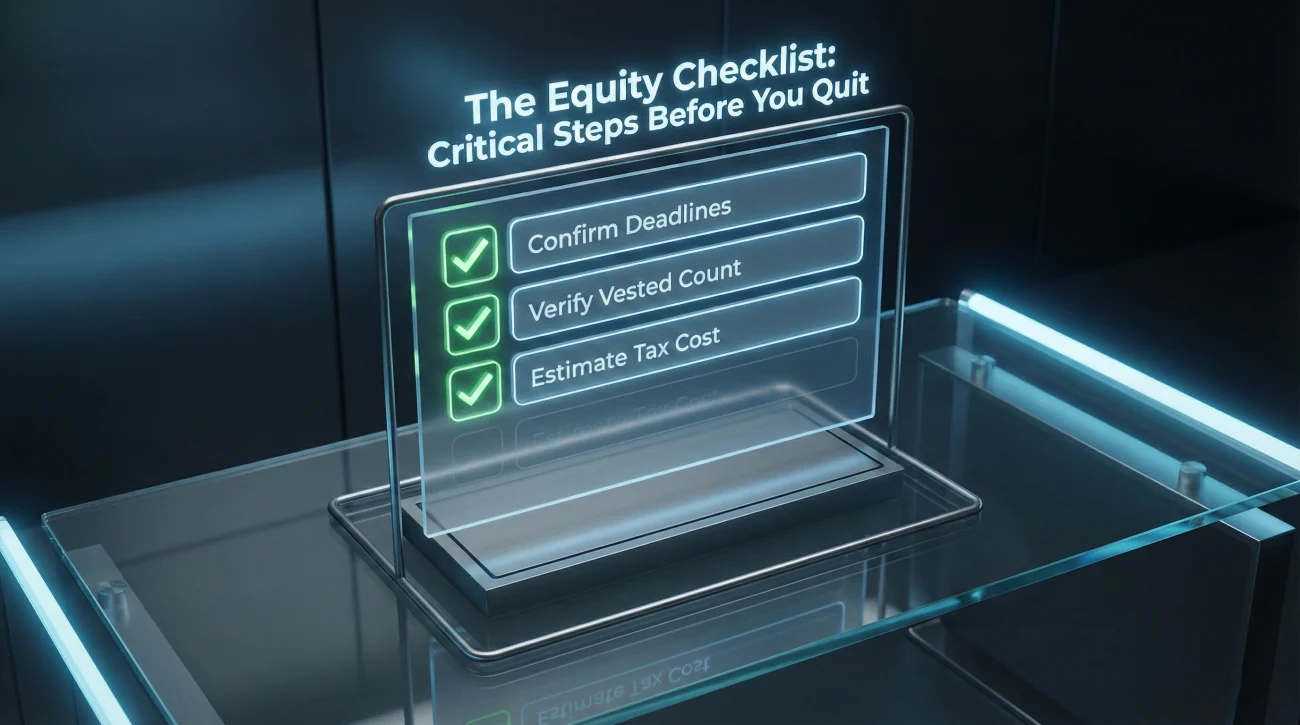
If you do nothing else, do this before your startup equity resignation. It turns your situation from “I hope I don’t lose it” into “I know my deadlines and choices.”
- ✅ Pull your grant agreements and the equity plan documents (not screenshots, the actual files).
- ✅ Confirm: vested count, unvested count, strike price, grant date(s), expiration date(s).
- ✅ Find the post-termination exercise window in writing (and note the exact deadline date).
- ✅ Identify option type(s): ISO, NSO, or your local equivalent classification.
- ✅ Estimate cash needed: strike cost + a conservative buffer for taxes/fees.
- ✅ Confirm exercise method: online portal, forms, wiring instructions, required signatures.
- ✅ Confirm what happens if you miss the window (expire, forfeit, convert, etc.).
- ✅ Save proof of everything: PDFs, emails, portal screenshots, and dates.
Then, and only then, plan your resignation logistics. Keep your exit message clean and boring: How to Write a Resignation Email.
Two Scripts That Get You Answers Without Sounding Alarmed
Script 1: Email HR/People Ops for plan documents and exact deadlines
Subject: Request: Equity Plan Documents and Post-Termination Exercise Window
Hi [Name],
I’m reviewing my equity information for my records. Could you please confirm and/or provide the following in writing:
- My current vested and unvested option counts
- The governing equity plan and my grant agreement(s)
- The post-termination exercise window that applies to my grants
- The exact deadline date/time (and time zone) for exercising vested options after termination
- The process to exercise (portal link/forms, payment method, required approvals)
Thank you for your help,
[Your Name]
Script 2: Ask for a step-by-step exercise process (so delays don’t burn your window)
Subject: Confirming Exercise Process and Timeline
Hi [Name],
Can you confirm the step-by-step process to exercise my vested options, including expected processing time and any dependencies (approvals, paperwork, payment verification)? I want to ensure I follow the correct steps and timelines.
Thanks,
[Your Name]
A Simple Decision Framework: Exercise, Walk Away, or Negotiate Time?
You usually have three realistic paths. None are universally “right.” The right choice is the one you can fund, understand, and live with.
| Path | When it fits | Main tradeoff |
|---|---|---|
| Exercise now | You can afford it and you want to preserve upside | Cash/tax impact + uncertainty of future liquidity |
| Walk away | Cost/risk is too high relative to your priorities | You give up potential upside to protect cash and stability |
| Seek clarity/extension (if possible) | You need time to decide and your plan/company allows flexibility | Not always available; never assume it exists without written confirmation |
If you’re tempted to stay “just for the equity,” do a reality check: Is the job cost (health, time, stagnation) larger than the equity probability you’re assigning in your head? Golden handcuffs only work when the upside is real and the job cost is tolerable.
Resign Professionally So Your Equity Admin Doesn’t Get Messy
Your equity process is easier when your exit is calm. Don’t mix “I’m leaving” with “I’m upset” and “also I need paperwork” in one emotional message. Keep the resignation email short, then handle equity as a separate administrative thread.
Use a clean resignation structure: Resignation Etiquette and, if you need help with notice period wording: Resignation Letter With Notice Period.
❓ FAQ
⏳ Is the exercise window always 90 days after I quit?
No. Many people hear “90 days” because some plans commonly use it, but your actual deadline is defined by your plan documents and grant agreements. Always confirm the exact window and deadline date in writing.
🧾 If I exercise, do I automatically owe taxes immediately?
It depends on your option type, jurisdiction, and personal situation. Some situations can trigger taxes at exercise, others at sale, and some involve additional rules. If you’re unsure, treat it as a potential cost and confirm with a qualified professional.
📄 Where do I find my vested count and exercise deadline?
Start with your equity portal (if you have one), then pull the equity plan documents and your grant agreements. If anything is unclear, request written confirmation from HR/People Ops.
🔒 Should I stay at the company just to avoid losing equity?
Only if the upside is truly worth the cost to your health, career growth, and life priorities. Equity can be valuable, but it’s not guaranteed liquidity. Make a decision based on reality: deadlines, affordability, and probability – not hope.
✅ What’s the one thing I should do before resigning?
Get your exercise window and exact deadline date in writing, then estimate the real cash/tax impact of exercising. That single step prevents the most common “I lost it by accident” outcome.
Final Thoughts
The goal is not to become an equity nerd. The goal is to avoid losing your upside by default. Your exercise stock options decision should be made with dates, documents, and cash reality – not with wishful thinking.
Pull the plan, confirm the window, calculate the cost, then resign like a professional. Equity shouldn’t be a surprise. It should be a choice.
⚠️ Legal Disclaimer: The resignation templates, email samples, and professional guidance provided in this guide are for informational purposes only and do not constitute legal advice. Employment laws and contract requirements vary by jurisdiction and individual circumstances. Please review your employment agreement and consult your HR department and/or a qualified attorney to ensure compliance with applicable laws and policies.