
- Core move: Resign cleanly first, then show handover risks, then offer consulting as an optional stabilizer.
- Prep first: Build a private inventory of what you own, choose one “yes” outcome and one hard “no,” and keep your leaving story boring.
- Pitch angle: Frame it as risk reduction and continuity, with specific outcomes and limited availability, not “I’ll keep doing my job.”
- Scope then money: Pick a simple package, define inclusions and exclusions, cap hours, set access limits, and lock an end date.
- Protect yourself: Expect HR caution, use a basic SOW, watch for scope creep, and avoid becoming a cheap shadow employee.
The Smoothest Way to Quit Is to Leave a Door You Can Walk Back Through
Here’s the uncomfortable truth: most people don’t struggle with quitting. They struggle with what comes after. The paycheck stops, your identity wobbles, and suddenly you’re doing math in your head at 2 a.m. That’s why a freelance transition feels so attractive when you do it right – because it lets you exit without falling off a financial cliff.
And the cleanest first client is often the one you already understand: your current company. Not because you want to cling to the past, but because you can solve a real problem for them with minimal ramp-up time. The win-win is simple: they keep momentum, you keep income, and the relationship ends on a professional high note instead of a messy scramble.
This playbook shows you how to resign without burning trust, how to position consulting without sounding opportunistic, and how to set boundaries so you don’t end up doing your old job… for less money… with zero authority. You’re not “trying your luck.” You’re designing a controlled exit.
The Mindset Shift That Makes This Work

The move isn’t “I quit, but please keep paying me.” The move is “I’m stepping out of the employee role, and I want to help you land the plane.” Your boss is not buying your time. They’re buying reduced risk, reduced chaos, and a cleaner handover than they can get in two rushed weeks.
That’s why this only works when you’re credible. If you’ve been a steady operator, if you own a critical system, if you’re the person who knows where the bodies are buried (metaphorically), you have leverage. Your job is to turn that leverage into an offer that feels safe, scoped, and easy to approve.
What to Do Before You Mention Consulting
Most people pitch consulting too early, while they’re still emotional. That’s when the language gets weird and the motives look suspicious. Instead, do your prep first. The goal is to make your resignation feel controlled and your consulting offer feel like a stabilizer – not a hustle.

Build your “handover inventory” in private
Write down the real list of what you own: recurring tasks, key stakeholders, access and credentials (not the passwords, the locations), vendor contacts, and the projects that will stall without you. This is not a brag sheet. It’s the skeleton of your consulting scope. If you can name the risks clearly, you can price them clearly.
Choose one outcome you want (and one you refuse)
Decide what “yes” looks like: a 4-week contract to finish a project, a 60-day transition retainer, or a limited “office hours” support plan. Then decide what “no” looks like: being on-call 24/7, attending all meetings, or acting like a shadow employee with none of the benefits. Boundaries aren’t rude; they’re how you protect the relationship.
Draft a simple story that doesn’t overshare
You do not need a dramatic reason for leaving. You need a clean narrative: you’re moving toward independent work, you want to leave responsibly, and you’re open to supporting a smooth transition. That’s it. Keep it boring. Boring reads as stable.
The Sequence That Gets You a “Yes” Without Awkwardness
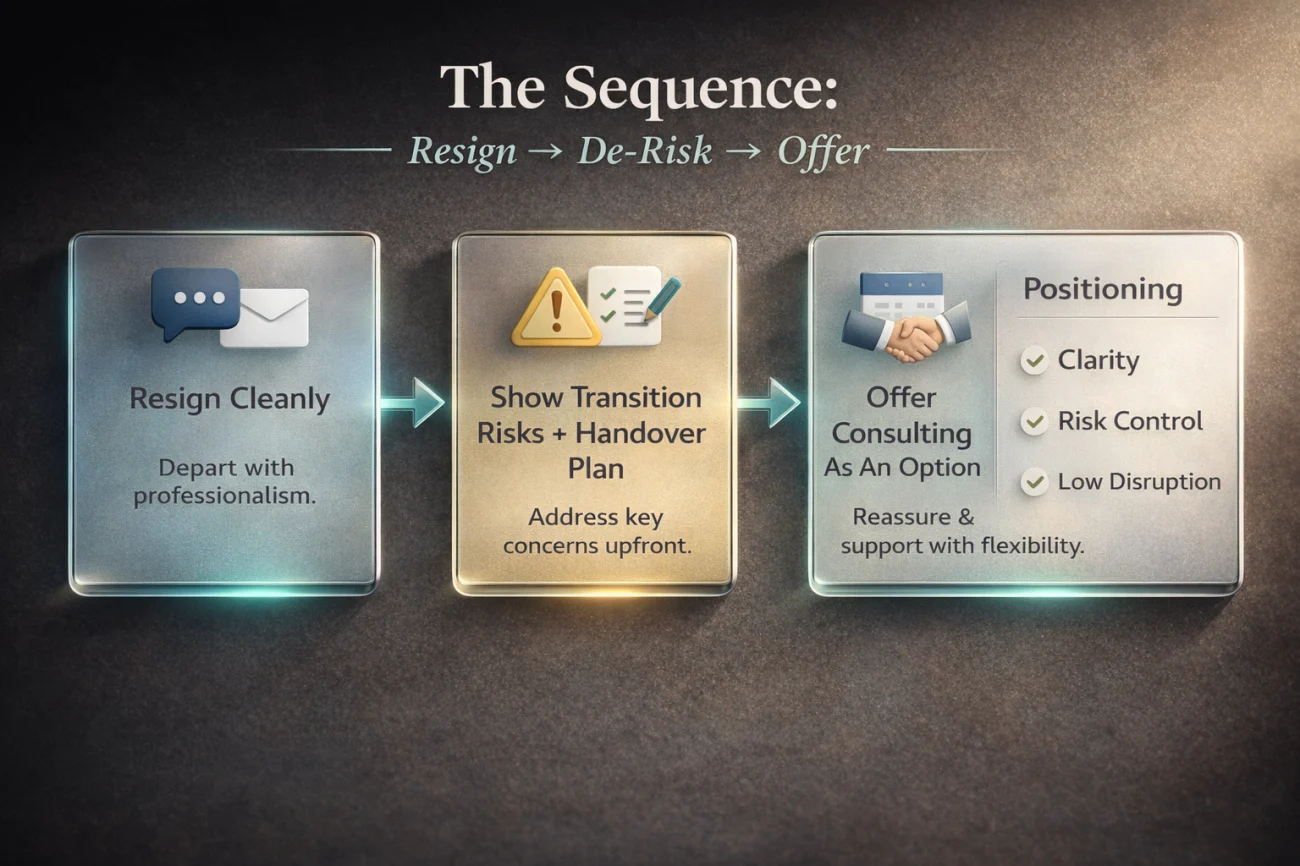
Think of this like a three-step conversation. If you flip the order, it feels like you’re trying to cash out. If you follow the sequence, it feels like you’re being professional.
- Step 1: Resign cleanly (talk first, then write).
- Step 2: Present the transition risks and your handover plan.
- Step 3: Offer consulting as an option, not a demand.
The psychological trick is simple: you don’t open with the ask. You open with responsibility. Once they feel you’re not trying to exploit the moment, your offer becomes easier to hear.
How to Pitch It So It Sounds Like Risk Management, Not Opportunism

If you say “I can consult for you,” some managers hear: “I’m leaving and I want more money.” If you say “I can reduce transition risk,” they hear: “I’m helping you not look bad.” That’s why you frame the offer around continuity, speed, and containment.
Use language like: “I can wrap documentation,” “I can train the replacement,” “I can complete X deliverable,” “I can be available for two hours twice a week for questions.” Avoid language like: “I’ll keep doing what I do now, but as a contractor.” That sounds like a legal and HR headache.
This is where your employee to freelancer transition becomes real. You are no longer selling effort. You’re selling outcomes with limits.
Scope First, Money Second (This Prevents the Worst Outcome)
The worst outcome is not “they say no.” The worst outcome is “they say yes,” then you discover they expect unlimited work for a tiny budget because nothing was defined. Your scope is your protection. It’s also what makes approval faster, because it reduces uncertainty.
Offer one of these three simple packages
Pick the package that matches your situation. You can adjust the numbers later, but keep the structure simple so it doesn’t feel like a negotiation trap.
- Project Wrap: Finish a single deliverable with a clear end date (best when there’s one obvious loose end).
- Transition Retainer: A fixed number of hours per week for 4–8 weeks (best when knowledge transfer is the main risk).
- Office Hours Support: Limited weekly time for Q&A only (best when they’re hiring your replacement and just need you as a safety net).
Define what’s included and what’s not
“Included” should be measurable. “Not included” should be explicit. Examples of exclusions that save your life: no emergency response outside scheduled hours, no attending standing meetings, no new feature development unless separately approved, and no acting as the decision-maker. If they want you to be a decision-maker, they’re asking for an employee.
Pricing Without Guessing or Apologizing
Pricing is where people panic, because they’re afraid of looking greedy. Don’t negotiate against yourself. You’re providing speed and reducing risk. That has value. Also, you’re absorbing costs the company used to cover: taxes, benefits, downtime, and business overhead.
If you’re unsure where to start, anchor your thinking around contracting rates. A common approach is to set an hourly rate that is meaningfully higher than your employee hourly equivalent, because contracting is not the same as payroll. You can also price by project if the outcome is clear, but hourly is usually simpler for a first arrangement with an old employer.
| Pricing Model | Best When | Risk Level | How to Keep It Safe |
|---|---|---|---|
| Hourly | Unpredictable work, Q&A, handover support | Low | Cap weekly hours and define response windows |
| Retainer | Ongoing transition for a defined period | Medium | Fixed hours + unused-hours policy in writing |
| Project fee | Clear deliverable with clear definition of done | Medium-High | Define scope tightly and add change-request rules |
One more practical note: if you’re truly consulting for old employer, you should treat it like a real business arrangement. That means a statement of work, a start date, a stop date, and payment terms. The goal is not to be “formal for the sake of it.” The goal is to keep the relationship clean.
How HR Usually Thinks About This
Your manager may love the idea. HR may be cautious. That’s normal. HR worries about misclassification (employee vs contractor), conflicts of interest, access control, and precedent. If you anticipate that, you can make the path smoother.
The safest posture is: “I’m happy to follow whatever process you require.” Offer to limit access, clarify working hours, and avoid taking on duties that look like employee responsibilities. When you make it easy for HR to say yes, your manager is more likely to push it through.
Two Copy-Paste Emails You Can Use
These templates are designed to sound normal. No drama, no pressure, no “pay me or else.” They position your offer as a transition option that reduces risk and protects continuity. Use them after you’ve had the verbal conversation.
Email 1: Resignation Follow-Up With a Clean Transition Offer
Subject: Transition plan and support options
Hi [Manager Name],
Thank you for speaking with me today. As discussed, I’m confirming my resignation and I’d like to make the transition as smooth as possible.
I’ve started a handover plan that includes documentation, stakeholder notes, and a walkthrough session for the team.
If it would help reduce risk and keep momentum, I’m also open to supporting a short consulting engagement after my last day.
One option could be [X hours/week] for [4–6 weeks] focused on handover support and finishing [specific deliverable], with clear boundaries and a defined end date.
I’m happy to follow HR’s process and adjust the scope to what’s most useful for the team.
Best,
[Your Name]
Email 2: Simple Scope and Terms Confirmation
Subject: Confirming scope and logistics for transition support
Hi [Manager/HR Name],
To make sure we’re aligned, here’s a simple summary of the proposed transition support:
scope: [list 2–4 bullets], availability: [days/times], duration: [start–end dates], and weekly hours cap: [number].
Please confirm the preferred process for setting this up (paperwork, access, billing, and who will approve time/scope changes).
I want the arrangement to be clear and easy to manage for everyone.
Thank you,
[Your Name]
The Checklist That Prevents You From Becoming a Cheap Shadow Employee
This is the part that protects your sanity. A consulting arrangement with your old employer should feel clean and limited.
If it starts to feel like your old job without the title, you’re drifting into the worst of both worlds.
| Item | What “Good” Looks Like | Red Flag |
|---|---|---|
| Scope | Defined deliverables or defined Q&A support only | “Just help with whatever comes up” |
| Hours | Weekly cap and schedule | On-call expectations or constant pings |
| Access | Access limited to what you need | Full access like an employee, no controls |
| Decision rights | You advise, they decide | You own outcomes but don’t control priorities |
| End date | Clear end date or renewal decision point | Open-ended “until we’re done” |
The moment you notice scope creep, address it early. The best consulting relationships stay healthy because both sides know when the engagement ends and what “done” means.
Turn Your Exit Into a Bridge, Not a Burn
Done well, this approach gives you a calm off-ramp and gives your company a controlled transition. You’re not trying to “hack” your resignation. You’re offering a mature solution to a real problem: handover risk. The key is sequence, scope, and boundaries – resign cleanly, document the risks, then offer a limited engagement that’s easy to approve.
If you want one sentence to carry with you, it’s this: a freelance transition works best when you stop selling your time like an employee and start selling outcomes like a professional.
❓ FAQ
✅ Should I resign first, or pitch consulting first?
In most cases, resign first in a calm, professional conversation, then offer consulting as an option to reduce transition risk. If you pitch consulting before resigning, it can sound like you’re negotiating a personal benefit instead of managing a clean handover.
📅 How long should a transition consulting engagement last?
Short is usually safer for a first engagement: 4–8 weeks is common for handover support or finishing a deliverable. A clear end date keeps expectations clean and prevents you from sliding back into an employee-shaped role.
💼 What if my manager wants me to keep doing my old job as a contractor?
That’s a scope problem, not a relationship problem. Redirect the conversation to outcomes and limits: define what you will deliver, cap weekly hours, and remove anything that looks like ownership of ongoing operations unless you’re pricing it appropriately and you truly want it.
🧾 Do I need a contract for a short engagement?
It’s strongly recommended, even if it’s simple. A short statement of work with scope, hours, start/end dates, payment terms, and boundaries protects both sides and keeps the relationship clean if priorities change midstream.
🔒 What’s the biggest mistake people make in this transition?
Being vague. Vague scope, vague availability, and vague end dates create the “cheap shadow employee” outcome. Clarity is what keeps the engagement professional and prevents resentment on both sides.
⚠️ Legal Disclaimer: ResignSmartly provides general informational guidance about resignation, workplace communication, notice periods, handovers, and career transitions. Content does not constitute individualized legal advice. Employment laws, contracts, workplace policies, and individual circumstances vary, so review the requirements that apply to your situation and consult an appropriate qualified professional when needed.