
- What it is: A character reference email proves who you are when skills do not matter, for court, security clearance, adoption, or trust-based roles.
- Key difference: Professional references validate performance, character references validate integrity, reliability, empathy, and remorse.
- Who to ask: Choose credible, respected witnesses first, mentors, volunteer coordinators, community leaders, then long-term peers, avoid family, party friends, subordinates, or anyone tied to the incident.
- How to ask: Be transparent about the stakes, keep the tone humble, and make it easy for them to say yes without feeling tricked.
- Make it strong: Send a briefing kit with talking points and anecdotes, offer a draft only if requested, and accept a “no” gracefully without pressure.
The “Soul Verification”: When Your Resume Isn’t Enough
In the professional world, we are obsessed with “hard skills.” Can you code Python? Can you close a Six-Figure deal? Can you manage a P&L? But there are high-stakes moments in life where your technical competence is completely irrelevant, and the only thing that matters is your moral fiber.
Whether you are applying for a Top Secret security clearance, seeking to adopt a child, facing a judge for a sentencing hearing, or entering a profession built on absolute trust (like law, medicine, or finance), the decision-makers don’t want to know if you are smart. They want to know if you are good.
This is where the character reference email comes in. Unlike a professional reference, which validates what you can do, a character reference validates who you are when no one is watching.
Drafting this request is arguably the most awkward email you will ever write. You are essentially asking someone: “Will you stake your personal reputation on my integrity? Will you vouch for my soul?” It feels heavy. It feels intrusive. And if you are asking because of a legal mistake, it feels shameful.
But here is the truth: A well-executed character reference can be a meaningful factor in high-stakes decisions. It can humanize you, add context about your integrity, and sometimes influence how decision-makers interpret risk and responsibility – whether that’s a judge weighing options, an investigator assessing trust, or a board deciding whether to approve you. It won’t override facts, but it can shape how your overall character is understood.
The Anatomy of Trust: Character vs. Professional References
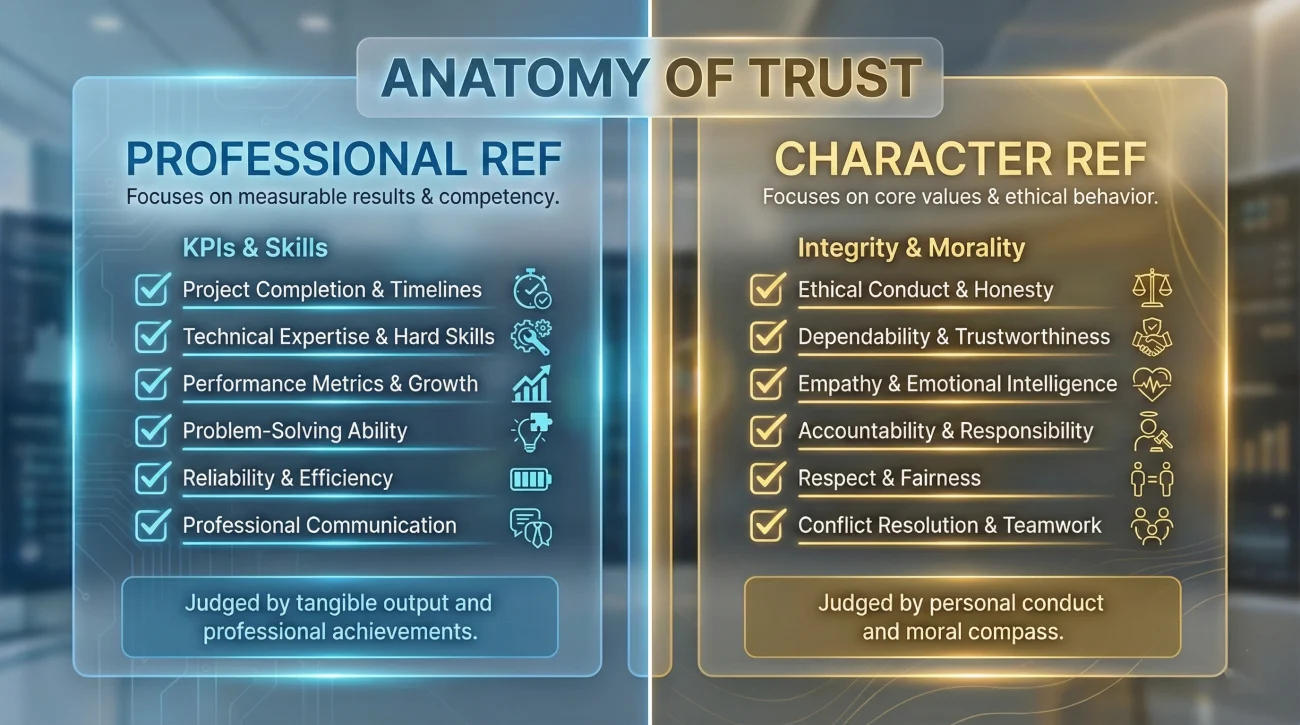
Before you hit send, you must understand the distinct psychological lane you are driving in. Confusing a professional reference with a character reference is a fatal error that can cost you the opportunity. They are judged by completely different metrics.
| Feature | Professional Reference | Character Reference |
|---|---|---|
| The Core Question | “Is this person a high performer?” | “Is this person a decent human being?” |
| The Currency | Productivity & Competence | Integrity, Empathy, & Remorse |
| The Relationship | Transactional (Boss/Employee) | Relational (Mentor/Friend/Peer/Pastor) |
| Key Traits | Skills, KPIs, Punctuality | Honesty, Reliability, Sobriety, Kindness |
| High-Stakes Contexts | Corporate Jobs, Internships | Court Sentencing, Adoptions, Security Clearances, Bar Admission |
When you are sending a personal reference request email, do not ask them to talk about your proficiency in Excel. It is irrelevant. You are asking them to talk about the time you returned a lost wallet, how you care for your aging parents, or your decade-long commitment to a volunteer cause.
The Hierarchy of Credibility: Who Vouches for You?

In a character reference, the “who” matters just as much as the “what.” The judge or investigator is looking for an unbiased, respected third party. A letter from your mom says you are a nice person (which counts for zero because she has to say that). A letter from a respected community leader says you are a pillar of society (which counts for everything).
Use this hierarchy to select your witnesses:
Tier 1: The Pillars of Integrity (The Gold Standard) 🏆
These people have “social capital” to burn. Their word carries weight because they are trusted by the community.
- The Mentor/Coach: Someone who has overseen your growth over years but wasn’t your direct employer. Think: High school football coach, thesis advisor, or scout leader.
- The Volunteer Coordinator: If you volunteered at a shelter for 3 years, this supervisor can speak to your altruism and reliability in an unpaid context.
- The Community Leader: A pastor, rabbi, imam, or board member of a non-profit who knows you personally.
Tier 2: The Long-Term Peers (Solid Backups) ✅
These people prove consistency over time. They show you aren’t just putting on a mask for a few weeks.
- The “Oldest Friend”: Someone who has known you for 10+ years. They can speak to your consistency over time and your growth since childhood.
- The Former Teacher: Especially one from years ago who has stayed in touch.
- The Neighbor: Someone who has lived next to you for 5 years can vouch for your stability, quietness, and neighborliness (crucial for housing references).
Tier 3: The Danger Zone (Avoid) 🚫
These references are often thrown out or viewed with extreme skepticism.
- Immediate Family: Parents, spouses, siblings. Their opinion is considered inherently biased. Only use them if a lawyer specifically requests “family impact statements.”
- The “Party Friend”: Someone you only see in social, intoxicated settings. They cannot speak to your sobriety, reliability, or work ethic.
- Subordinates: Never ask someone who reported to you for a character reference. The power dynamic makes it look coercive (“I had to write this or he’d fire me”).
- Someone involved in the incident: If you are in legal trouble, do not ask the person who was with you when it happened.
The Psychology of the Ask: Why It Feels So Hard
Why is writing this email so difficult? Because it triggers our deepest fear of rejection. We are asking, “Do you think I am a good person?” and we are terrified the answer might be “No.”
If you are asking for a reference due to a mistake (DUI, legal trouble, firing), the shame factor is paralyzing. You might feel like you are burdening your friends with your drama.
The Mindset Shift: Most people are honored to be asked. It signals that you view them as a person of high moral standing. If you have built a life of integrity (outside of perhaps one mistake), your community wants to rally around you. You just need to give them the tool to help you.
The Rule of Transparency: If the reference is for a negative reason (court, disciplinary hearing), you must be transparent. Do not trick someone into writing a “general” reference that you then use for a DUI hearing. That is a betrayal of trust. Own the narrative.
Asking for a character reference requires vulnerability. Use these scripts to maintain dignity while being clear about the stakes.

Scenario 1: The Legal/Court Reference (The High Stakes)
Context: This is the most sensitive request. You need a character reference letter for court/job sentencing or a hearing. Honesty is non-negotiable here. You need to show remorse, not excuses.
Subject: A personal and difficult request / Important
Dear Pastor Williams,
I am writing to you with a difficult and humble request. As you may have heard, I am currently facing legal proceedings regarding [General Description, e.g., a traffic violation / DUI].
My lawyer has advised me to gather character references to demonstrate to the judge that this incident was out of character and that I am otherwise a contributing member of our community. I want to be clear: I am not asking you to excuse my mistake – I take full responsibility for my actions. I am asking if you would be willing to attest to the person you have known for 10 years in the congregation.
The court is looking for insight into my general reputation, honesty, and community involvement to determine sentencing. If you are open to this, I can send you a guide on how to format the letter for the judge.
I completely understand if you prefer not to be involved given the circumstances. I value our relationship regardless of your answer.
Sincerely,
Michael
Scenario 2: The Security Clearance (The “Loyalty” Check)
Context: Government jobs (FBI, CIA, Defense) require references who can speak to your loyalty, stability, and susceptibility to blackmail. They will be interviewed by an investigator.
Subject: Reference Request for Security Clearance
Hi Sarah,
I have some exciting news – I have tentatively accepted a position with [Government Agency]. As part of the background check process for my security clearance, I need to provide references who have known me well over the last 7 years.
Since we have been friends since college and you know my history, habits, and lifestyle better than almost anyone, would you be willing to be listed? An investigator may contact you for a short interview. They typically ask about:
• My reliability and honesty.
• My financial stability.
• Any potential red flags (drugs/alcohol).
You don’t need to prepare anything; you just need to answer honestly. Are you comfortable with me listing your contact info?
Thanks,
Alex
Scenario 3: Adoption or Foster Care (The “Parental” Check)
Context: Agencies want to know if you are stable, patient, and safe around children.
Subject: Character Reference for our Adoption Application
Dear Maria,
As you know, John and I are in the process of adopting! It is a long journey, and the next step involves gathering character references for the agency.
We are asking you because we have spent so much time with your kids over the years. You have seen us interact with them, handle tantrums, and manage stress. Would you be willing to write a letter attesting to our potential as parents?
The agency specifically wants to know about our patience, our stability as a couple, and our support network.
We would be honored to have your support in building our family.
Love,
The Millers
Scenario 4: The Housing Board (The “Good Neighbor” Check)
Context: Co-op boards (especially in NYC) or strict landlords want to know you won’t throw parties at 3 AM.
Use this for: A friend reference email for housing.
Subject: Favor: Personal Reference for my Apartment App
Hi David,
I’m in the final stages of applying for that apartment in Brooklyn! The landlord is old-school and has asked for a personal character reference from a non-relative who has known me for at least 5 years.
Since we’ve been neighbors for 6 years, would you be willing to write a brief blurb? He basically just wants to verify that I’m quiet, respectful, pay bills on time, and am unlikely to burn the building down.
I can send you a draft if that helps! I promise to buy you dinner to make up for the awkwardness.
Thanks,
Alex
The “Ghostwriting” Guide: Helping Them Write It
Character references are notoriously hard to write because “being a good person” is vague. If you just ask for a letter, you will get fluff like “He is a nice guy.” That helps nobody.
You need to help them help you. Once they agree, send them a Briefing Kit with specific anecdotes.

What to Include in the Briefing Kit:
- The “Redemption Arc” (For Court): “It would be helpful if you mentioned the volunteer work I’ve been doing since the incident. It shows I’m trying to make amends.”
- The “Stability Proof” (For Housing/Jobs): “Please mention that I’ve held the same volunteer position for 4 years. It shows consistency.”
- The Specific Traits: “They are looking for ‘Empathy’. Maybe mention the time I helped you move house when you were sick?”
Drafting Tips (If they ask you to write it):
If they say “Just write it and I’ll sign it,” be careful. It must sound like them, not you.
- Use “I” statements: “I have known Alex since…”
- Include their status: “As a former Police Chief, I know the value of integrity…”
- Admit Flaws (Strategic Honesty): A letter that says you are perfect is suspicious. A letter that says “Alex has made mistakes, but has learned from them” is credible.
❓ FAQ: Addressing Your Anxiety
📝 Can I write the character reference myself?
Generally, no. While you can draft professional references, character references need to sound authentically personal. A letter that sounds like legalese or corporate-speak will trigger alarm bells for a judge or investigator. Instead of a draft, give them a list of “Talking Points” or specific memories to jog their brain.
⚖️ Does a character reference really help in court?
Often, yes. Judges are human, and a well-written letter from a credible person can help provide context and humanize you. It can turn you from “a case file” into a whole person with responsibilities, community ties, and a track record of reliability. Quality and credibility matter more than volume.
Note: This is general information, not legal advice. If you have an active case, follow your attorney’s guidance on what to include (and what to avoid).
📧 What if I don’t have anyone to ask?
This is a common fear. If you feel isolated, look at your “loose ties.” A landlord you paid rent to on time for 3 years. A neighbor you wave to. A librarian who sees you every week. You don’t need to be best friends; you just need someone who has observed you acting consistently and decently over time.
🤝 Should I offer to pay them?
Never. Paying for a character reference destroys its credibility and can be considered fraud or bribery, especially in legal contexts. A thank you card or a small, nominal gift (like cookies) after the fact is acceptable, but never transactionalize the request beforehand.
🚫 What if they have a criminal record?
If your character reference has their own legal troubles, their credibility in court or for security clearances might be compromised. It is better to choose someone with a “clean” record if possible. However, if they have rehabilitated themselves, their story of redemption could actually be powerful in a sentencing context.
Final Thoughts: The Currency of Reputation
In a world of digital noise, character remains the ultimate currency. Asking for character reference support is an exercise in auditing your life. It forces you to ask: “Who have I been to the people around me?”
When you send that email, you are doing more than checking a box on an application. You are activating your social capital. Approach it with humility, provide your references with the context they need, and you will find that people are often more willing to vouch for your goodness than you give them credit for.
For more guidance on navigating sensitive professional and personal communications, explore our resources on resignation etiquette and career transitions.
⚠️ Legal Disclaimer: ResignSmartly provides general informational guidance about resignation, workplace communication, notice periods, handovers, and career transitions. Content does not constitute individualized legal advice. Employment laws, contracts, workplace policies, and individual circumstances vary, so review the requirements that apply to your situation and consult an appropriate qualified professional when needed.