
- The Skill Clock is Ticking: The World Economic Forum estimates that 39% of worker skills will be disrupted by 2030. Standing still is effectively moving backward.
- Engagement is Dropping: Global employee engagement has fallen to 21% (Gallup), driving many to quit out of frustration rather than strategy.
- Don’t Just Escape: “Smart Quitting” means leaving a role only when you know exactly which skills you are upgrading next, not just which stress you are leaving behind.
Quitting Is No Longer Just About Changing Desks
For decades, resignation was simple geography. You left Company A to go to Company B, usually doing the exact same job for slightly more money. In 2026, that playbook is dangerous.
We are living through a fundamental “skill shift.” According to the World Economic Forum’s Future of Jobs Report 2025, an average of 39% of the skills required for your current job will change or become obsolete between now and 2030. This statistic should terrify (and motivate) anyone planning a resignation.
If you quit simply because you are tired (and with engagement dropping, many are), you risk entering a market that doesn’t just want “more of you”; it wants a “different version of you.” Smart quitting today isn’t about escaping a bad boss; it is about strategically positioning yourself on the right side of that 39% disruption curve.
The “Escape Trap”: Why We Quit for the Wrong Reasons
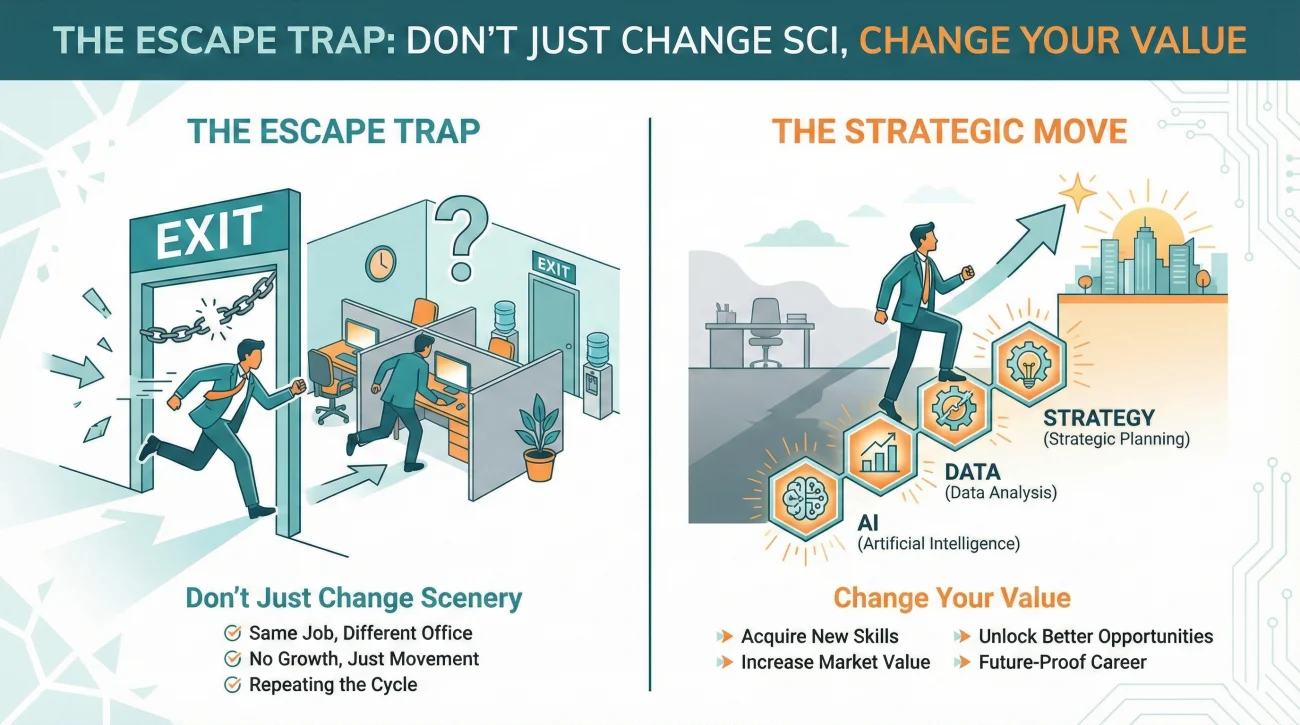
In my HR practice, I see a clear pattern. Candidates are exhausted. The Gallup State of the Global Workplace 2024 report confirms this, showing that global employee engagement has dropped from 23% to 21%. This decline signals a crisis of motivation.
When engagement falls, the impulse to resign spikes. You feel stuck, unappreciated, or bored. The natural reaction is to run toward the exit. But here is the “field note” reality I see in exit interviews:
Key Point: Quitting to escape burnout often leads to “rebound roles,” which are jobs that look different on the surface but require the exact same stagnating skill set. You change the scenery, but you don’t change your market value.
The OECD Employment Outlook 2025 notes that while labor markets remain resilient, they are slowing down. Real wages are rising in some sectors, but the easy gains of 2021 are gone. In a slowing market, lateral moves (same skills, new place) are risky. The only safe move is an upward move in capability.
The Smart Quitting Rule: The “Next Skill” Story

Before you draft your resignation letter, you need to answer one question. Not “Where am I going?” but “What am I becoming?”
Smart quitting requires you to identify the “skill gap” between where you are and where the market is going (that 39% shift). Your resignation should be the bridge across that gap.
Before resigning, ask:
1. Is my current role preventing me from learning [Critical New Tool/AI Workflow]?
2. Does the new role explicitly offer training or exposure to that tool?
3. If I stay here 12 more months, will my resume look “2024” in a “2026” world?
Scenario: The “Escaper” vs. The “Strategist”
Let’s look at two Senior Marketing Managers, Sam and Elena. Both are burned out and facing the same WEF data.
Sam (The Escaper):
Sam hates the long hours. He resigns to take a similar role at a “slower” company. He uses the same tools he mastered five years ago.
👉 Two years later, automation tools make his manual workflow obsolete. He is laid off with a skillset that is now 40% depreciated.
Elena (The Strategist):
Elena is also tired, but she realizes her current firm won’t pay for AI training. She resigns specifically to join a mid-sized agency that is piloting generative AI campaigns. She takes a lateral salary move but gains access to the new tech stack.
👉 Two and a half years later, she is a “Head of AI Marketing Operations,” commanding a premium because she updated her skills while Sam stood still.
“I’m quitting to get a 10% raise.” (Short-term income focus)
“I’m quitting to gain access to a toolstack that will keep me employable in 2030.” (Long-term equity focus)
How to Execute a Skill-Based Resignation
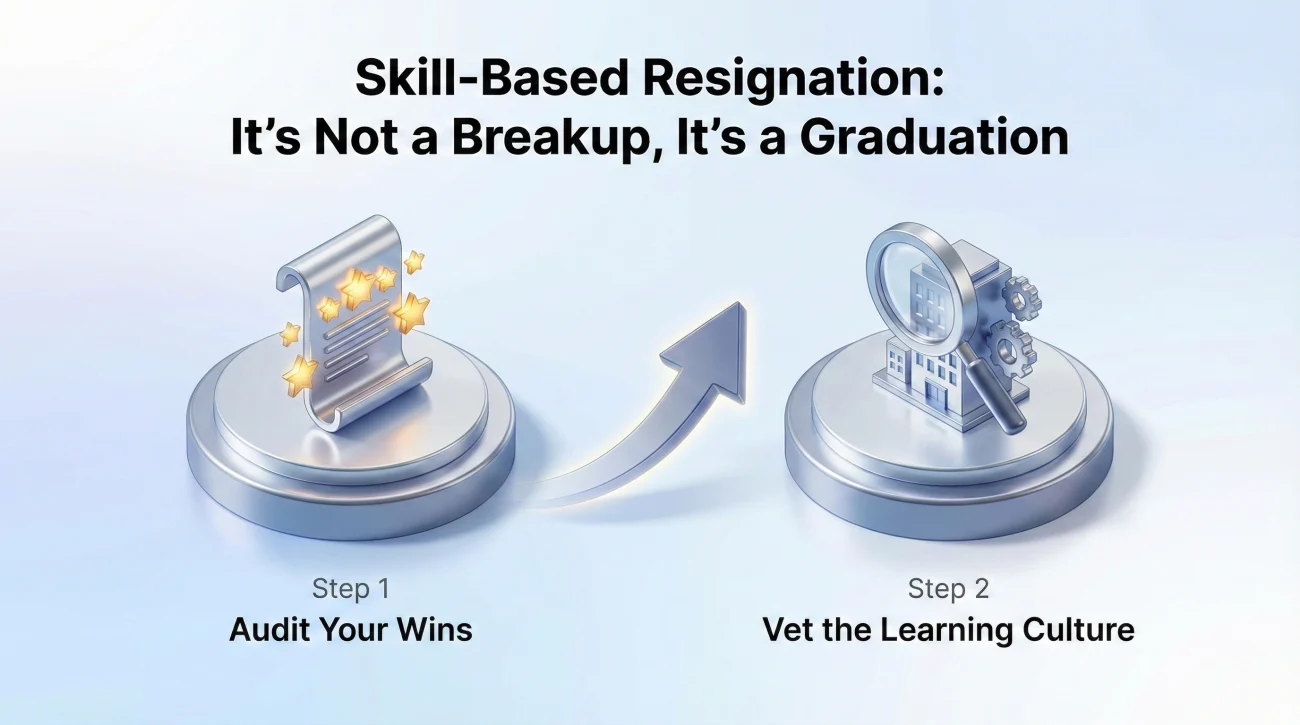
If you have decided to leave to upgrade your skills, your exit process needs to reflect that maturity. This isn’t a breakup; it is a graduation.
🔆 Pro Tip: Use your exit interview to frame your departure around growth, not dissatisfaction. “I am leaving to pursue specific technical challenges in [Area]” lands much better than “I am bored.”
1. Audit Your Wins (and Your Gaps)
Document what you delivered, but honestly list what you missed. Did you shy away from the new software implementation? Did you stick to manual spreadsheets? Know your weak spots so you don’t hide them in the next role; you attack them.
2. Vet the New Employer for “Learning Culture”
In the interview for your next job, ask hard questions. “How much of the budget is allocated to L&D?” “What new tools did the team adopt last quarter?” If they don’t have good answers, you aren’t “smart quitting”; you are just “slow quitting.”
Final Thoughts
The numbers from the World Economic Forum and Gallup tell a combined story: The world of work is changing fast (39% skill churn), and we are less happy about it (21% engagement). It is a volatile mix.
But volatility creates leverage for the prepared. Don’t just quit because you are done with the past. Quit because you are ready for the future. Make your resignation the moment you stop defending your old skills and start building your new ones.
❓ FAQ
🔄 How do I know if my skills are becoming obsolete?
Look at job descriptions for the role above yours. If they list tools or methodologies you have never used, your skills are lagging. Also, check industry reports like the WEF Future of Jobs to see which skills are “declining” vs. “rising.”
📉 Is it better to stay in a boring job if it’s safe?
Safety is relative. Staying in a role where you learn nothing new is actually dangerous in the long run. If your “safe” job disappears in 3 years, and your skills haven’t grown, you will face a much harder job market then.
🗣️ Should I tell my boss I’m leaving to learn new skills?
Yes, this is a very professional reason to resign. It shows ambition and prevents burning bridges. It implies “I would stay if you could teach me this,” which is a valid business reason for departure.
🎓 Can I quit to just take a course?
In a slowing market (OECD data), quitting without a job is risky. It is usually better to upskill while employed (even if it means late nights) or find a new role that offers on-the-job training.
🤖 Will AI really replace my job by 2030?
It’s less about replacement and more about transformation (the 39% figure). The risk isn’t AI taking your job; it’s another professional using AI taking your job. Quitting to move to a firm that embraces AI is a smart defensive move.
Sources & Data Context
This article relies on forward-looking data to help you make strategic career decisions.
- Skill Disruption: The projection that 39% of worker skills will change by 2030 is from the World Economic Forum’s Future of Jobs Report 2025.
- Employee Engagement: Data on the drop in global engagement to 21% is sourced from Gallup.
- Market Outlook: Insights on labor market resilience and wage trends are referenced from the OECD Employment Outlook 2025.
⚠️ Legal Disclaimer: ResignSmartly provides general informational guidance about resignation, workplace communication, notice periods, handovers, and career transitions. Content does not constitute individualized legal advice. Employment laws, contracts, workplace policies, and individual circumstances vary, so review the requirements that apply to your situation and consult an appropriate qualified professional when needed.