
- Core dilemma: Quitting while pregnant is a timing and money decision because insurance, income, and benefits are on the line.
- Timing windows: Choose between early exit, post-maternity-leave exit, or safest option returning briefly first to avoid benefit clawbacks.
- Know your leverage: Understand what you give up by resigning under PDA and FMLA, and when ADA accommodation refusals should be documented.
- Insurance plan: Bridge coverage via partner plan transfer, COBRA, or marketplace options, and avoid gaps that can turn delivery into a major financial hit.
- Communication strategy: Use the right script for privacy, medical necessity, or keeping the door open, and only expect unemployment if you can prove good cause with medical documentation.
The Career vs. Family Dilemma
Discovering you are pregnant is a life-altering moment. Realizing you cannot stay in your current job while pregnant is a crisis. You are caught in a high-stakes conflict: the biological need to reduce stress for your baby versus the economic necessity of health insurance and income.
Resigning while pregnant is not just a standard career move; it is a complex calculation involving federal law, insurance premiums, and timing. One wrong move could cost you your paid leave, leave you uninsured during delivery, or trigger a demand for thousands of dollars in repayment to your employer.
This guide cuts through the noise. We are not just talking about “listening to your body.” We are talking about the cold, hard strategy of exiting a job safely without bankrupting your growing family.
The Calculus of Timing: Quit Now or Wait?
The single biggest mistake expecting mothers make is resigning based on emotion rather than the calendar. Your resignation date determines your insurance coverage and your eligibility for benefits. You generally have three strategic windows:
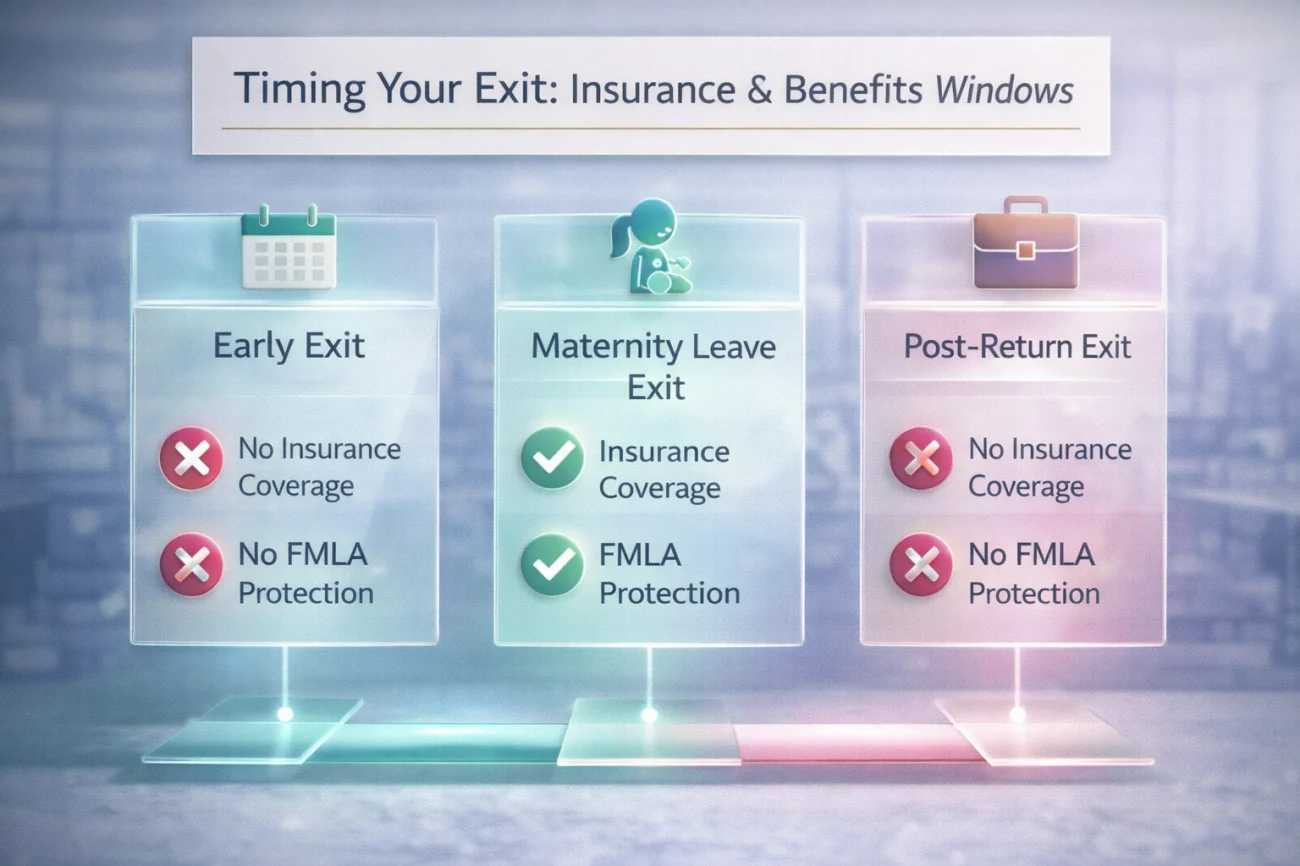
Window 1: The Early Exit (First/Second Trimester)
If the job is toxic or physically unsafe, leaving early is necessary. The strategy here is “Bridge the Gap.”
- The Risk: You lose FMLA protection and maternity pay.
- The Strategy: Do not quit on the 1st of the month. Quit on the 2nd or 3rd. Most employer insurance plans cover you through the end of the month in which you resign. Quitting on March 2nd usually gives you coverage until March 31st, buying you 30 days to find a new plan.
Window 2: The “Maternity Leave” Exit (The Golden Handcuffs)
This is the most common but most dangerous strategy: Waiting until you give birth, taking your 12 weeks of leave, and then quitting.
The Trap: Check your employee handbook for a “Return to Work” clause. Many companies require you to return to work for a specific period (usually 30 days) after your leave ends. If you do not return, or if you quit during your leave, you may be liable to repay the employer’s portion of your health insurance premiums.
The Math: If your employer pays $1,500/month for your insurance and you take 3 months off, you could owe them $4,500 if you don’t return.
Window 3: The “Post-Return” Exit
The safest financial route is often to take your leave, return for the mandatory minimum period (e.g., 30 days), and then hand in your notice. It requires stamina, but it protects your bank account from clawbacks.
Know Your Rights: PDA and FMLA
Before you write your resignation letter, you need to know what protections you are waving goodbye to. Understanding resigning while pregnant rights helps you negotiate.
| Law | What It Does | Does It Apply If I Quit? |
|---|---|---|
| Pregnancy Discrimination Act (PDA) | Prevents them from firing you or demoting you due to pregnancy. | No. Once you resign voluntarily, you waive most claims unless you prove “Constructive Discharge.” |
| FMLA (Family Medical Leave Act) | Guarantees 12 weeks of unpaid, job-protected leave. | No. FMLA is job protection. If you don’t want the job, FMLA is irrelevant. |
| ADA (Americans with Disabilities Act) | Requires “reasonable accommodation” for pregnancy complications (e.g., sitting vs standing). | Maybe. If you are quitting because they refused accommodations, document this. It creates a legal record. |
Solving the Insurance Puzzle

In the US, childbirth costs average between $10,000 and $30,000 without insurance. You cannot afford a gap. When quitting before maternity leave, you have three lifelines:
1. The Partner Transfer (Best Option)
Leaving your job is a “Qualifying Life Event” (QLE). This allows your spouse or partner to add you to their employer’s plan outside of the open enrollment period.
Warning: You typically have a strict 30-day window from the date your coverage ends to file this paperwork. Do not miss it.
2. COBRA (The Expensive Option)
You can keep your current insurance for up to 18 months. However, you pay 102% of the premium (your share + the employer’s share + 2% admin fee). This is often prohibitively expensive but ensures you keep your current OB/GYN.
3. The Marketplace / Medicaid (The Safety Net)
Losing job-based coverage also qualifies you for a Special Enrollment Period on Healthcare.gov. Depending on your household income after you quit, you might qualify for subsidies or even pregnancy Medicaid, which covers prenatal care at little to no cost.
Strategic Resignation Scripts
What you say depends on your goal. Are you burning the bridge? Leaving the door open? Or protecting yourself legally?
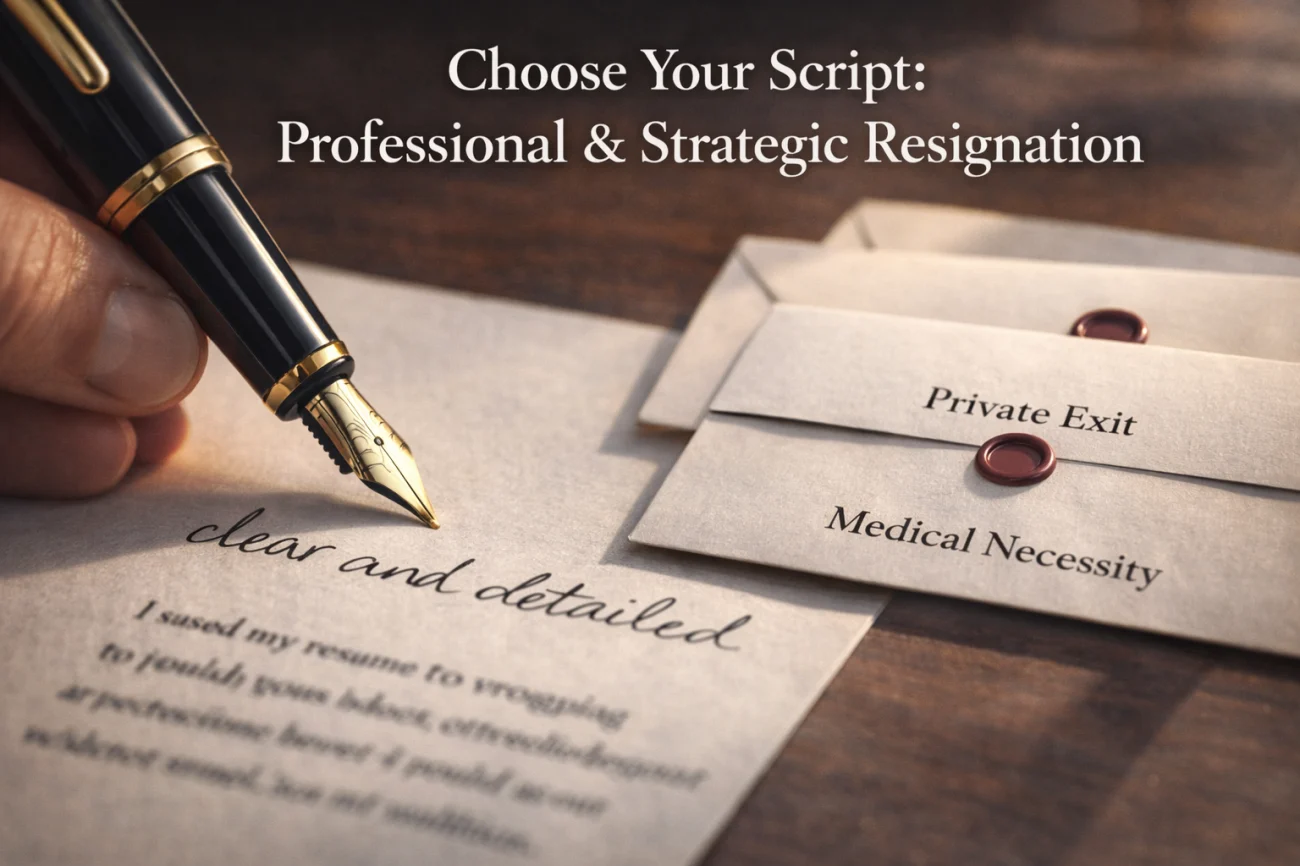
Scenario A: The “Private” Exit (No Disclosure)
Use this if you are early in the pregnancy and don’t want to discuss it. You have no legal obligation to disclose your pregnancy upon resignation.
[Your Name]
[Address]
[Date]
[Manager Name]
[Company Name]
Dear [Manager Name],
Please accept this letter as my resignation from my position as [Job Title], effective [Date].
I have decided to move on to a new opportunity that aligns with my current personal and professional goals. I want to thank you for the support during my time here.
I will ensure all my projects are handed over by my final day.
Sincerely,
[Your Name]
Scenario B: The “Medical Necessity” Exit (Constructive Discharge)
Use this if you are quitting because the workplace is unsafe for your pregnancy and they refused to help. This is critical documentation for unemployment claims.
[Your Name]
[Address]
[Date]
[Manager Name]
[Company Name]
Dear [Manager Name],
Please accept this letter as my resignation, effective [Date].
As I have communicated in our emails on [Date 1] and [Date 2], my physician has advised that my current working conditions pose a risk to my health. Unfortunately, since my requests for [specific accommodation: e.g., remote work/sitting duties] were denied, I have no choice but to resign to prioritize my medical well-being.
I regret that it has come to this, as I enjoyed my role here.
Sincerely,
[Your Name]
Scenario C: The “Door Open” Exit (Post-Baby Return?)
Use this if you are leaving to be a stay-at-home mom but want to maintain a good relationship for the future.
Dear [Manager Name],
Please accept my resignation, effective [Date].
With the upcoming addition to my family, I have decided to take an extended career break to focus on full-time caregiving. This was a difficult decision, as I have truly valued my time at [Company].
I hope to stay in touch and would love to be considered for future opportunities when I am ready to return to the workforce.
Sincerely,
[Your Name]
Can You Get Unemployment?
This is a common gray area. Generally, if you quit voluntarily, you do not qualify. However, pregnancy offers a unique exception in some states.
If you quit because the work posed a documented health risk to you or the baby, and your employer could not accommodate you (as seen in Script B above), you may qualify under the “Good Cause” doctrine. You must have a doctor’s note before you quit advising you to leave the job. Without medical documentation, the state will likely view your resignation as a personal preference, disqualifying you from benefits.
❓ FAQ
🤰 Should I disclose my pregnancy in a job interview?
Legally, you are not required to. Strategically, most experts advise waiting until you have a signed offer letter. Once you are hired, the PDA protects you. If you tell them during the interview, unconscious bias might cost you the job, and it is very hard to prove.
📅 Can they fire me if I put in notice while pregnant?
They can accept your resignation effective immediately, which is common. However, if they fire you because of the pregnancy before you resign, that is illegal discrimination. If you give 2 weeks’ notice and they walk you out that day, you may be eligible for unemployment for those 2 weeks.
💸 What exactly is the “Clawback” provision?
It is a clause in your benefits package. It states that if you do not return to work for 30 days after FMLA leave, you must repay the health insurance premiums the company paid for you during your leave. It does not usually apply to your salary or paid time off (PTO) you earned.
🏥 How do I switch OB/GYNs if I change insurance?
This is the hardest part. Many OBs will not take new patients after 24-28 weeks. Before you switch insurance plans, call the new insurance provider and get a list of in-network doctors, then call those doctors to confirm they accept late-term transfers.
⚖️ Is “stress” a valid medical reason to quit?
Only if a doctor documents it. “I’m stressed” is subjective. “Patient has pregnancy-induced hypertension exacerbated by work stress” is a medical diagnosis that can support an unemployment claim.
Final Thoughts

Resigning while pregnant is an exercise in risk management. The system is not designed to make this easy for you, so you must be diligent.
Do the math on the insurance premiums. Check your handbook for clawback clauses. And most importantly, time your exit to ensure you and your baby are covered. Your career will be there when you get back; your focus now is ensuring a safe and financially secure transition to parenthood.
⚠️ Legal Disclaimer: ResignSmartly provides general informational guidance about resignation, workplace communication, notice periods, handovers, and career transitions. Content does not constitute individualized legal advice. Employment laws, contracts, workplace policies, and individual circumstances vary, so review the requirements that apply to your situation and consult an appropriate qualified professional when needed.