
- Core reality: Using an external offer as leverage is a high-risk ultimatum that can permanently break trust.
- Why it backfires: Managers feel cornered, assume you are a flight risk, and counter-offers often only delay your exit.
- Leverage test: Only try it if you are truly top-tier, tied to critical work, the company can pay, and you have a real offer.
- How to say it: Frame it as market correction and loyalty, not a threat, and ask to bridge the gap collaboratively.
- After you win: Expect scrutiny and replacement planning, then rebuild credibility with documentation and consistent delivery.
The Ultimate Career Gamble
It is the classic corporate fantasy: You walk into your manager’s office, slide a competitor’s offer letter across the desk, and confidently state, “Match this, or I walk.” In movies, the boss panics, realizes your immense value, and immediately doubles your salary. You walk out a hero.
In the real world, however, asking for a raise before quitting using a resignation threat is one of the most volatile and dangerous maneuvers you can make in your professional life. Negotiation experts refer to this as “Gun to the Head” negotiation. While it is undoubtedly the fastest way to force a salary correction, it fundamentally alters the psychological contract between you and your employer.
Once you pull this trigger, you cannot un-pull it. You are no longer just an employee; you are a “flight risk.” While you might get the money, you often lose something far more valuable: trust. Before you attempt to use an external offer as leverage, you need to understand exactly why this strategy backfires so often – and how to execute it with surgical precision if you decide to proceed.
Why Bosses Hate the “Ultimatum”
To succeed in this negotiation, you must understand what is happening in your boss’s head. When you say, “I have another offer, match it,” you are not just asking for money. You are backing them into a corner.
Most managers react emotionally to this tactic. They feel:
- 💢 Betrayed: “I invested in this person, and now they are holding me hostage.”
- 😰 Panicked: “Who will do their work if they leave tomorrow?”
- 🤔 Suspicious: “If they were looking for a job, they have been unhappy for a while. Even if I pay them, will they leave next month anyway?”
This is why statistics regarding counter-offers are grim. Studies consistently show that a vast majority of employees who accept a counter-offer to stay end up leaving within 6 to 12 months anyway. Why? Because the money changed, but the relationship didn’t. The trust is broken.
The “Irreplaceability” Audit
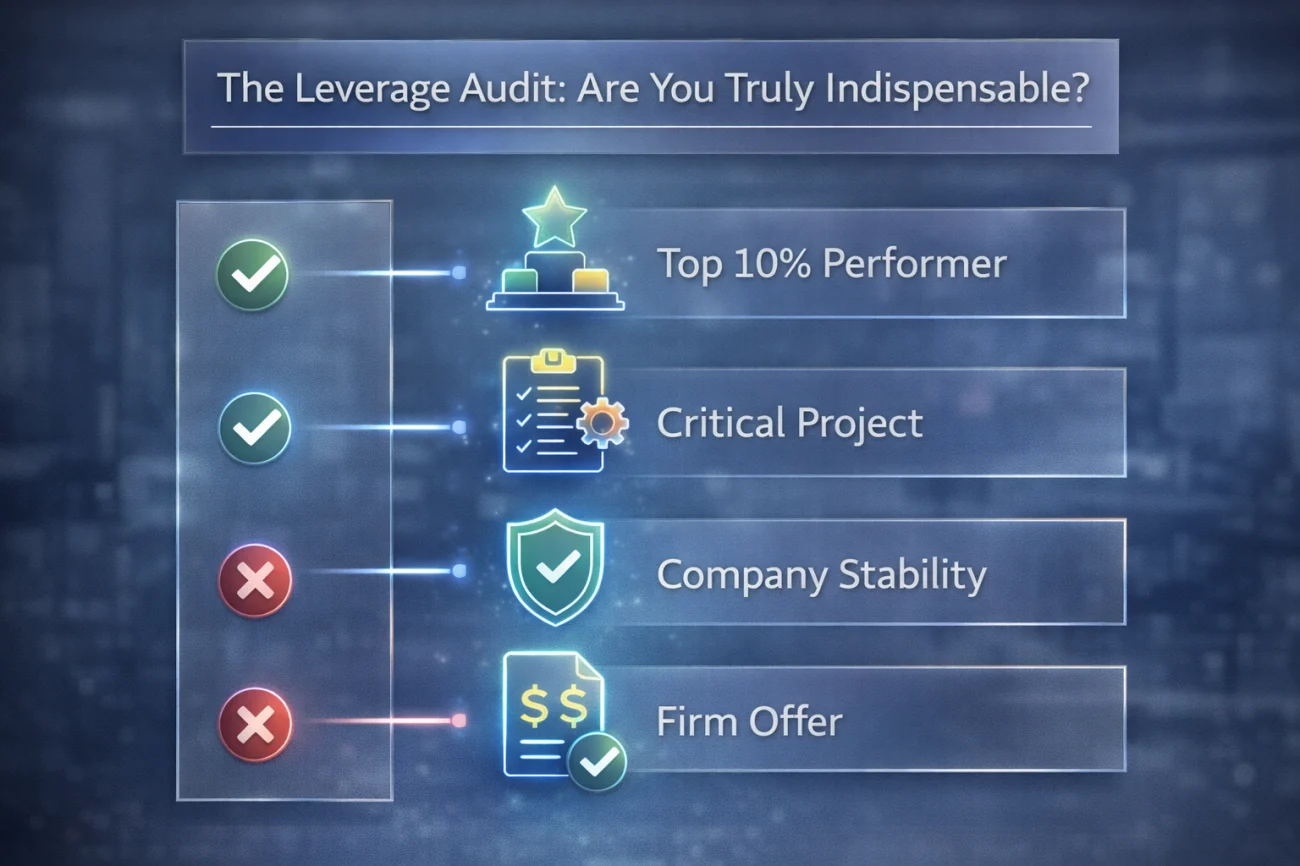
This strategy is not for everyone. You cannot bluff with a weak hand. Before you consider using job offer to negotiate raise bumps, you must conduct a brutal audit of your standing in the company.
If you answer “No” to any of the following, do not try this strategy. Just take the new job.
| The Leverage Checklist | Why It Matters |
|---|---|
| Are you in the top 10% of performers? | Average employees are easily replaced. If you are “just okay,” your resignation might be accepted with relief. |
| Is your project critical to revenue? | If your departure would cause immediate financial loss or project failure, your leverage is high. |
| Is the company financially stable? | If they are in a hiring freeze or layoffs are looming, they literally cannot pay you more, no matter how much they want to. |
| Do you actually have a firm offer? | Never, ever bluff. If they call your bluff and say “Goodbye,” and you don’t have a backup, you are unemployed. |
The Strategy: “Market Correction” vs. “Threat”
If you are determined to stay but need a salary adjustment, you must strip the “threat” out of your conversation. You are not holding them hostage; you are bringing them “market data.”
Your goal is to frame the external offer as a validation of your market value, not a weapon. You want to position yourself as an ally who is caught in a dilemma.

The “Soft Leverage” Script
Do not say: “Company X offered me $120k. Match it or I quit.”
Instead, use this asking for raise strategy:
“I want to be transparent with you because I value our relationship. I wasn’t actively looking to leave, but I was approached by a recruiter for a role that offers $120k, which is a 25% increase over my current salary.
My absolute preference is to stay here. I love the team and the mission. However, that financial gap is too significant for my family to ignore. I would love to see if we can bridge that gap so I can decline their offer and focus 100% on our goals here.”
Why this works:
- ✅ It emphasizes loyalty (“My absolute preference is to stay”).
- ✅ It frames the problem as “the gap,” not “the boss’s stinginess.”
- ✅ It invites collaboration (“Can we bridge that gap?”).
Winning the Battle, Losing the War?

Let’s assume it works. They match the offer. You get the raise. You pop the champagne. But what happens next Monday?
You now have a target on your back. You are expensive, and you have proven you are willing to look elsewhere. In many companies, the following scenario plays out silently:
- The “Band-Aid” Phase: They pay you to stay because they can’t afford to lose you right now.
- The “Redundancy” Phase: They immediately start cross-training someone else to do your job, or they quietly start interviewing for your replacement.
- The “Replacement” Phase: Six months later, once your knowledge is transferred, they let you go or “restructure” your expensive role out of existence.
Survival Rule: If you leverage resignation for salary, you must work twice as hard to rebuild trust. You need to demonstrate that you are “all in” and not looking for the next exit.
Templates for the High-Stakes Conversation
Paperwork is critical here. Never resign verbally. Never accept a counter-offer verbally. Everything must be documented to protect yourself.
Email to Request the Meeting
Subject: Urgent: Discussion regarding my career path and compensation
Hi [Manager Name],
I hope you’re having a good week.
I would appreciate 15 minutes of your time today or tomorrow for a time-sensitive discussion regarding my compensation and future at [Company]. I have received an external offer that has prompted me to re-evaluate my current standing, but my priority is to discuss this with you before making any decisions.
Please let me know when you have a moment.
Best,
[Your Name]
Accepting the Counter-Offer (The Protection Clause)
If they match the offer and you decide to stay, send this email to confirm details.
Subject: Confirmation of adjusted compensation terms
Dear [Manager Name],
Thank you for our constructive conversation yesterday. I am happy that we were able to find a solution that allows me to continue my journey with [Company].
Per our discussion, I am writing to confirm my acceptance of the salary adjustment to [New Salary Amount], effective [Date]. I also understand that my role and responsibilities regarding [Project X] remain unchanged.
I have declined the external offer and am excited to move forward with the team.
Best regards,
[Your Name]
❓ FAQ
🤥 Can I lie about the amount of the other offer?
This is extremely dangerous. HR departments often have access to salary benchmarking data. If you claim an offer that is wildly above market rate, they will know you are lying. Worse, they might ask to see the offer letter to “get approval from Finance.” If you can’t produce it, you are finished.
📄 Do I have to show them the offer letter?
You are not legally obligated to, but refusing looks suspicious. A good middle ground is to show it but redact (black out) the company name and contact details to “protect the privacy of the other party.” This proves the numbers are real without revealing your hand.
🙅 What if they say “We can’t match it”?
Then you must leave. If you threaten to quit, get a “no,” and then stay anyway, you lose all professional respect. You become the employee who complains but never acts. This is why you must actually be willing to take the other job before you start this conversation.
⏳ How long should I give them to decide?
Speed is your friend. Give them 24 to 48 hours. Say, “I need to give the other company an answer by Wednesday.” If you let them drag it out for a week, they might be using that time to find your replacement before they cut you loose.
📈 Can I negotiate non-monetary perks instead?
Yes. Sometimes budgets are frozen, but perks are not. You can negotiate for more vacation days, a guaranteed remote work schedule, a title change, or company stock options. Sometimes these are worth more than a small salary bump.
Final Thoughts

Using a resignation as leverage is not a “hack”; it is a nuclear option. It should be reserved for situations where you are severely underpaid, indispensable to the organization, and genuinely prepared to walk away if things go south.
If you choose to play this game, play it with professionalism, transparency, and a clear exit strategy. The goal isn’t just to get paid more – it’s to ensure that when the dust settles, you still have a career worth asking for a raise before quitting for.
⚠️ Legal Disclaimer: ResignSmartly provides general informational guidance about resignation, workplace communication, notice periods, handovers, and career transitions. Content does not constitute individualized legal advice. Employment laws, contracts, workplace policies, and individual circumstances vary, so review the requirements that apply to your situation and consult an appropriate qualified professional when needed.