
- The Market Has Shifted: Job openings hit a multi-year low of 6.542 million in late 2025, meaning the “easy switch” era is over.
- Risks Are Higher: Quitting without a plan in 2026 often leads to longer gaps and weaker salary leverage than in previous years.
- Strategy is Safety: “Smart Quitting” isn’t about staying stuck; it’s about timing your exit, securing your narrative, and verifying your financial runway before you resign.
The Era of the “Easy Quit” Is Over
If you have worked in HR as long as I have, you start to see employment cycles as clearly as seasons. There are “summers” (like the post-pandemic hiring boom) where candidates held all the cards, resignations were casual, and finding a new role was often a matter of days. And then, there are “winters.”
As we settle into 2026, the data and the daily reality of recruitment suggest the season has turned. The labor market is cooling. It hasn’t frozen, but the heat is gone.
According to data from late December 2025, U.S. job openings dropped to 6.542 million, the lowest level we have seen since September 2020. Yet, the quit rate is holding steady at 2.0%, with 3.2 million people still leaving their jobs. This creates a dangerous disconnect: people are still quitting like it’s 2022, but the market is hiring like it’s a much more cautious year.
This article is not about telling you to stay in a toxic job out of fear. It is about smart quitting. In a cooling market, resignation is no longer just an administrative act; it is a strategic risk management decision. Before you draft that resignation letter, you need to understand exactly what has changed and how to protect your career transition.
The Data: Why 2026 Is Different
To make a smart decision, we have to look at the numbers without emotion. In HR, we track “openings” versus “quits” to measure candidate leverage. When openings are high and quits are low, candidates have the power. When openings drop, that power shifts back to employers.
The drop to 6.542 million job openings is significant. It signals that companies are scrubbing their budgets, cancelling “nice-to-have” roles, and focusing only on critical hires. Meanwhile, the fact that quits remain at 3.2 million suggests that employee frustration hasn’t gone down, only the safety net has.
Key Point: In a cooling market, the “Time to Hire” metric usually increases. A job search that might have taken 4 weeks in 2022 could easily take 3 to 5 months in 2026.
I mention this because the most common regret I hear in exit interviews lately isn’t “I shouldn’t have left,” but rather, “I should have lined up the next thing first.” Reuters and other major outlets have highlighted this weakening context, noting that previous employment data was revised downward. The trend is clear: the cushion is thinner.
The Three Risks of “Impulsive Quitting” Right Now
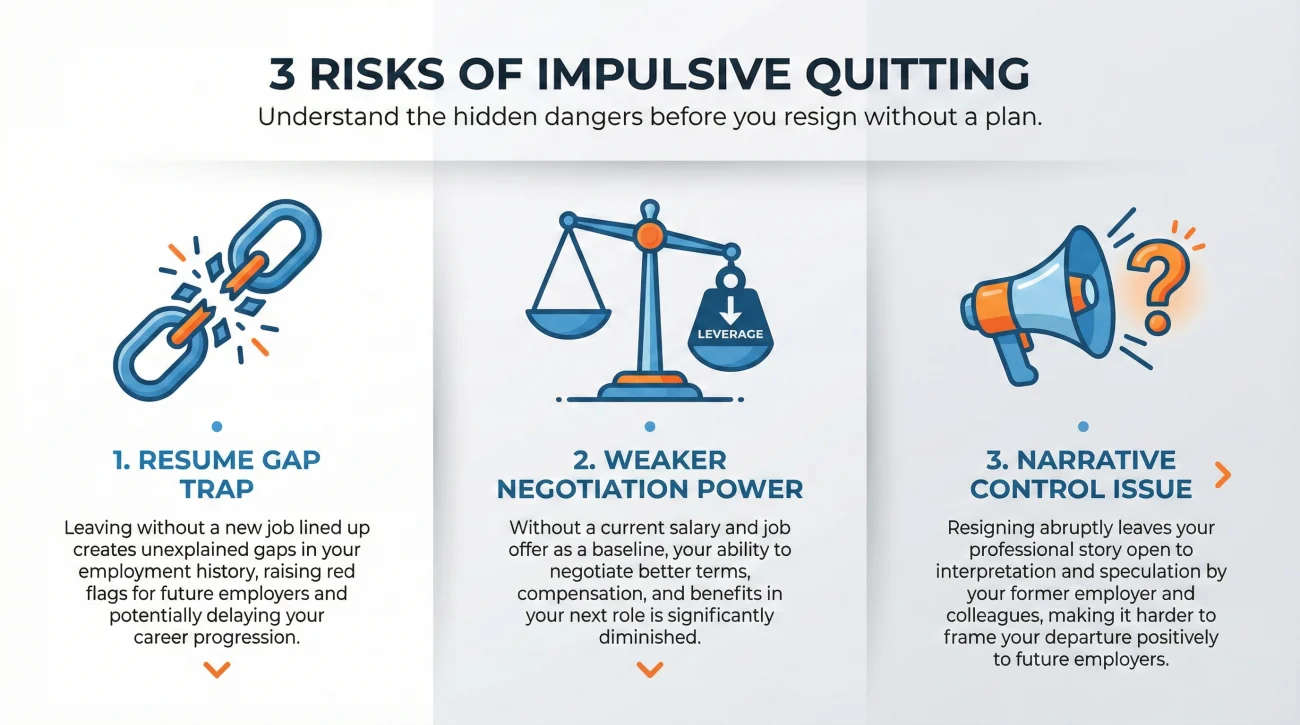
When the market is hot, you can rage-quit on a Friday and have three interviews by Tuesday. In the current climate, leaving on impulse carries specific risks that can damage your long-term career trajectory.
1. The Resume Gap Trap
In a slow market, hiring managers become more risk-averse. They scrutinize gaps more closely. If you resign without a destination, and your search stretches from two months to six, you lose leverage. You move from being a “passive candidate” (highly desirable) to an “unemployed candidate” (unfortunately, often viewed with more skepticism).
2. Weaker Negotiation Power
Salary offers in 2026 are stabilizing. The massive 20% to 30% jumps we saw a few years ago are becoming rare exceptions. If you are unemployed when you negotiate, companies know you have less leverage. They are more likely to offer the midpoint of the salary band rather than the top, knowing you need the role more than they need you.
3. The Narrative Control Issue
When you quit without a plan, you lose control of your story. “Why did you leave your last role?” is the hardest question to answer when the honest answer is “I was just tired of it.” In a tighter market, employers want resilience. They want to see that you run toward opportunities, not just away from problems.
⚠️ Warning: Be very careful about relying on verbal promises of job offers. In a cooling market, verbal offers get rescinded more frequently due to sudden budget freezes. Always wait for the signed offer letter before giving notice.
The “Smart Quitting” Framework
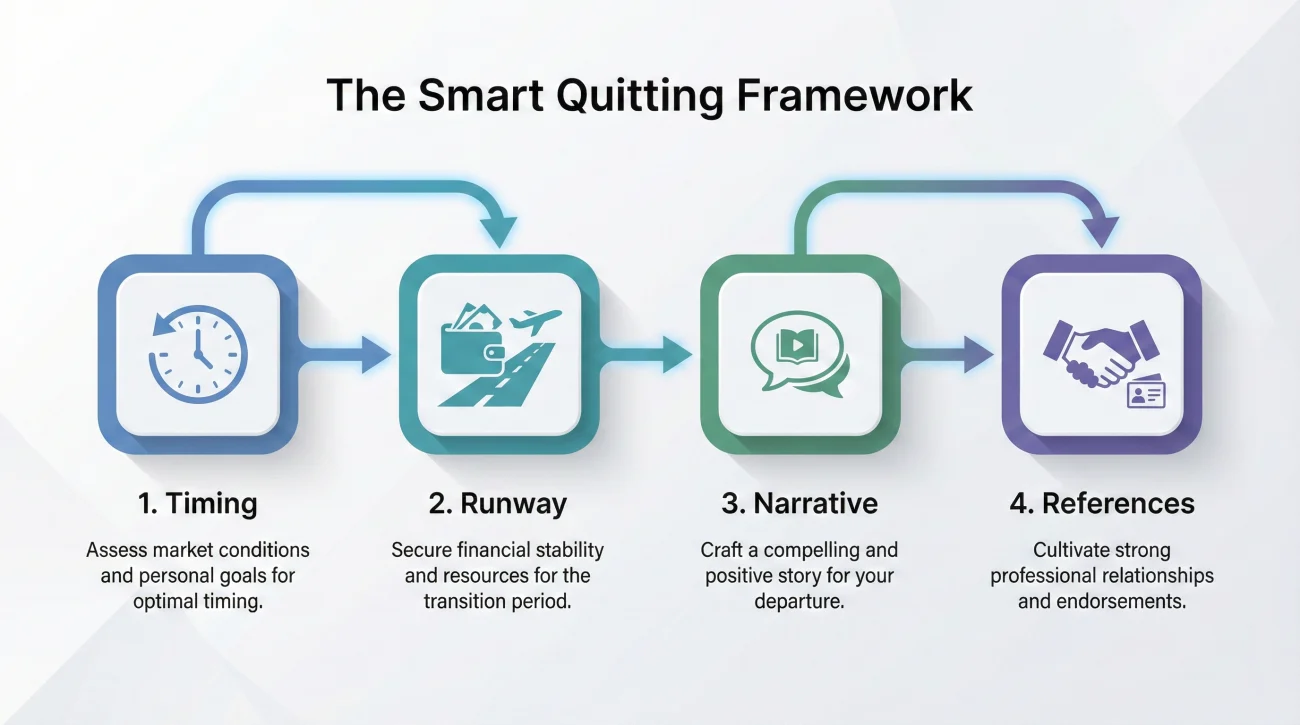
So, how do you leave a job safely in 2026? You move from an emotional reaction to a strategic operation. In my coaching practice, I guide professionals through four specific checkpoints before they are allowed to type “I resign.”
1. Timing: Does my exit align with the hiring cycles of my industry?
2. Runway: Do I have the resources to survive a search that takes 2x longer than expected?
3. Narrative: Is my reason for leaving professional, strictly factual, and forward-looking?
4. References: Have I secured my advocates before I burn the bridge?
1. Timing Your Exit
Timing is everything. In HR, we know that hiring budgets often reset in January and July, but freeze in November and December. Quitting in a cooling market during a hiring freeze is a tactical error.
Look at your specific industry data. Are your competitors posting roles? If you see a wave of layoffs in your sector, it might be wise to “shelter in place” for another quarter, using that time to upskill rather than jumping into a flooded candidate pool.
2. Validating Your Runway
This is where I ask you to be brutally honest with your spreadsheet. “Smart quitting” requires a financial buffer. In 2021, I might have said three months of savings was plenty. With openings down to 6.5 million and hiring processes dragging out with 5 or 6 interview rounds, I now recommend planning for a six-month search if you plan to resign without a new job lined up.
If you don’t have that runway, the “smart” move is to stay, perform the bare minimum required to remain in good standing, and dedicate your energy to the job hunt after hours. It is exhausting, yes, but it preserves your income stream.
3. Constructing Your Narrative
Your story matters. When you resign, you need a script that protects your reputation. In a tighter market, backchannel reference checks happen constantly. People talk.
The “Field Note” Reality: I recently worked with a candidate, let’s call him Mark, who quit his Director role abruptly because of a disagreement with leadership. He was talented, but he left with zero handover notes and a blast email. When the market tightened, he applied to a new firm. The hiring manager there knew Mark’s old boss. One phone call later, Mark’s application was archived. In a cooling market, your reputation is your most fragile asset.
Smart quitting means drafting a resignation letter that is boring, professional, and grateful, even if you are seething inside.
4. Securing References Early
Don’t wait until you are gone to ask for recommendations. Secure them while you are still in the building. Connect with colleagues on LinkedIn. Ask for endorsements. Make sure your peers (who might be your future referral sources) know you are leaving on good terms.
Scenario: When to Hold vs. When to Fold
To make this practical, let’s look at a realistic scenario comparing two employees facing the same market data.
Scenario A: The Impulsive Exit
Jordan is frustrated with a micromanaging boss. The team is understaffed. One Tuesday, after a bad meeting, Jordan resigns without a backup plan. Jordan assumes finding a new role will take a month.
Result: Three months later, Jordan is still interviewing. The market is slow. Desperation sets in, and Jordan accepts a role with a lower title and lower pay just to stop the bleeding.
Scenario B: The Smart Quit
Alex is on the same team, equally frustrated. Alex looks at the JOLTS data and realizes hiring is slowing. Alex decides to stay for four more months. During that time, Alex:
- Updates the resume with metrics from the current project.
- Reconnects with three former colleagues at other firms.
- Saves 20% of every paycheck to build a buffer.
- Secures a written offer from a competitor before submitting a resignation letter.
Finally, Alex leaves with confidence, a higher salary, and no gap in employment.
The difference wasn’t talent. It was patience and market awareness.
“I can’t take this anymore, I’m out.” (Focus on emotion)
“My runway is secure, my offer is signed, and my handover is ready.” (Focus on logistics)
The “Pre-Resignation” Document Sweep
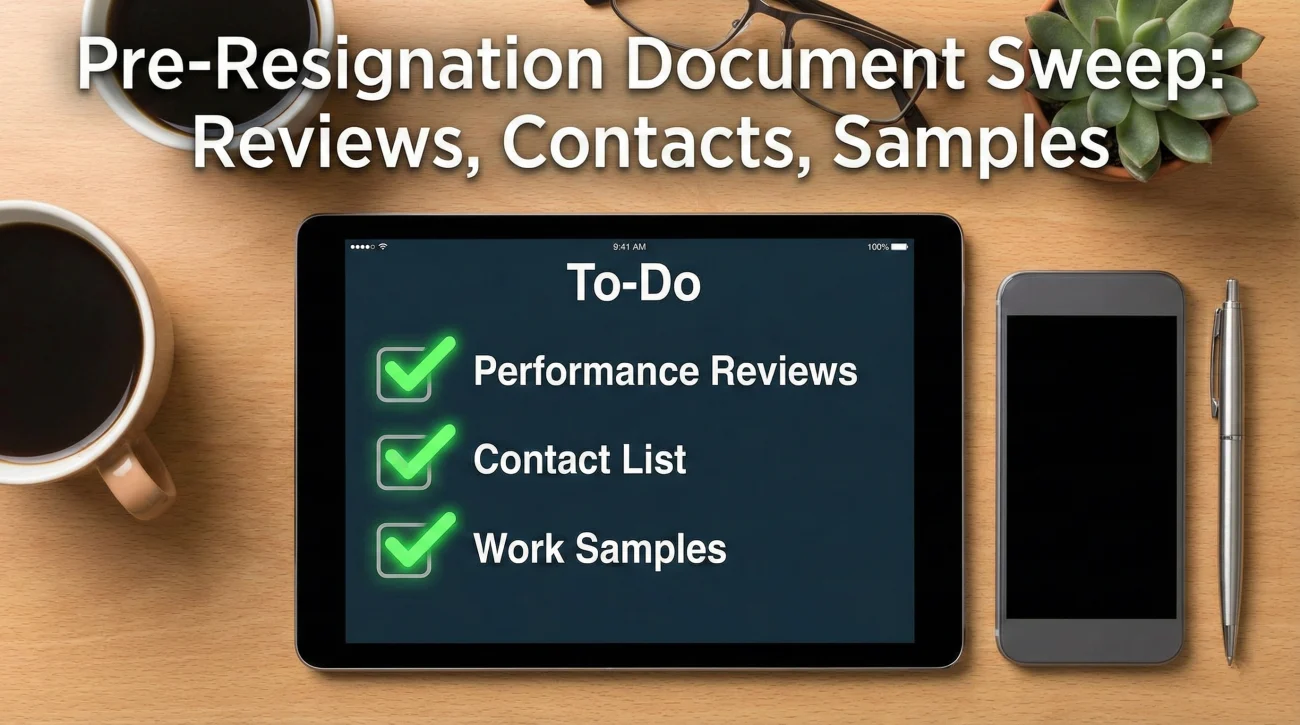
Before you give notice in this market, ensure you have your personal house in order. Once you resign, you may be walked out immediately (a common practice when companies are tightening security). Do not rely on having a “two-week notice period” to organize your files.
- ✅ Performance Reviews: Download copies of your past reviews and wins. You will need these for your resume.
- ✅ Contacts: Ensure you have personal contact info for the colleagues you want to keep in your network.
- ✅ Samples: If your contract allows, save non-proprietary examples of your work to your personal portfolio.
Final Thoughts
The job market of 2026 demands a different level of discipline. The days of jumping ship on a whim are behind us, at least for now. But looking at the numbers (6.5 million openings and a 2.0% quit rate) should not paralyze you.
People are still moving. Careers are still growing. The professionals who win in this environment are the ones who treat their resignation as a professional project, not an emotional release. Control your timing, protect your reputation, and ensure you have a firm place to land. That is how you resign smartly.
❓ FAQ
📉 Is it bad to quit a job without another one lined up in 2026?
It is significantly riskier now than in previous years. With job openings down and hiring timelines extending, a gap can easily stretch to several months. Unless you have a massive financial buffer or are facing a severe mental health crisis, it is generally safer to secure a new role before leaving.
💰 How much savings do I need before I resign?
In a cooling market, the standard advice of 3 months is often insufficient. Aim for 6 months of living expenses if possible. This gives you the freedom to reject low-ball offers and wait for the right opportunity.
📝 What if my company has a hiring freeze but I want to leave?
If your current company is freezing hiring, competitors might be too. Do thorough research. Sometimes, an internal transfer to a more stable department is a better short-term move than quitting entirely.
🗣️ How do I explain leaving a job during a downturn?
Focus on “pull” factors, not “push” factors. Do not say you left because you were worried or unhappy. Say you left because you were ready for a specific new challenge that the previous organization couldn’t offer. Confidence is key.
📅 When is the best time of year to quit in a slow market?
January and February often see a spike in new budget approvals. September and October can also be active. Avoid resigning in late November or December unless you have a signed offer, as hiring practically stops for the holidays.
Sources & Data Context
To ensure our advice is grounded in reality, this article utilizes labor market data available as of early 2026.
- Job Openings and Labor Turnover Survey (JOLTS): Specific figures regarding the drop to 6.542 million openings (the lowest since September 2020) and the 2.0% quit rate refer to the U.S. Bureau of Labor Statistics JOLTS Report data for December 2025.
- Market Analysis: Context regarding the cooling hiring climate and downward data revisions references reporting from financial news outlets, specifically Reuters.
⚠️ Legal Disclaimer: ResignSmartly provides general informational guidance about resignation, workplace communication, notice periods, handovers, and career transitions. Content does not constitute individualized legal advice. Employment laws, contracts, workplace policies, and individual circumstances vary, so review the requirements that apply to your situation and consult an appropriate qualified professional when needed.