
- Why It Matters: LinkedIn recommendations are social proof that de-risks you, recruiters trust what others say more than what you claim.
- Fastest Yes Lever: Use the reciprocity loop, write 3 to 5 strong recommendations first, then ask 2 days later with a personal note.
- Best Timing Windows: Ask right after a win, during a graceful notice period, or on a work anniversary when the ask feels natural.
- High-Quality Requests: Use tailored scripts for manager, peer, client, or old connection, and give a “silver platter” list of bullets they can mention.
- Quality Control: Offer a short draft they can edit, avoid default LinkedIn messages, mass blasts, vague asks, and always send a thank you after it posts.
For the broader post-resignation process, see our guide to resignation etiquette.
The Digital Currency of Trust: Why Your Profile Needs More Than a Resume
Imagine a recruiter lands on your LinkedIn profile. They scan your headline, skim your “About” section, and glance at your job titles. It all looks professional, standard, perhaps even impressive. But then they scroll down to the “Recommendations” section. If it is empty, or filled with two generic “Great guy!” comments from 2014, their enthusiasm cools. Why? Because in the digital age, we don’t trust what people say about themselves; we trust what others say about them.
This is the power of social proof. A strong linkedin recommendation request is not just an ego boost; it is a strategic asset that works for you while you sleep. It is the difference between a recruiter thinking “They claim they can lead teams” and “Here is proof from a former Director that they led a team of 15 through a crisis.”
Yet, most professionals freeze when it comes to asking. It feels awkward. It feels needy. We worry about bothering our network. This guide is designed to dismantle that fear. We are going to treat the process of asking for linkedin recommendation endorsements not as a favor, but as a professional project that cements relationships and builds your personal brand equity.
The Psychology of Social Proof: Why It Works

To understand why you need to prioritize this, we have to look at the psychology of hiring. Hiring is fundamentally a risk-management exercise. A hiring manager is constantly asking, “What if I get this wrong?”
Recommendations act as “Trust Signals” that de-risk you as a candidate. When a third party – especially someone with a reputable title – puts their name and face next to a statement about your competence, it creates a “Halo Effect.” If a respected VP says you are a strategic thinker, the recruiter is psychologically primed to believe it before they even interview you.
Furthermore, LinkedIn rewards signals of credibility and activity. While no single factor guarantees visibility, recent, specific recommendations can strengthen the cues recruiters notice when they land on your profile. By ignoring this section, you are leaving a powerful trust signal unused.
The “Reciprocity Loop”: The Easiest Way to Get a Yes
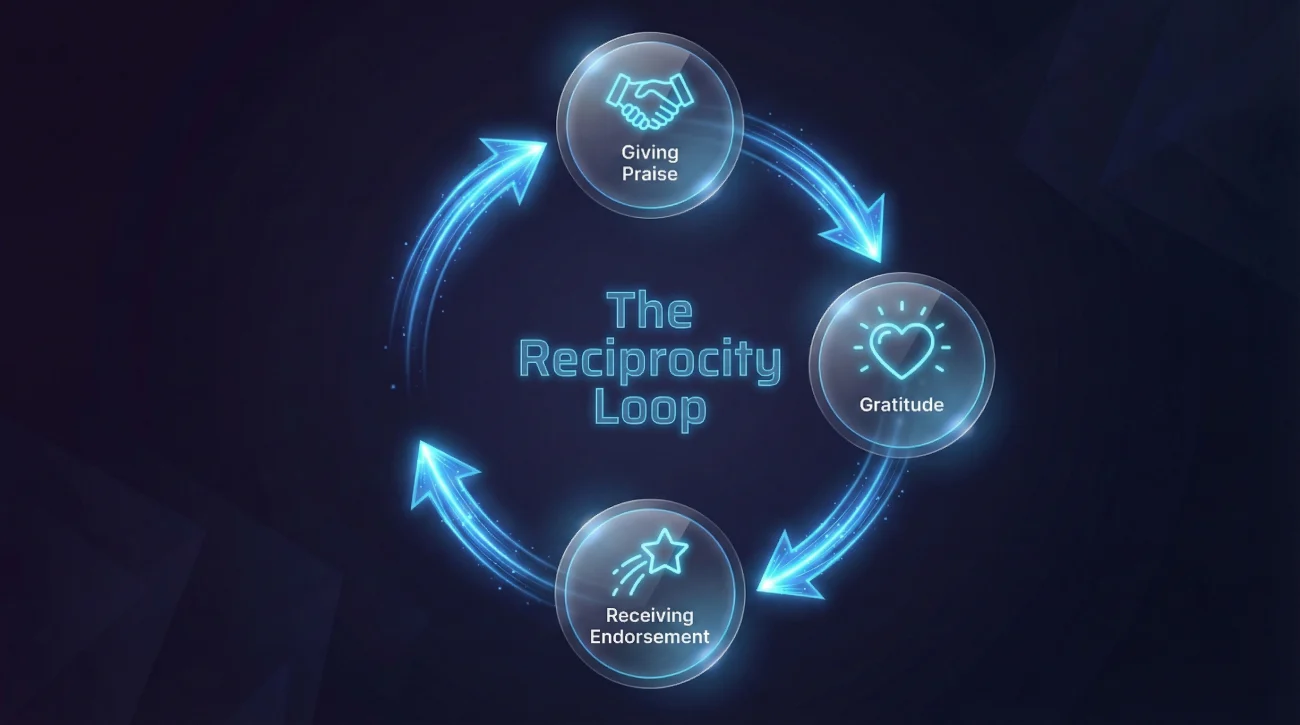
The single biggest mistake people make is sending a “cold” request. They hit the “Request Recommendation” button on LinkedIn, which sends a generic “Hi, would you write me a recommendation?” message. This is easy to ignore.
The smartest strategy is to leverage the psychological principle of Reciprocity.
The Strategy: Before you ever ask for a recommendation, give one. Pick 3-5 colleagues whose work you genuinely respect. Write them a thoughtful, specific, and glowing recommendation. Do not ask for anything in return. Just post it.
The Result: When they receive the notification that you have publicly praised them, they feel a surge of gratitude and a subconscious obligation to balance the scales. Two days later, when you send a message asking for linkedin recommendation reciprocation, they are already primed to say “Yes.” In fact, they are often eager to do it.
Strategic Timing: The “Golden Hours” of Asking
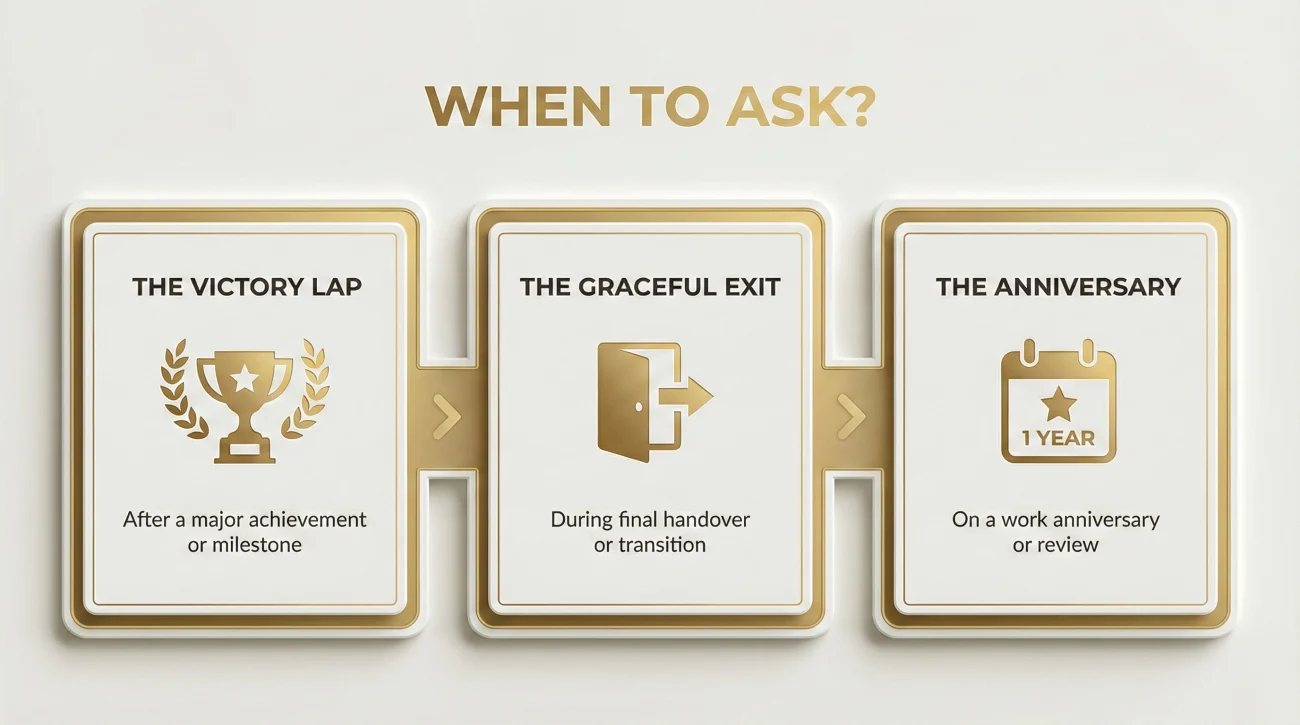
Timing isn’t everything, but it’s close. Asking at the wrong moment makes you look tone-deaf. Asking at the right moment makes the request feel natural.
- 🚀 The “Victory Lap”: The absolute best time to ask is immediately after you have successfully delivered a project. The emotions are high, the relief is palpable, and your value is undeniable. Strike while the iron is hot.
- 👋 The “Graceful Exit”: During your notice period (but after the initial resignation shock has worn off). Asking colleagues to memorialize your time together is a standard and respected part of the offboarding process.
- 🤝 The “Anniversary”: Work anniversaries are natural touchpoints. “Congrats on 5 years, Sarah! I was reflecting on our work together…” opens the door perfectly.
The Master Scripts: Copy, Paste, Customize
Never make the recommender do the heavy lifting. The following scripts are designed to guide them exactly where you want them to go, using the “Silver Platter” method we discussed in previous guides.
1. The “Current Manager” (The Exit Strategy)
Use this linkedin endorsement request email when you are leaving on good terms. It frames the request as a summary of your tenure.
Subject: Wrapping up & LinkedIn Request
Hi Sarah,
As I prepare to hand over my keys next week, I wanted to say again how much I’ve enjoyed working under your leadership. The [Project Name] we launched last year remains a career highlight for me.
I am currently updating my LinkedIn profile to reflect my time here, and I would be honored if you could write a brief recommendation. Given your direct oversight, your words carry a lot of weight.
To make it easy, perhaps you could touch on:
• My management of the remote sales team.
• The 20% growth we achieved in Q3.
• My ability to handle cross-functional conflict.
I know you are busy, so even 2-3 sentences would be amazing. I’m also happy to draft something for you to edit if that helps!
Best,
Marcus
2. The “Colleague” (The Reciprocity Play)
This request for recommendation sample is perfect for peers. It feels like a partnership rather than a favor.
Subject: LinkedIn Swap?
Hi Jennifer,
I was just updating my LinkedIn profile and realized I never publicly credited you for the incredible work you did on the Acme Crisis last month. I just wrote and posted a recommendation for you – hope it captures how crucial you were to that win!
If you have a moment, would you be open to writing one for me as well? I’d love it if you could mention my role in the technical implementation of that project. I think it would really help strengthen my profile for future tech-lead roles.
No pressure at all, but would appreciate it!
Thanks,
David
3. The “Client” (The High-Value Ask)
Client testimonials are gold dust. They prove you deliver value to the people paying the bills.
Subject: Our partnership / LinkedIn
Hi Michael,
It has been a pleasure working with you on the platform migration this year. I’m thrilled we got it live ahead of schedule.
I am looking to work with more clients in your industry, and I was wondering if you would be willing to share a brief testimonial on my LinkedIn? A short note about my responsiveness and problem-solving during the migration would be incredibly helpful for me to build trust with future partners.
I can send over a draft if that saves you time!
Warmly,
Alex
4. The “Old Connection” (The Reconnect)
If you haven’t spoken in a year, you need to warm it up first.
Subject: Thinking of you / Quick favor
Hi Rachel,
I saw the news about your promotion to VP – huge congratulations! Well-deserved.
I am currently refreshing my professional presence as I look for Director-level roles, and I realized I don’t have any recommendations from my time at [Previous Company]. Since we worked so closely on the Supply Chain overhaul, I’d love to have your endorsement.
Would you be open to writing a brief recommendation for me on LinkedIn? I’d be happy to refresh your memory on the specific metrics we hit (I saved the old report!).
Let me know if you’re open to it.
Best,
Alex
The “Ghostwriting” Technique: Ensuring Quality

Here is a hard truth: People are bad writers. If you leave it entirely up to them, you might get: “Marcus is a nice guy and works hard.” While kind, this is useless to a recruiter.
To get a high-impact recommendation, you must guide the pen. This is why offering a draft is not “cheating” – it is project management. When you offer to draft it, you ensure the recommendation includes specific keywords (e.g., “Python,” “Agile,” “Revenue Growth”) that search algorithms are looking for.
How to Offer the Draft:
“I know writing these things takes mental energy. To save you time, I’ve drafted a short blurb below based on our work together. Feel free to edit, cut, or rewrite entirely – I just wanted to give you a starting point!”
5 Ways to Ruin the Ask
Avoid these common pitfalls that turn a “Yes” into an “Ignore.”
- 🚫 1. The Default Message: Never use the standard LinkedIn message. It shows zero effort. If you don’t care enough to write a personal note, why should they care enough to write a recommendation?
- 🚫 2. The “Blast” Approach: Do not ask 20 people at once. If a recruiter sees 10 recommendations all dated “October 12th, 2023,” it looks staged and fake. Space them out.
- 🚫 3. Asking People You Barely Know: Social proof only works if the person has credibility. A recommendation from someone you met once at a conference looks suspicious. Stick to people who have managed you or worked alongside you.
- 🚫 4. Being Vague: “Write whatever you want” is a burden. “Please mention the Q3 Project” is a direction. Give them direction.
- 🚫 5. Forgetting to Say Thanks: Once they post it, send a thank you note. Better yet, send a handwritten card. It makes you memorable.
❓ FAQ: Troubleshooting Your Requests
⏰ How long should a LinkedIn recommendation be?
Short and punchy is best. 3-5 sentences is the sweet spot. Recruiters are skimming. They want to see: Context (how they know you), Impact (what you did), and Soft Skills (how you did it). A wall of text often gets skipped.
📧 What if they ignore my request?
It happens. People are busy. Follow up once after a week with a gentle nudge: “Just floating this to the top of your inbox!” If they still don’t reply, let it go. Do not become a nuisance. Move on to the next person on your list.
📝 Can I hide a recommendation if it’s bad?
Yes! LinkedIn allows you to “Ask for an edit” or simply hide the recommendation from your profile. You have full control. If someone writes something lukewarm or riddled with typos, you are not obligated to display it.
💼 Should I ask for recommendations if I was laid off?
Absolutely. Layoffs are often due to budget, not performance. Asking for recommendations immediately after a layoff helps you rebuild confidence and signals to the market that you left on good terms with your colleagues, despite the company’s decision.
🤝 Is it okay to trade recommendations?
Yes, but be transparent. “Quid pro quo” is common on LinkedIn. However, ensure the recommendation is honest. Don’t invent projects. Authenticity is key because savvy recruiters can smell a fake “you scratch my back, I scratch yours” arrangement if the praise is too generic.
Final Thoughts: Build Your Repository of Trust
Your LinkedIn profile is your 24/7 digital ambassador. While you are sleeping, it is selling your skills to the world. An empty recommendations section is a silent objection – it raises the question, “Did anyone enjoy working with this person?”
By proactively managing your linkedin recommendation request strategy, you are building a repository of trust. You are controlling the narrative of your career. It takes courage to ask, but the ROI (Return on Investment) is infinite. Every recommendation is a permanent asset that will help you land jobs five, ten, even fifteen years from now.
So, open a new tab. Pick three people. Draft that email. And start building the social proof that your career deserves.
⚠️ Legal Disclaimer: ResignSmartly provides general informational guidance about resignation, workplace communication, notice periods, handovers, and career transitions. Content does not constitute individualized legal advice. Employment laws, contracts, workplace policies, and individual circumstances vary, so review the requirements that apply to your situation and consult an appropriate qualified professional when needed.