- Core reality: Leaving a family business is changing a relationship pattern, not just quitting a job.
- Stable why: Use a reason that does not invite debate, then keep the conversation future-focused instead of turning it into a trial.
- Exit style: Choose one clear lane, clean break, phased exit, or advisory only, so “I’ll help whenever” does not trap you.
- Conversation plan: Speak privately to the decision-maker first, stay calm and firm, then widen the message after the basics are aligned.
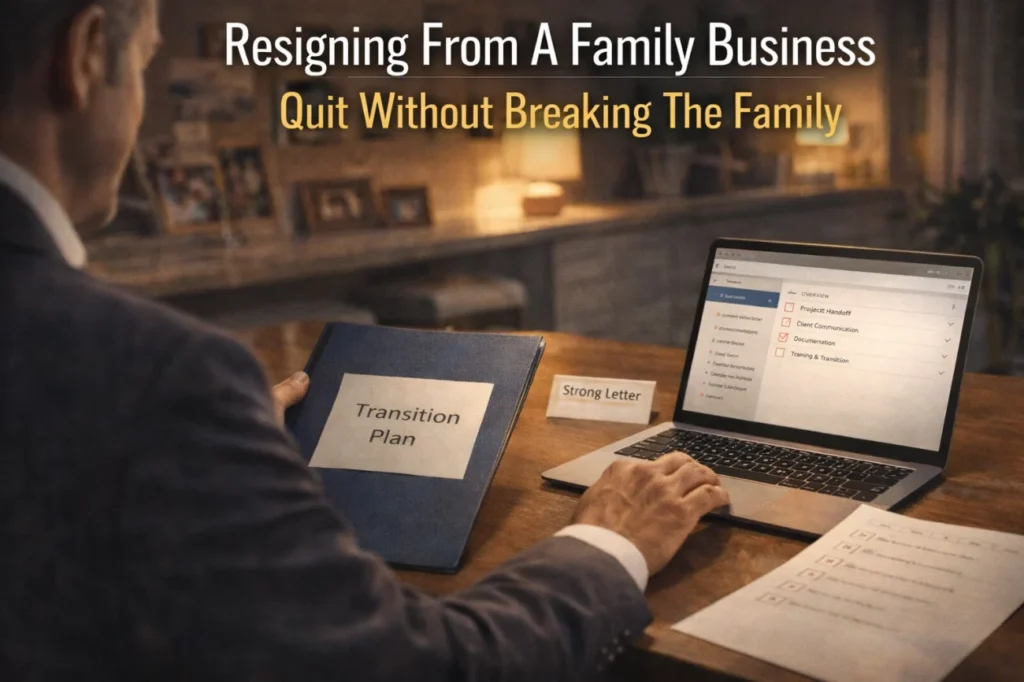
- Transition and boundaries: Separate love from labor with a real handover plan, clear owners, clear last day, and no endless “one more thing” work.
This Isn’t Just a Job. It’s a Family Role You’re Trying to Put Down.
Leaving family business doesn’t feel like resigning. It feels like disappointing someone who taught you how to work, how to survive, and how to show up when it’s inconvenient. In a normal company, you can quit and let the org chart absorb the shock. In a family company, the org chart is attached to dinner.
That’s why the goal isn’t “quit fast.” The goal is “quit clean.” You’re not just ending a work arrangement. You’re changing a relationship pattern. If you do it with clarity and a real transition plan, you can leave the job without leaving the family.
Why Leaving Hits Different in a Family Business
In a family business, gratitude and obligation often get tangled together. People don’t just evaluate your performance; they evaluate your loyalty. Your role might have been “the reliable one,” “the responsible one,” or “the one who doesn’t say no.” When you resign, you’re not only changing your schedule – you’re changing the story people tell themselves about you.
That’s why you need a plan that addresses both parts at once: the operational reality (who will do the work) and the emotional reality (what they believe your exit means).
Before You Say Anything: Get Clear on Your “Why” Without Turning It Into a Trial

You don’t need a dramatic reason. You need a stable reason. A stable reason is one that doesn’t invite debate. “I’m ungrateful” invites debate. “I need to build my own path” is harder to argue with. So is “I want a different career direction” or “I’m not the right long-term fit for this role.”
If you’re leaving the family company because you feel stuck, underpaid, or emotionally trapped, you can still keep the conversation clean. You are not required to litigate every grievance to justify your exit. The more you argue the past, the less energy you have to design a workable transition.
Pick Your Exit Style: Clean Break, Phased Exit, or Advisory Support
Most family exits fail because they stay vague. “I’ll help whenever” turns into “you never really left.” So choose an exit style before the talk. Then you can offer something concrete instead of emotionally negotiating on the fly.

Option 1: Clean break
Best when the family dynamic is unhealthy, boundaries aren’t respected, or the business keeps pulling you back in. It’s also best when you need psychological distance to grow.
Option 2: Phased transition
Best when the business genuinely needs time to replace you, and you trust they’ll honor the timeline. This can look like 30–90 days of handover with a clear end date.
Option 3: Advisory support only
Best when your knowledge is valuable but you cannot remain “on staff.” Advisory support must be limited: scheduled calls, defined topics, and no “emergency” work.
How to Have the Conversation Without Burning the Relationship

The conversation should be private, calm, and planned. Not after a fight. Not during a busy week. Not as a surprise announcement in front of other family members. If possible, talk to the decision-maker first (often a parent), then do the wider family conversation after.
If your situation is “quitting dad’s business,” the hardest part is usually tone. A defensive tone triggers a defensive response. A steady tone reduces the drama. You can be firm without being cold.
“I’ve thought about this carefully. I’m going to step away from the business. This isn’t a reaction to one bad day. It’s a long-term decision about my career direction. I want to do this respectfully, and I’m bringing a transition plan so the business isn’t left scrambling.”
The Boundary That Saves You: Separate Love From Labor

The biggest trap is emotional bargaining disguised as business urgency. “We need you” can quietly mean “we don’t want you to become independent.” You can love your family and still say no to the role. The boundary is not cruelty. It’s clarity.
Here’s the clean framing: you are stepping away from the job, not stepping away from the relationship. Say that directly. Then reinforce it with behavior: clear timeline, clear handover, and no infinite “just this one thing” after you leave.
This is the core of a real family business exit strategy: your plan must be operationally helpful and emotionally consistent.
Build a Transition Plan They Can’t Easily Attack
A good transition plan does two things at once: it lowers the business risk and lowers the emotional temperature. When people see you’re not leaving them to clean up a mess, they argue less. They might still be upset, but it becomes harder to label you as irresponsible.
| Transition Item | What You Deliver | Why It Matters |
|---|---|---|
| Role map | List of your weekly responsibilities | Stops “we didn’t know you did that” surprises |
| Key contacts | Vendors, clients, accountants, tools (where to find them) | Prevents access chaos after you leave |
| Handover sessions | 1–3 walkthrough meetings with notes | Transfers knowledge, reduces panic |
| Replacement plan | Options: hire, train, outsource, redistribute | Gives them choices, not just loss |
| End date | A specific last day and what happens after | Creates real closure and boundaries |
Copy-Paste Scripts That Keep the Message Calm
The key is to keep it short, steady, and future-focused. You’re not asking permission. You’re informing them with respect and offering a plan.
Script 1: The first conversation
“I want to talk about something important. I’ve decided I’m going to step away from the business. I’m grateful for what I’ve learned here, and I’m not saying this lightly. I also don’t want the business to be put in a bad position, so I’m proposing a transition timeline and a handover plan.”
Script 2: If they accuse you of being ungrateful
“I hear you. I’m grateful for everything you’ve done. Gratitude doesn’t change the fact that this role isn’t right for my long-term path. I want to handle this responsibly and protect our relationship while we make the transition work.”
Script 3: The boundary line (no endless help after you exit)
“After my last day, I won’t be able to keep doing ongoing work. If we want an advisory setup, we can define a limited schedule for questions, but I can’t remain the default person the business depends on.”
Script 4: The wider family message
“I want to share that I’m stepping away from the business. My last day will be [date]. I’m grateful for the opportunity and I’m focused on a smooth transition. This decision is about my career direction, not about rejecting the family.”
The Mistakes That Turn a Resignation Into a Family War
You don’t need to be perfect. You just need to avoid the classic failure modes that create lasting resentment.
- Announcing it in a public family setting (it turns into a performance and people take sides).
- Arguing every historical grievance (you turn the exit into a courtroom).
- Offering unlimited help “whenever you need” (you never actually leave).
- Leaving without a timeline (they feel abandoned and panic escalates).
- Mixing business conflict with personal insults (damage that doesn’t heal).
Checklist: How to Tell Family You’re Leaving Without Chaos
If you want the “cleanest” version of this, run this checklist before you speak. It turns emotion into structure, which is exactly what a tense family system needs.
| Checklist Item | What You Decide | Why It Helps |
|---|---|---|
| Your exit style | Clean break, phased exit, or advisory support | Prevents vague promises |
| Your “stable why” | Career direction sentence that doesn’t invite debate | Reduces emotional arguments |
| Timeline | Last day + what happens after | Creates closure |
| Handover plan | Responsibilities, contacts, and sessions | Reduces operational fear |
| Boundary script | How you will say “no” later | Protects you from being pulled back |
You Can Leave the Role and Still Keep the Relationship
The cleanest exits are the ones where your behavior matches your words: calm, respectful, and structured. If you’re resigning from family business, your job is not to convince everyone to like the decision. Your job is to make the transition real and the boundary stable.
Leaving family business can feel like betrayal when the family has fused love with labor. But it can also be the start of a healthier relationship – one where you’re family because you’re family, not because you’re on payroll.
❓ FAQ
✅ How do I resign from a family business without destroying relationships?
Keep the message steady, pick a private setting, and bring a transition plan. Separate love from labor: “I’m stepping away from the role, not from the family.” Then reinforce it with a clear last day and boundaries.
📅 Should I give more notice when I’m leaving the family company?
Often, yes – if it’s safe and your boundaries will be respected. A phased transition can reduce panic. But don’t give “infinite notice.” Choose a specific timeline so you don’t get trapped in permanent handover mode.
💬 What do I say if my family calls me ungrateful?
Acknowledge feelings without negotiating the decision: “I’m grateful, and I hear you. This decision is about my long-term path. I’m still committed to a smooth transition and keeping our relationship strong.”
🧾 How do I avoid being pulled back in after I quit?
Don’t offer unlimited help. If you want to support, define a limited advisory setup with scheduled times. Otherwise, make your boundary simple: after the last day, you’re not available for ongoing work.
🔒 Who should I tell first when I’m leaving my family business?
Tell the primary decision-maker first (often a parent or founder), privately. Then align on timing before telling other family members or employees. A controlled sequence prevents embarrassment and public conflict.
⚠️ Legal Disclaimer: The resignation templates, email samples, and professional guidance provided in this guide are for informational purposes only and do not constitute legal advice. Employment laws and contract requirements vary by jurisdiction and individual circumstances. Please review your employment agreement and consult your HR department and/or a qualified attorney to ensure compliance with applicable laws and policies.