
- Meaning: Emotional detachment is not “not caring”, it is stopping the emotional bleeding while still doing your job.
- Why now: The weeks before you quit are where reputations collapse, and detachment keeps your output steady and your tone neutral.
- Healthy vs sabotage: Healthy detachment keeps clear communication and documentation, sabotage looks like disappearing and missing responsibilities.
- How to do it: Identify emotional hooks, shrink your scope to what you control, set one real boundary, and respond to facts not vibes.
- Templates: Use one message to reset priorities without revealing you are leaving, then a neutral resignation email that focuses on dates and handover.
Emotional Detachment Isn’t “Not Caring”, It’s “Not Bleeding”
If you’re googling emotional detachment work, you’re probably not trying to become a cold person. You’re trying to stop paying an emotional tax every single day. The kind where you replay conversations, overthink every Slack message, and carry the job home like it’s a second backpack you never agreed to wear.
Here’s the uncomfortable truth: detaching before you quit is often the cleanest way to protect your next move. Not because you want to punish your employer, but because you want to exit with your health intact and your reputation still usable.
This guide shows you how to detach in a professional way: reduce emotional hooks, tighten boundaries, stop over-investing in outcomes you can’t control, and still deliver your work without “quiet sabotage.”
Why Detaching Before You Quit Is a Smart Career Move
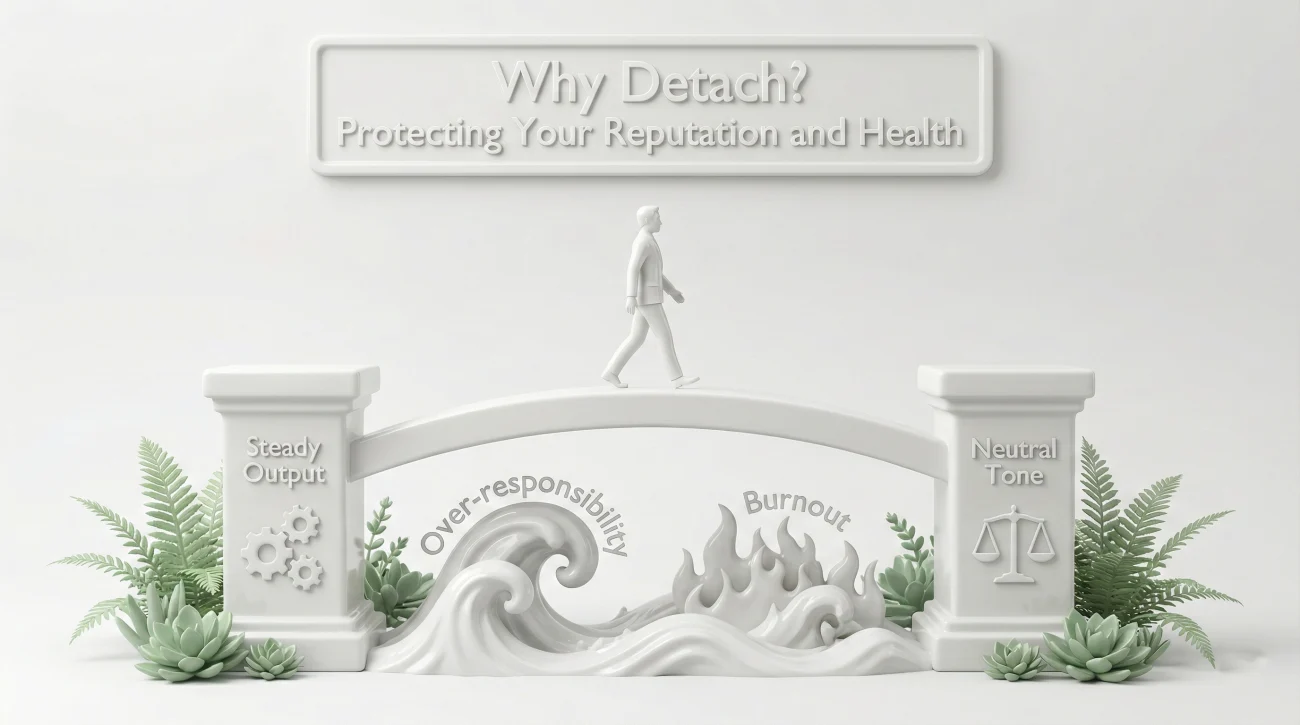
A lot of people assume detachment happens after resignation, like a switch flips. In reality, most damage happens in the weeks before you leave, when you’re mentally done but still physically present. That limbo is where you either protect yourself, or you burn everything down by accident.
Detachment prevents the “last month reputation collapse”
When you’re emotionally fused to the job, every problem feels personal. When you finally decide to leave, that emotional intensity doesn’t vanish; it often turns into irritability, avoidance, and messy communication. Detachment helps you keep your output steady and your tone neutral, which is exactly what people remember.
Detachment is not quitting, it’s controlling the cost of staying
If you’re still employed, you’re still in a contract: you deliver work, they deliver pay. Emotional detachment is simply reducing unpaid labor. That includes over-responsibility, constant worry, and the need to “prove” yourself to people who were never going to be satisfied.
What Emotional Detachment Looks Like When It’s Done Right
Healthy detachment is a mindset shift: you stop treating every task as a referendum on your worth. You still do the job, but you stop donating your nervous system to it. The difference matters, because “detachment” can also be misused as an excuse to disengage.
| Healthy detachment | Career sabotage |
|---|---|
| You do your work, but stop obsessing over approval | You ignore responsibilities and dare people to react |
| You communicate clearly and document decisions | You disappear, miss messages, and create confusion |
| You set boundaries and manage expectations | You weaponize “boundaries” as hostility |
| You accept what you can’t control | You stop caring about outcomes that still impact others |
Detachment done well makes you boring in the best way: predictable, calm, and hard to blame. That’s exactly what you want right before an exit.
Emotional Detachment Techniques That Don’t Damage Your Performance

You don’t detach by repeating “I don’t care” like a mantra. You detach by removing the triggers that keep pulling you into over-caring. The steps below are designed to be practical, especially if you’re stuck in a quiet quitting mindset but still want to leave clean.
1) Identify your emotional “hooks” (the real source of the drain)
Most people think work drains them because tasks are hard. Usually, the drain comes from invisible hooks: needing approval, fear of being disliked, fear of being seen as replaceable, or the belief that “if I don’t fix it, everything collapses.”
Write down the top three moments you spiral in a week. Then name the hook underneath. When the hook is named, it becomes a pattern, not a personality flaw.
2) Shrink your scope to what you control
Detachment starts when you stop trying to control outcomes that belong to other people. Your scope is your deliverables, your communication, your documentation, and your professionalism. Their scope is leadership, resourcing, and decisions they refuse to make.
A simple phrase helps: “I can influence this, but I can’t own it.” That one sentence is a quiet form of self-respect.
3) Build real work life boundaries (not motivational boundaries)
Boundaries aren’t ideas, they’re behaviors. If you say you won’t answer messages after hours but keep replying, your boundary is fictional. Start with one boundary you can keep without drama: a response window, a meeting limit, or protected focus blocks.
The fastest boundary that works for most roles is time-boxing: “I will work on this until 4:30, then I will send an update.” You’re not refusing work. You’re refusing endless work.
4) Stop processing every message like it’s a threat
If your brain treats Slack like a danger signal, detachment will feel impossible. One of the simplest emotional detachment techniques is changing how you consume communication: batch notifications, read messages twice (once for facts, once for tone), and respond only to facts.
When someone sends a vague or sharp message, don’t match their mood. Ask for specifics. Clarity is the professional version of emotional armor.
5) Replace “I must care more” with “I must care smarter”
People often try to stop caring about work by shutting down completely. That usually backfires. A better shift is caring smarter: you care about execution, not politics; facts, not vibes; your standards, not their moods.
You’re not becoming indifferent. You’re becoming selective, which is what adults do when something costs too much.
How to Detach and Still Look Like a Professional
If you plan to resign soon, your goal is to keep your final weeks “unremarkable.” Not because you’re hiding, but because you’re protecting your exit. The easiest way to do that is to standardize your behavior: predictable updates, documented decisions, and calm delivery.

Use documentation as your emotional shield
When you document status and decisions, you stop needing emotional arguments. You don’t have to fight for recognition or fairness in real-time, because the record speaks for you. Detachment gets easier when you don’t have to “win” conversations to feel safe.
Keep your output steady, not heroic
Detachment doesn’t require perfection. It requires consistency. Pick a baseline you can maintain without burning out, then hit it reliably. People forgive “not a superstar month.” They don’t forgive chaos.
Avoid the two last-week mistakes that ruin exits
- Becoming passive-aggressive because you feel unseen.
- Disappearing because you feel guilty and overwhelmed.
Detachment is the middle path: calm, present, and emotionally uninvested in the outcome.
Two Templates: One to Reduce the Emotional Load, One to Exit Cleanly
These templates are built for a controlled, professional tone. Use them to stabilize your last stretch at work and to resign without oversharing. If you want a broader checklist for leaving gracefully, keep this open as your reference: this etiquette checklist.
Template 1: Reset expectations without revealing you’re about to quit
Subject: Aligning on priorities for the next two weeks
Hi [Manager Name],
I want to align on priorities and workload so I can deliver reliably over the next two weeks. Right now, I’m balancing [Project A], [Project B], and [Project C], and I want to confirm what should take precedence.
My proposal is:
(1) focus on [highest priority] as the primary deliverable,
(2) set clear deadlines for [secondary items],
and (3) pause or deprioritize [lowest priority] unless you prefer a different tradeoff.
If you agree, I’ll send a brief weekly status update every [day] so you have visibility.
Thanks,
[Your Name]
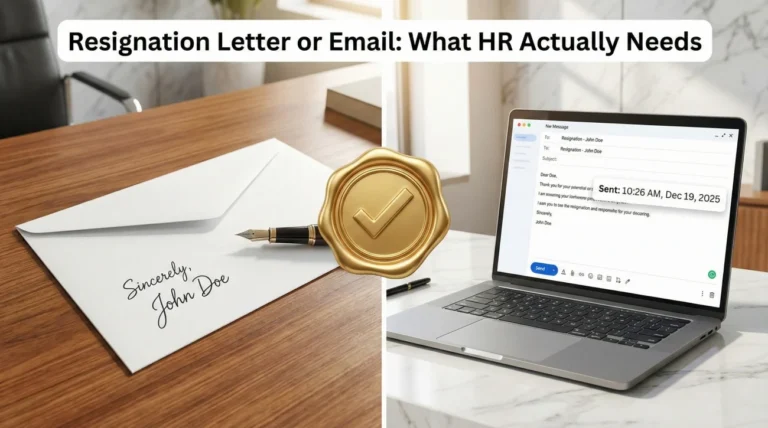
If you’re ready for the actual resignation email, follow a clean structure so you don’t accidentally turn it into a diary entry:
this email-writing guide.
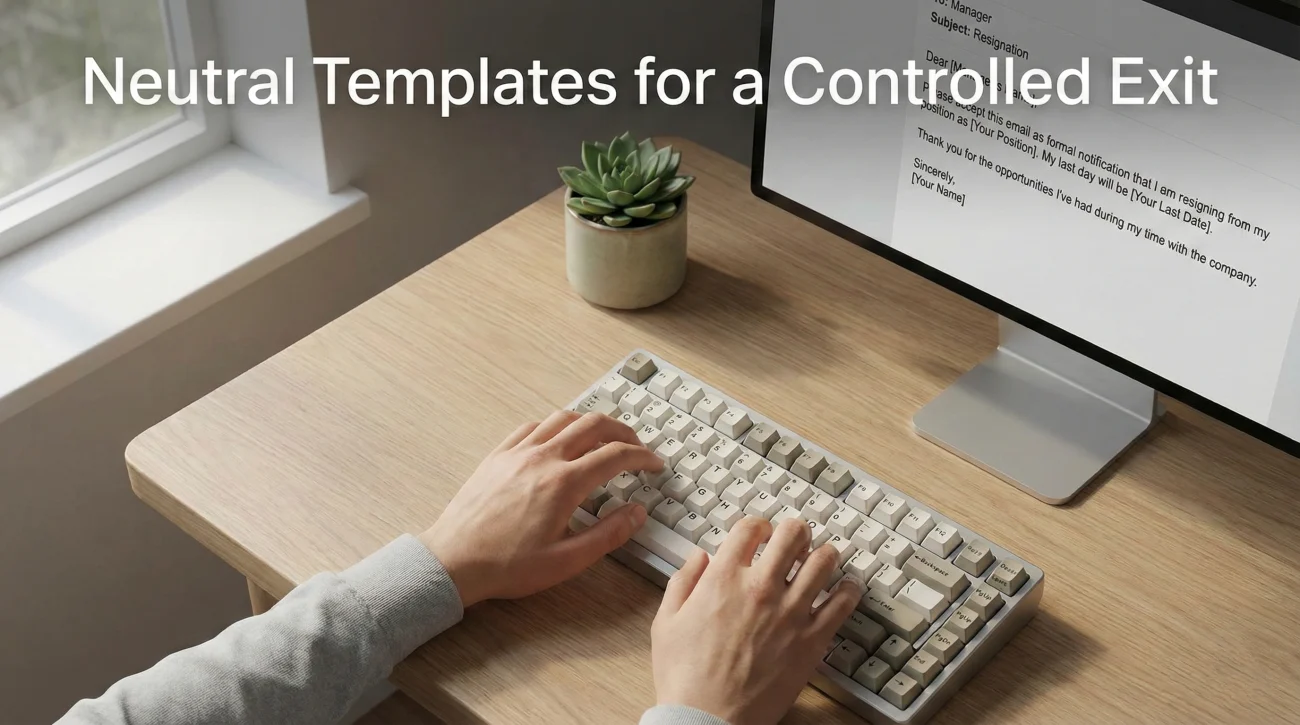
Template 2: Resignation email with neutral wording (no emotional spill)
Subject: Resignation
Hi [Manager Name],
Please accept this email as formal notice of my resignation. My last working day will be [date], in accordance with my notice period.
I appreciate the opportunity to work with the team. Between now and my last day, I will document my current responsibilities, provide status notes on active work, and support a smooth handover.
Thank you,
[Your Name]
Final Thoughts: Detach First, Then Leave Like a Professional
Emotional detachment isn’t about becoming colder. It’s about becoming safer. When you detach, you stop donating your attention to every mood shift, every vague comment, and every unnecessary urgency.
If you do it well, you leave your job with stable output, clean communication, and a reputation that still works for you. That’s the real win: emotional detachment work that protects your next chapter without turning your current one into chaos.
❓ FAQ
🧠 Is emotionally detaching from work the same as quiet quitting?
Not necessarily. Emotional detachment is about reducing emotional over-investment, while still doing your job professionally. Quiet quitting often implies doing the bare minimum; healthy detachment can still include solid, consistent delivery.
⚖️ Won’t detaching make me perform worse?
Done correctly, detachment usually improves performance because you stop wasting energy on anxiety and approval-seeking. The key is to detach emotionally while keeping your deliverables and communication consistent.
📩 What if my manager notices I “care less” and pressures me?
Use clarity and documentation. Ask for priorities, confirm deadlines in writing, and provide short status updates. Most pressure loses power when you operate in facts and timelines instead of emotions.
🧱 What boundary should I start with if I’ve never had boundaries?
Start with one boundary you can keep without drama: a response window, a daily cutoff time, or a weekly priority check-in. The best boundary is the one you can maintain consistently.
🚪 Is it okay to detach if I’m planning to resign soon?
Yes. Detaching can help you exit cleanly. The goal is not to punish anyone; it’s to protect your energy and avoid a messy final stretch that damages references or your professional reputation.
⚠️ Legal Disclaimer: The resignation templates, email samples, and professional guidance provided in this guide are for informational purposes only and do not constitute legal advice. Employment laws and contract requirements vary by jurisdiction and individual circumstances. Please review your employment agreement and consult your HR department and/or a qualified attorney to ensure compliance with applicable laws and policies.