
- What happens: Your 401(k) stays yours after you quit, but you stop contributing and plan rules can change what you can do.
- Four options: Leave it, Roll into a new employer plan, Roll into an IRA, Cash out only for true emergencies.
- Main trap: Choose a direct rollover to avoid withholding, deadlines, and accidental taxes that come with indirect rollovers.
- 30-minute plan: Gather plan basics, pick a destination, request the direct rollover, handle Roth or after-tax buckets correctly, save proof.
- Big pitfalls: Do not ignore 401(k) loans, small-balance forced moves, or cash-out penalties, and avoid common mistakes like scattered accounts and missing confirmations.
Your 401(k) Doesn’t “Disappear” When You Quit, But You Can Still Mess It Up Fast
When you resign, your brain focuses on the obvious stuff: your last day, the handover, the goodbye email, the laptop return. Meanwhile, your 401(k) just sits there quietly. And that’s exactly why people accidentally cash it out, miss a deadline, or pay taxes they didn’t need to pay.
This 401k rollover guide is designed to be practical, not preachy. You’ll learn what happens to your 401(k) when you quit, the four options you actually have, the traps that cost people money, and a simple 30-minute plan to keep your retirement savings working.
If you’re still planning your exit, keep your resignation itself clean too: resignation etiquette.
Quick Disclaimer Before We Start
This article is for general educational purposes only and is not tax, legal, or financial advice. Rules can vary based on your plan, your state, and your personal situation. When in doubt, confirm details with your plan administrator and a qualified tax professional.
What Happens to Your 401(k) When You Quit?
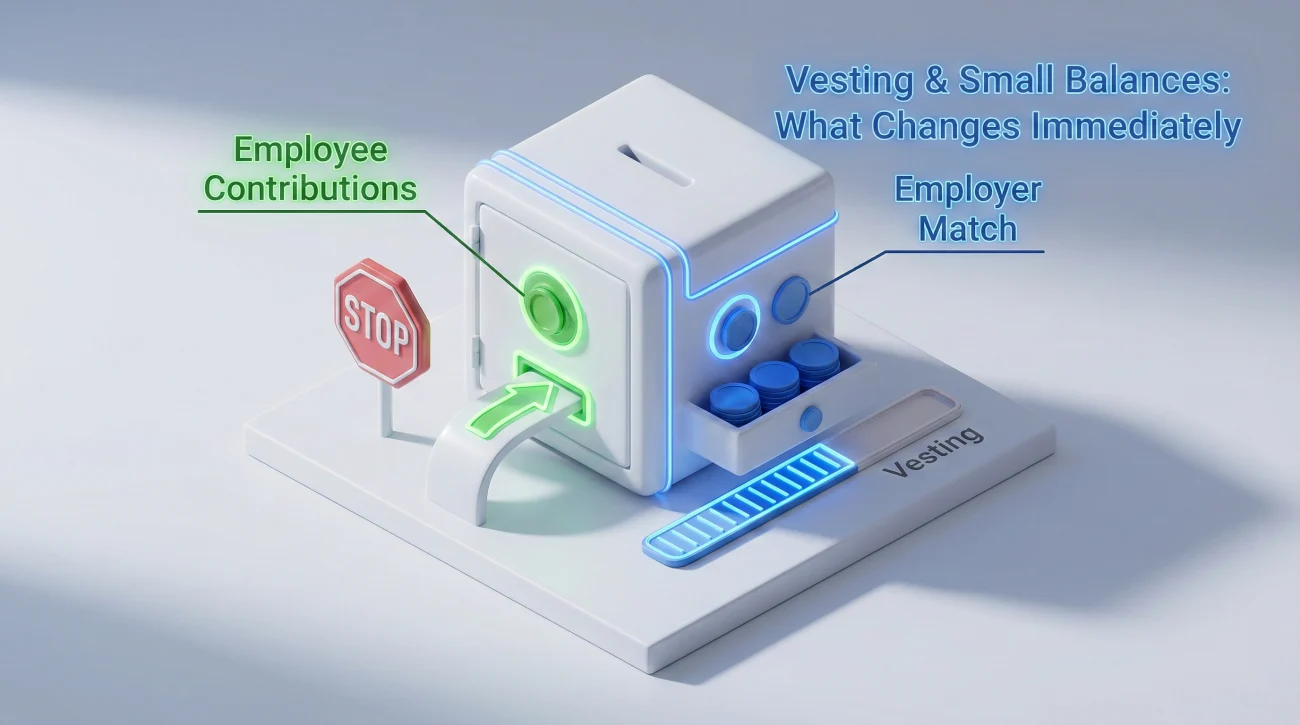
Your account typically stays in the employer’s retirement plan unless you move it. You still own your money. You can still invest it inside the plan (depending on plan rules). What changes is your relationship with the plan: you stop contributing, you stop receiving employer matches, and you may have fewer options than an active employee.
Two details matter immediately:
- Vesting: You always keep your employee contributions, but employer contributions may be partially vested depending on your plan.
- Small balances: Some plans can force a distribution or automatic rollover when balances are small, which can trigger paperwork you don’t want to ignore.
Your 4 Options: Leave It, Roll It, Move It, or Cash It Out
Most people only hear “roll it over.” In reality, you have four standard paths. The best choice depends on fees, investment options, your next job timeline, and whether you want simplicity.
| Option | Best for | Main upside | Main downside |
|---|---|---|---|
| 1) Leave it in your old employer’s plan | You like the plan’s funds/fees, or you want to decide later | No immediate paperwork | Easy to forget; fewer features; you can’t contribute |
| 2) Roll over to your new employer’s 401(k) | You want one workplace retirement account | Consolidation; simple long-term management | New plan might have worse fees or limited investment choices |
| 3) Roll over to an IRA | You want more investment control and consolidation outside employers | Often more flexibility | Requires choosing a provider and managing it yourself |
| 4) Cash out | Only true emergencies | Immediate cash | Taxes, possible penalties, and long-term compounding loss |
For most people, the biggest “do not accidentally do this” move is cashing out. If you’re tempted, pause and treat it as a last-resort decision, not an automatic checkbox.
The Trap That Costs People Money: Direct Rollover vs. Indirect Rollover
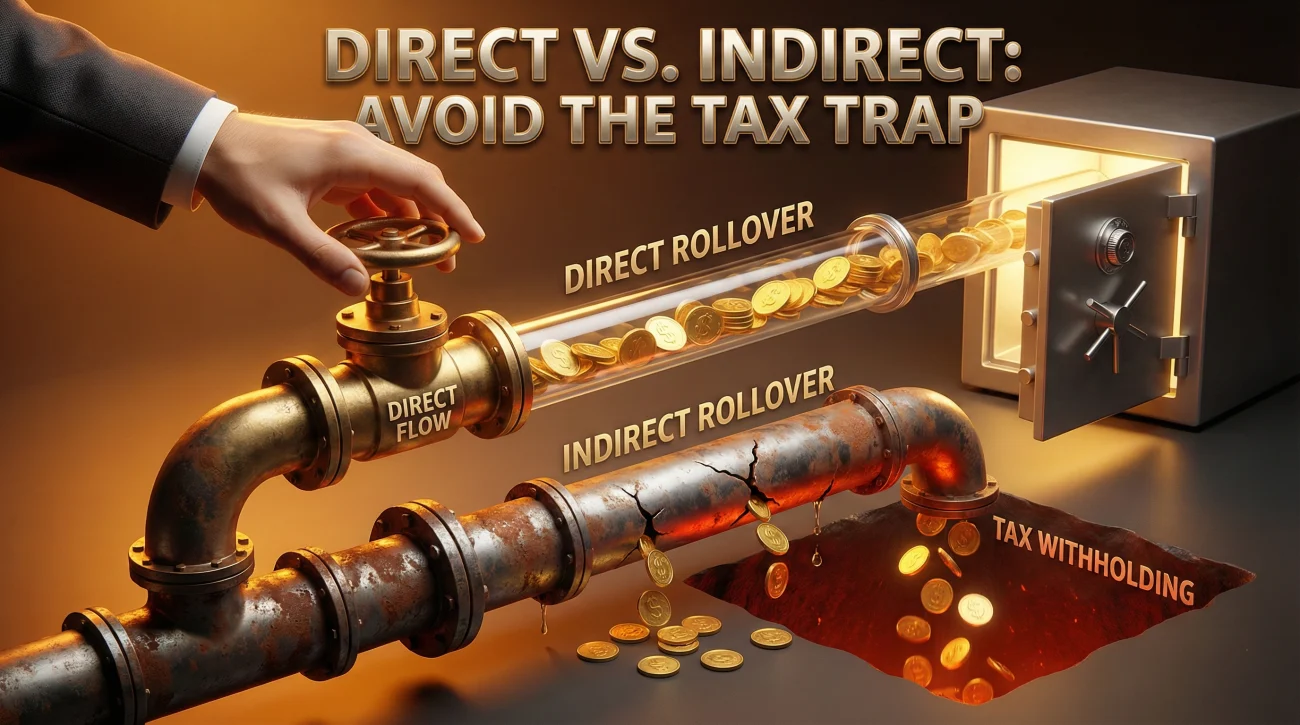
When you move retirement money, the cleanest route is usually a direct rollover: the plan sends the money directly to the new plan or IRA custodian. That’s the “do it once, no drama” option.
The risky route is an indirect rollover: the plan sends the money to you first, and you have to deposit it into a new retirement account within a deadline. This is where the famous problems happen.
Why indirect rollovers backfire
- If money is paid to you, the plan may withhold part of it for taxes.
- You may have a limited window to redeposit it into a qualified account.
- To roll over the full amount, you may need to replace withheld taxes out-of-pocket, then wait to recover that money at tax time.
The clean rule: if you’re doing a rollover, request it as a direct rollover whenever possible.
It’s the simplest way to avoid accidental taxes and penalties.
Do This in 30 Minutes: The Clean 401(k) Move Checklist
You don’t need a weekend. You need one focused session. Here’s a simple plan that prevents 90% of “I didn’t realize…” mistakes.
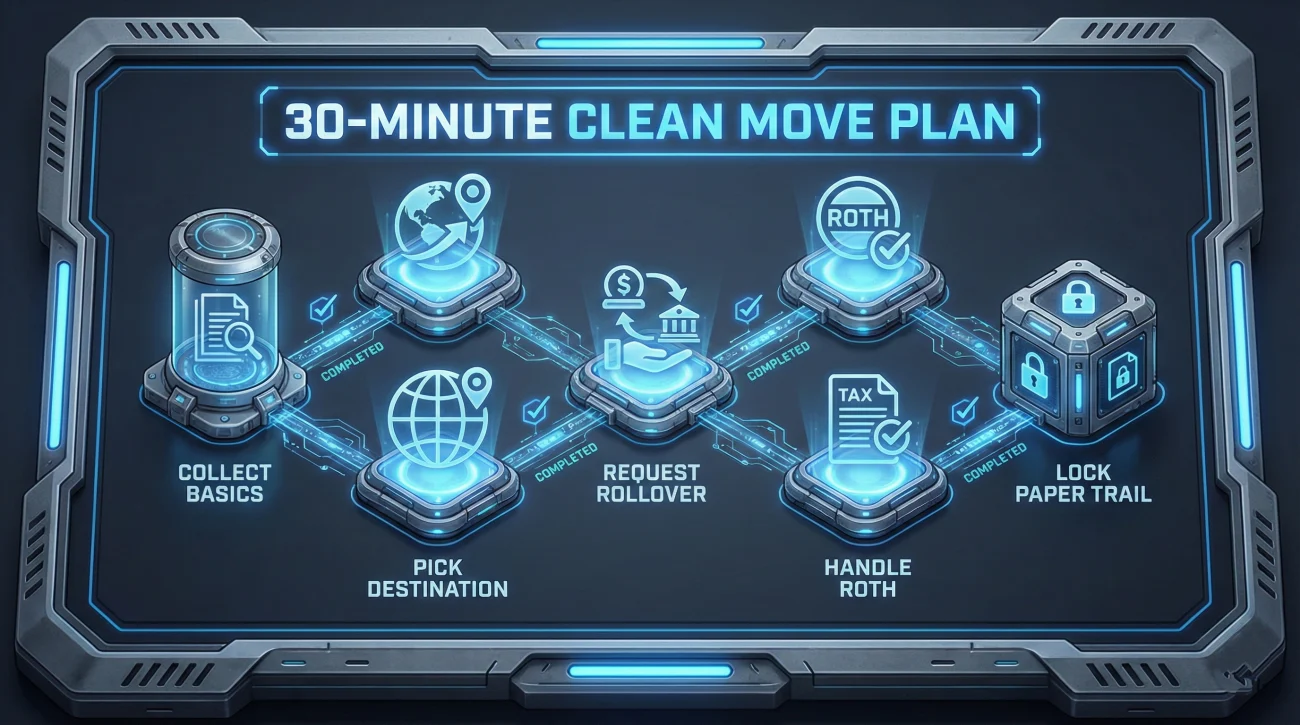
Step 1: Collect the basics (5 minutes)
- Old plan provider name + account login
- Your current balance and whether you have Roth and/or traditional contributions
- Vesting status (how much of employer match you keep)
- Any outstanding 401(k) loan balance
Step 2: Pick a destination (5 minutes)
Choose one: keep it in the old plan, roll to your new employer plan, or roll to an IRA.
If you’re starting a new job soon and their plan is decent, rolling into the new 401(k) can be a clean consolidation move.
If you want more control, an IRA rollover can make sense.
Step 3: Request a direct rollover (10 minutes)
- Ask the old plan for a direct rollover form/process.
- Confirm how checks are made payable (ideally payable to the new custodian, not to you personally).
- Ask whether they can transfer electronically or by check.
Step 4: Handle Roth, after-tax, and “mixed” money correctly (5 minutes)
Some 401(k)s contain multiple “buckets” (traditional pre-tax, Roth, and possibly after-tax contributions). The right rollover destination can differ by bucket. If your plan includes after-tax contributions, ask the plan administrator how they are handled in a rollover.
Step 5: Lock down your paper trail (5 minutes)
- Save confirmation emails and screenshots of the rollover request.
- Write down the check number or transfer reference ID.
- Set a calendar reminder to confirm the rollover landed successfully.
If You Have a 401(k) Loan, Don’t Ignore It When You Leave

A 401(k) loan is one of the most common “surprise taxes” after resignation. Many people assume they can keep paying it forever like a normal loan. But depending on your plan rules, leaving the employer can trigger a payoff requirement or a loan offset that may be treated as a taxable event.
What to do immediately:
- Ask your plan administrator what happens to the loan when employment ends.
- Ask what your payoff deadline is (if any).
- Ask whether an unpaid balance becomes a taxable distribution or loan offset and what rollover options apply.
If your exit plan isn’t finalized yet, keep the overall resignation process clean too: resignation letter with notice period.
Cashing Out: When It’s “Emergency-Only,” and How to Reduce Damage
Cashing out a 401(k) can create a double hit: you may owe income tax, and you may owe an additional penalty if you’re under a certain age. That’s why the default advice is simple: don’t do it unless you truly have no safer options.
If you’re considering cashing out, do two things before you click anything:
- Ask the plan what will be withheld automatically, so you’re not shocked by the deposit amount.
- Confirm whether you’ll owe any additional taxes or penalties when you file your return.
Common Mistakes After Quitting (That You Can Avoid Easily)
- Doing an indirect rollover “for speed” and getting hit by withholding and deadlines.
- Forgetting vesting and overestimating how much employer match you keep.
- Ignoring a 401(k) loan until it becomes a taxable event.
- Leaving accounts scattered across employers and losing track of logins over time.
- Not confirming whether your account contains Roth or after-tax money before moving it.
The goal is boring: keep your retirement savings intact, avoid accidental taxes, and make your future self grateful.
❓ FAQ
✅ What happens to my 401(k) when I quit?
In most cases, the account stays in your former employer’s plan unless you move it. You still own your money, but you stop contributing and may have fewer features than active employees.
🏦 Is a direct rollover better than an indirect rollover?
Often, yes. A direct rollover generally avoids common traps like mandatory withholding and missed rollover deadlines, because the money moves directly to the new plan or IRA custodian.
💸 What happens if I cash out my 401(k) when leaving a job?
Cashing out can trigger income taxes and may trigger additional penalties depending on your age and situation. It also stops long-term compounding, which is usually the biggest hidden cost.
📌 Can I keep my 401(k) with my old employer forever?
Sometimes. It depends on plan rules and your balance. Some plans allow former employees to keep assets in the plan, while others may require action for smaller balances.
🧾 What should I do if I have a 401(k) loan and I’m quitting?
Contact your plan administrator and ask what happens to the loan when employment ends. Some plans require payoff within a timeframe, and unpaid balances can become taxable.
Final Thoughts: Your Best Move Is the One That Avoids Accidental Taxes
When you quit, your 401(k) becomes your responsibility to manage – quietly, but seriously. The safest default for most people is: choose a destination, request a direct rollover, document everything, and confirm it landed.
If you do that, your resignation doesn’t just end cleanly. Your money keeps working while you move on.
⚠️ Legal Disclaimer: The resignation templates, email samples, and professional guidance provided in this guide are for informational purposes only and do not constitute legal advice. Employment laws and contract requirements vary by jurisdiction and individual circumstances. Please review your employment agreement and consult your HR department and/or a qualified attorney to ensure compliance with applicable laws and policies.