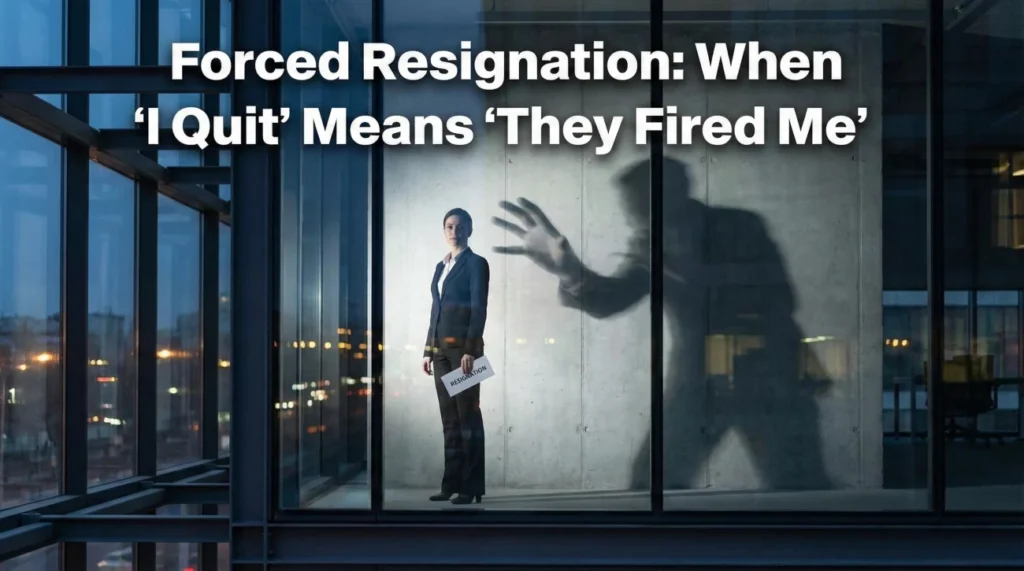
- Core idea: “Forced resignation” is often constructive dismissal, meaning you resign but were pushed out by serious employer conduct or a major breach.
- Red flags: Fundamental changes like pay cuts, demotion, squeeze-you-out scheduling, forced relocation, or escalating hostile and retaliatory conditions.
- Three mistakes: Rage letter, No documentation because “everyone knows”, Waiting too long then resigning for a different reason.
- Protection plan: Build a dated timeline, Object calmly in writing, Use the internal process at least once when safe, Plan a controlled exit with clean handover.
- Templates: One email to HR to document and request remedy, One neutral resignation message that stays factual and consistent without legal labeling.
The Moment You Realize This “Resignation” Wasn’t Really Voluntary
There’s a specific kind of quitting that doesn’t feel like quitting. You don’t resign because you found a better offer. You resign because your workplace turns into a pressure cooker: pay changes, threats, humiliation, impossible demands, or a slow campaign to make you feel unwelcome until you break.
When an employer’s behavior leaves you with no realistic option except to leave, that’s the territory people often describe as constructive dismissal. The label matters because it changes how you should document the situation, how you write your resignation, and how you protect yourself after you exit.
This is not legal advice, and rules vary by jurisdiction. But the strategy is consistent almost everywhere: don’t rely on vibes, rely on records. Your goal is a clean, provable story: what changed, how you responded, and why staying became unreasonable.
What Constructive Dismissal Really Means in Plain English
The simplest explanation is this: you resign, but you argue that the resignation was triggered by the employer’s serious conduct or major breach – so in substance, you were pushed out. Some countries use the term “constructive dismissal,” others use “constructive discharge,” and some treat it as a form of forced resignation.
The key idea is not “I hated my job.” It’s “my employer changed something fundamental or allowed conditions to become so intolerable that a reasonable person would feel forced to resign.” If you’re trying to understand your situation, focus on the word forced, not the word resignation.
| Situation | What it usually looks like | What matters most |
|---|---|---|
| Normal resignation | You leave by choice (new role, relocation, personal preference) | Clear notice + clean handover |
| Termination | Employer directly ends your employment | Written termination reasons + final pay/benefits |
| Constructive dismissal | You resign after a serious breach / intolerable conditions | Evidence: timeline, objections, HR steps, documented impact |
The Red Flags That Turn “This Job Is Bad” Into “This Might Be Forced”
Not every unpleasant workplace qualifies as a forced exit. A rough manager, a stressful quarter, or a job you dislike is not automatically a “case.” What matters is the pattern and severity – especially changes to core terms or sustained conduct that makes continued employment unreasonable.
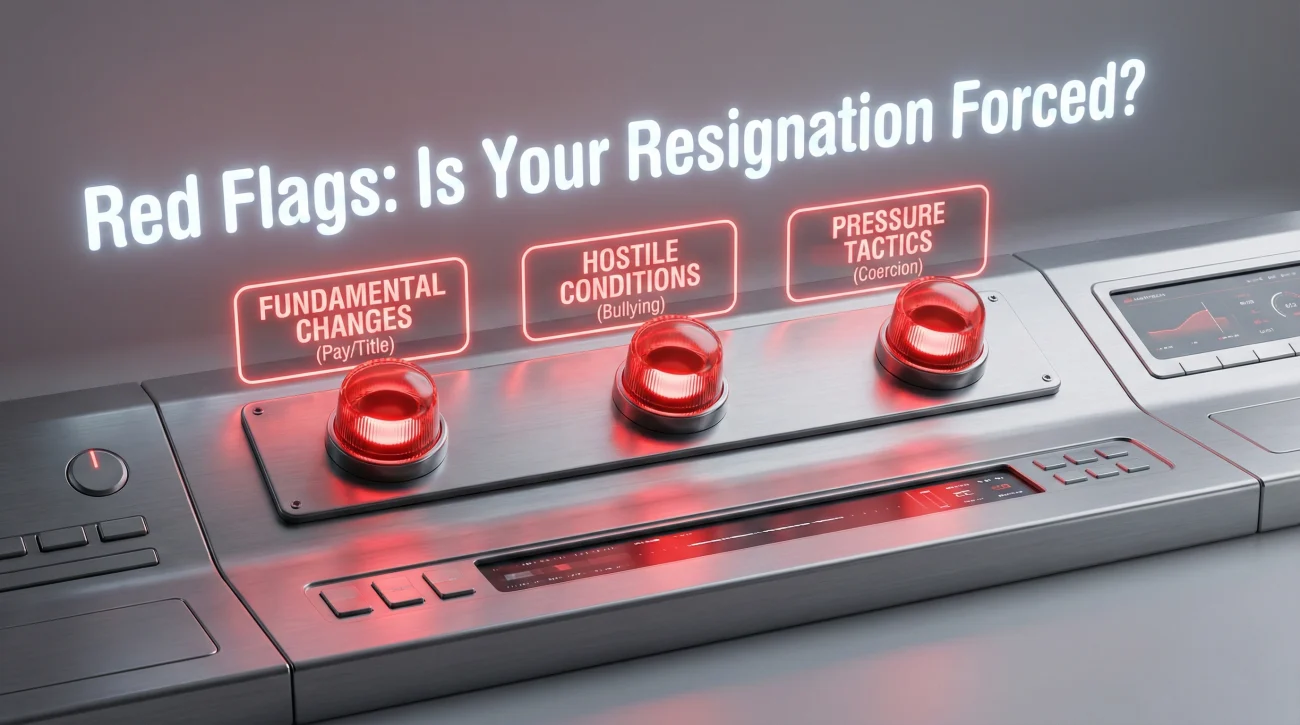
Red flag category 1: Fundamental changes you didn’t agree to
- Major pay cut, delayed pay, or “temporary” pay changes that don’t end.
- Demotion in title, duties, or authority that damages your career path.
- Schedule changes designed to squeeze you out.
- Forced relocation or working pattern changes without agreement.
Red flag category 2: A hostile environment that escalates, then never resolves
A hostile work environment is often described casually online, but here’s the practical test: Does the workplace feel persistently unsafe, humiliating, discriminatory, or retaliatory – and did the employer ignore or enable it after you raised it?
- Bullying, harassment, discrimination, or targeted humiliation.
- Retaliation after reporting issues or filing a complaint.
- Threats about your future, reputation, or visa/status tied to compliance.
- “Performance management” that is clearly pretextual and inconsistent.
Red flag category 3: Pressure tactics that create a paper trail you should not ignore
Many forced exits start with language that sounds polite but functions like coercion: “It’s better if you resign,” “We can make this easy,” “Sign this today,” “If you don’t resign, we’ll terminate you.” If you’re being told to resign immediately without time to review anything, that’s a signal to slow down, document, and protect yourself.
If you genuinely feel you must resign under duress, your priority becomes: (1) safety, (2) documentation, (3) a controlled exit message.
The Three Mistakes That Ruin Your Leverage After a Forced Exit
People lose protection not because the situation wasn’t serious, but because they handle the exit emotionally. Here are the three mistakes that show up again and again.

Mistake 1: Resigning with a “rage letter” that can be used against you
Anger is understandable. But a resignation email full of accusations, threats, or personal attacks often becomes Exhibit A for “employee was unstable.” Even when your complaints are true, the tone can harm you.
Mistake 2: Not documenting because you assume “everyone knows”
In disputes, “everyone knows” becomes “no one can prove.” If you believe you’re being pushed out, treat your situation like a timeline project. You want a consistent record that shows what happened, when it happened, and how you tried to resolve it. This is how you document workplace harassment in a way that isn’t messy.
Mistake 3: Waiting too long after a serious breach, then resigning for a different reason
One practical reality: if you stay indefinitely after the “final straw,” it can weaken the argument that the breach forced you out. If conditions are truly intolerable, your actions should reflect that seriousness: you raise it, you object, you give a chance to remedy (when safe), and you exit with a consistent reason.
The Protection Plan: A Simple Timeline That Keeps Your Story Clean
If you suspect a forced resignation scenario, your goal is not to “win a legal battle” in your email. Your goal is to leave with a clean record that supports your position, while keeping your tone professional.

Step 1: Build a timeline in one document
- Date + what happened + who was involved.
- Any written proof (emails, messages, policy documents, payslips, meeting invites).
- Impact on your role (pay, duties, location, safety, health, performance expectations).
Step 2: Object in writing (calmly)
If it’s safe to do so, object to the change or conduct in writing. This can be an email to your manager or HR that says: what changed, why it’s unacceptable, and what remedy you’re requesting. Keep it factual. Avoid insults. You’re not “arguing,” you’re recording.
Step 3: Use the company process at least once (when safe)
If your employer has an HR process, grievance procedure, or reporting channel, use it at least once unless doing so puts you at risk. A recorded attempt to resolve the situation matters because it shows you didn’t quit impulsively; you responded to a serious problem.
Step 4: Plan your exit like a controlled operation
Decide your last day, your handover boundaries, and how you will return company property. If you’re in a sensitive role where access might be cut immediately, make sure key handover notes exist in shared systems before you trigger offboarding.
Two Templates: One to Put HR on Notice, One to Resign Without Self-Sabotage
These templates are designed to protect you from the two extremes: silence (no record) and emotional explosion (bad record). They aim for calm clarity.
Template 1: Email to HR to document the issue and request remedy
Subject: Formal concern and request for resolution
Hi [HR Name],
I’m writing to formally document a serious workplace concern and request a prompt resolution. Over the past [time period], the following issues have occurred:
- [Date]: [Brief factual description of incident/change]
- [Date]: [Brief factual description of incident/change]
- [Date]: [Brief factual description of incident/change]
I have raised these concerns with [Manager Name / team] on [date(s)], but the issue has not been resolved. The current situation is materially impacting my ability to continue working under reasonable conditions.
I am requesting the following resolution steps:
- [Requested action #1]
- [Requested action #2]
- [Requested action #3]
Please confirm receipt of this email and advise next steps and expected timelines for review. I’m available to meet on [2–3 time options].
Regards,
[Your Name]
[Role / Team]
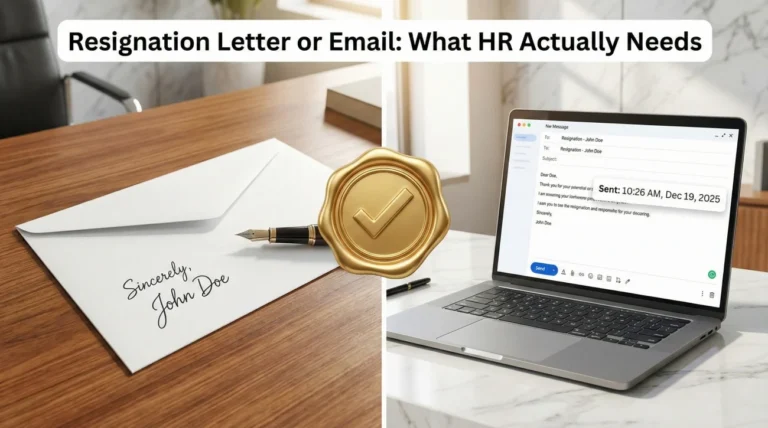
If you want the general structure of a clean resignation email (so your tone stays controlled), use this email writing guide.
Template 2: Resignation message (neutral, consistent, no oversharing)
[Your Name]
[Your Address]
[City, State ZIP]
[Date]
[Recipient Name]
[Title]
[Company]
Dear [Recipient Name],
Please accept this letter as formal notice of my resignation from my position as [Job Title]. My last working day will be [Last Day], in accordance with applicable notice requirements.
This resignation is due to ongoing workplace issues that I have raised through appropriate channels and that remain unresolved. I am providing notice in good faith and will cooperate with a reasonable transition process.
Between now and my last day, I will document current responsibilities, provide status notes on active work, and support a smooth handover as agreed.
Sincerely,
[Your Signature]
[Your Name]
If you need a “keep it neutral” wording library (without turning the letter into a rant), use this reason wording reference.
Final Thoughts: Your Exit Should Read Like a Professional Record
A forced resignation situation is emotionally exhausting, and that’s exactly why you need structure. The goal is not to create drama. The goal is to leave with clarity, documentation, and a timeline that makes sense to a neutral third party.
If you suspect constructive dismissal, slow down before you send anything. Build your record, use a calm written objection (when safe), and resign in a way that protects your future opportunities without sacrificing your dignity.
❓ FAQ
⚖️ Is constructive dismissal the same as being fired?
It’s usually treated as a resignation triggered by the employer’s serious conduct or breach, rather than a normal voluntary quit. How it’s handled depends on your jurisdiction, but the core idea is: you left because staying became unreasonable.
🧾 What kind of evidence matters most in a forced resignation situation?
A dated timeline, written objections, HR/grievance records, and proof of fundamental changes (pay, duties, hours, location) are often more powerful than long narratives. Think: facts + timestamps + impact.
📩 Should I complain to HR before resigning?
If it’s safe, using the internal process at least once can strengthen your record because it shows you attempted resolution. If reporting would put you at risk, prioritize safety and document what you can.
🗣️ Should I use the words “constructive dismissal” in my resignation email?
Often, it’s safer to keep the resignation message neutral and factual, and avoid legal labels in the email itself. You can document facts and unresolved issues without turning the message into a legal argument.
🚪 If my employer tells me to resign “or else,” what should I do?
Don’t rush. Ask for anything in writing, request time to review documents, and document the conversation (date, time, exact words, witnesses). If you feel unsafe or pressured, consider speaking with a qualified professional in your jurisdiction.
⚠️ Legal Disclaimer: The resignation templates, email samples, and professional guidance provided in this guide are for informational purposes only and do not constitute legal advice. Employment laws and contract requirements vary by jurisdiction and individual circumstances. Please review your employment agreement and consult your HR department and/or a qualified attorney to ensure compliance with applicable laws and policies.