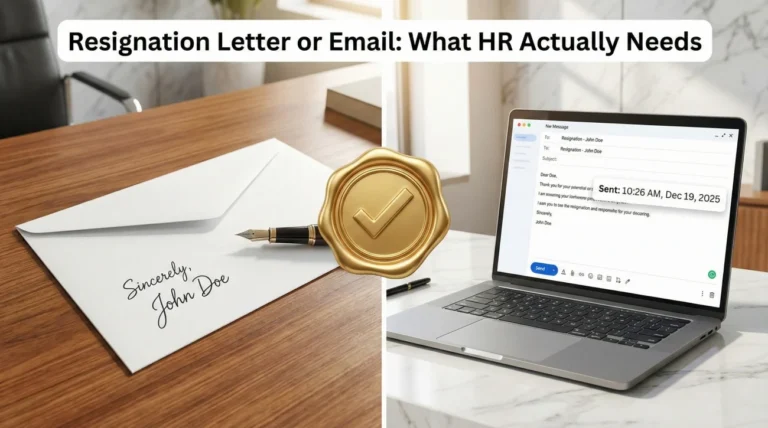

- Myth vs reality: Two weeks is often a norm, not a universal legal rule, but skipping it can still create real consequences.
- What “required” means: Separate Law, Contract, and Company policy because they drive different obligations and outcomes.
- When notice is truly mandatory: Signed notice clauses, union terms, regulated roles or visas, and repayment or equity timing rules.
- If you skip notice: Expect practical fallout like reference damage, rehire ineligibility, PTO payout issues, and equipment return headaches.
- Clean exit option: If you cannot do two weeks, offer shorter notice with a structured handover and get key details in writing.
The Two-Week Notice “Rule” Is Often a Myth (But the Consequences Can Be Real)
People talk about two weeks’ notice like it’s a law of physics. You resign, you owe two weeks, end of story. But the truth is more complicated: in many situations, is 2 weeks notice mandatory is the wrong question. The better question is: “What am I actually obligated to do, and what happens if I don’t?”
Because even when two weeks isn’t legally required, skipping notice can still create real consequences: burned references, a “not eligible for rehire” status, delayed equipment return drama, awkward final paycheck questions, or a manager who suddenly decides your last days will be miserable.
This guide helps you separate law from policy from etiquette, so you can make a clean decision and leave like a professional – not like someone guessing.
What “Required” Actually Means: Law vs Contract vs Company Policy
When someone says “two weeks is required,” they might mean three different things. Mixing them up is how people get scared into staying longer than they should, or quit impulsively and get surprised later.
| Type of “Requirement” | Where it comes from | What it usually means for you |
|---|---|---|
| Legal requirement | Local labor law or regulations | Only mandatory if the law says so in your jurisdiction |
| Contract requirement | Employment contract, offer letter terms, collective bargaining agreement | Could be enforceable, depending on what you signed and local rules |
| Policy / handbook requirement | Company policy, HR handbook, internal guidelines | Often affects rehire eligibility, payout rules, and references more than legality |
Here’s the practical takeaway: “Two weeks” is frequently a professional norm, not a universal legal obligation. But contracts and policies can still matter, so you want to check what applies to you before you decide.
When Two Weeks (or Any Notice) Can Be Truly Mandatory

There are situations where a notice period is more than etiquette. If any of these apply, treat your resignation like a document review exercise, not a vibe-based decision.
1) You signed a contract with a notice clause
Some roles include a required notice period (two weeks, four weeks, thirty days, or more). If you signed it, it may be enforceable depending on local law. Even if enforcement is rare, companies can still push consequences through policy channels.
2) You’re under a collective bargaining agreement or union contract
Union and CBA terms can define notice requirements and offboarding procedures. If you’re covered, don’t assume the “standard” rules apply.
3) You have visa, licensing, or regulated-role constraints
Some jobs involve professional licenses, regulated client responsibilities, or immigration sponsorship realities. The “right” exit might require clean transitions, documented handoffs, and timelines that protect you.
4) You’re bound by repayment, bonus, or equity terms
Certain bonuses, relocation payments, tuition assistance, or equity grants have conditions tied to resignation timing. Two weeks may not be the issue; the timing of your separation date might be.
If You’re “At-Will,” Does That Mean You Can Quit Anytime?

In at-will setups, the idea is that either side can end the relationship without a long runway. That’s why people often assume two weeks notice is never “required.” But even in at-will environments, company policies can still shape practical outcomes.
The real-world question is: what do you lose if you leave without notice? If the answer is “nothing meaningful,” then your decision becomes simpler. If the answer is “payout, reference, rehire eligibility, or a clean exit,” then two weeks might be worth it even if it’s not legally mandatory.
What Happens If You Quit Without Notice?
People worry about “getting sued” for quitting without notice. That’s usually not the most common consequence. The more common consequences are administrative and reputational. They’re not dramatic, but they can be expensive in time and stress.
| Area | What can happen | What you can do to protect yourself |
|---|---|---|
| Final paycheck timing | Usually still owed, but admin can become messy | Get payout details in writing; keep resignation email |
| PTO / vacation payout | Some policies reduce payout if you don’t give notice | Check policy before resigning; ask HR to confirm |
| References | Manager may refuse or give minimal confirmation | Ask for a reference before you resign if possible |
| Rehire eligibility | Marked “not eligible for rehire” if you skip notice | If you care, negotiate a shorter notice instead of none |
| Equipment and access | Immediate access cut; urgent return requirements | Inventory list + proof of return |
| Legal risk | Usually low, but depends on contract and role | Review your agreement; keep communication factual |
If you’re considering quitting without notice, the smart move is to treat your exit like a risk decision: protect your money, protect your future references, and minimize chaos.
A Simple Decision Matrix: Should You Give Two Weeks or Leave Sooner?
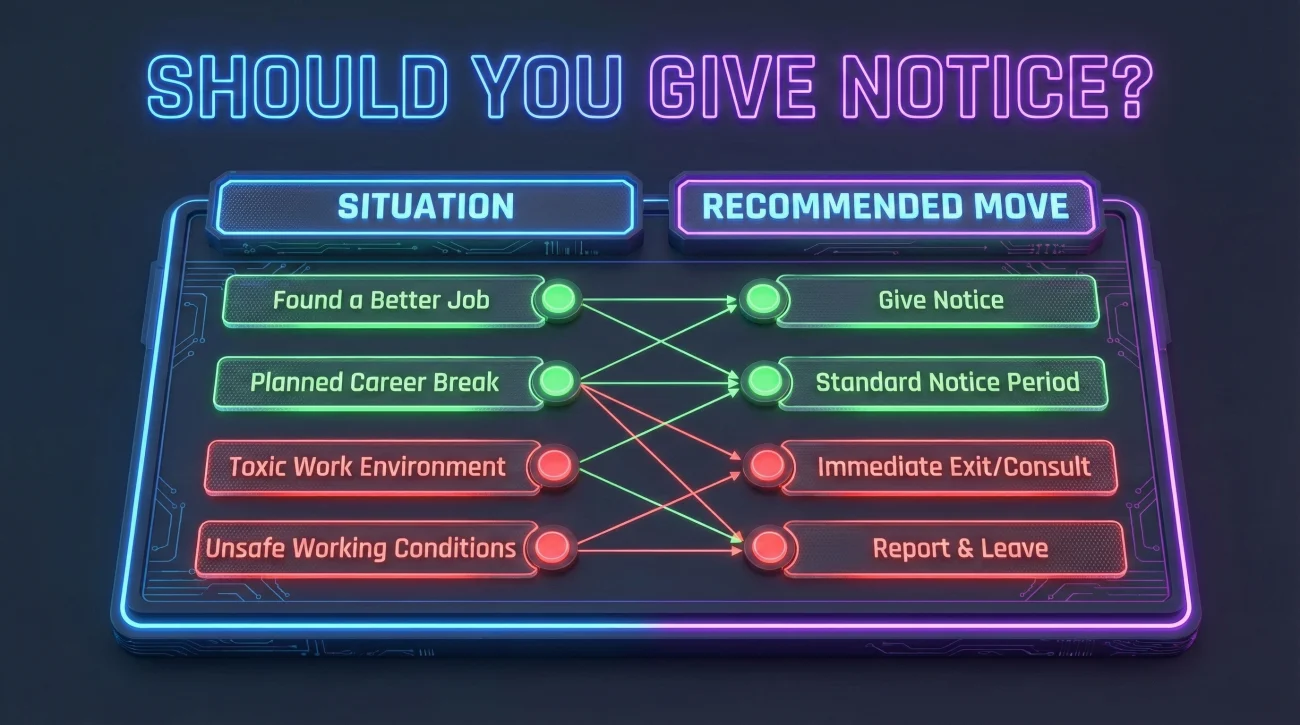
If you want a fast way to decide without spiraling, use this matrix. You’re balancing personal safety, future risk, and what you stand to lose.
| Situation | Recommended move | Why |
|---|---|---|
| You feel unsafe, harassed, or at risk | Prioritize safety; leave immediately if needed | Health and safety beat etiquette |
| You have a signed contract with notice terms | Follow contract or get advice before deviating | Reduces enforceability and payout disputes |
| You need your PTO payout or benefits window | Time your exit carefully; give notice if it protects money | Resignation timing is a financial decision |
| You want a strong reference and clean rehire status | Give notice, or negotiate a shorter notice with a plan | Protects your long-term career options |
| You’re done emotionally but not in danger | Consider a shorter notice + tight handover | Gives closure without maximum fallout |
If You Can’t Do Two Weeks, Offer a Shorter Notice With a Clean Handover

If your manager or HR insists “two weeks is required,” you don’t need to fight. You can stay calm and propose a structured alternative. The move is: “Here’s what I can do,” not “Here’s why you’re wrong.”
The key is to replace time with clarity. If you can’t give two full weeks, you can still leave a clean footprint: documentation, status notes, access handoffs, and a short training session for whoever inherits your work.
Script: Requesting a shorter notice period
Hi [Manager Name], I want to discuss my resignation timeline. I understand the standard expectation is two weeks, but due to personal constraints I can only offer [X business days]. I’ll make the transition as smooth as possible by providing a handover document, completing priority tasks, and doing walkthrough sessions before my last day. Can we align on the best plan?
What to Say When They Ask: “Is Two Weeks Notice Mandatory?”
You don’t want to sound like you’re quoting internet advice. You want to sound like a professional who is aligning on process. Keep it simple: acknowledge the standard, ask what policy applies to you, and confirm the consequence in writing.
Script: Calm clarification with HR
Subject: Notice period requirement clarification
Hi [HR Name],
I’m confirming the notice period expectations for my role. Could you please clarify whether two weeks’ notice is required under my employment agreement or company policy, and whether the notice period impacts any final payments (such as PTO payout) or rehire eligibility?
Thank you,
[Your Name]
What If You Give Notice and They End Your Employment Immediately?
Some companies accept your resignation but choose to end access immediately for security or operational reasons. If that happens, the professional move is to stay calm and ask for confirmation of your last working day, pay arrangements, and equipment return steps.
The reason this matters is simple: your resignation notice and your last working day may not be the same thing. Clarity avoids payroll confusion and protects you from “missing equipment” claims later.
Script: Confirming final details if they end access early
Thank you for confirming. To avoid misunderstandings, could you please confirm in writing my final employment date, final paycheck timing, any PTO payout details, and the equipment return process? I will return all company property as instructed.
Short Resignation Note Template (Two Weeks, One Week, or Immediate)
Keep resignation notes boring. Your resignation is not the place to explain your entire story. Your goal is a clear timestamp, a last day, and a clean tone.
Template: Standard two weeks
Subject: Resignation
Hi [Manager Name],
Please accept this email as formal notice of my resignation. My last working day will be [date], two weeks from today. I’ll do everything I can to ensure a smooth transition and complete my handover responsibilities.
Thank you,
[Your Name]
Template: Shorter notice
Subject: Resignation
Hi [Manager Name],
Please accept this email as formal notice of my resignation. Due to personal constraints, my last working day will be [date]. I’ll support a smooth transition by documenting my work, prioritizing key deliverables, and coordinating a handover plan.
Thank you,
[Your Name]
Template: Immediate resignation (keep it minimal)
Subject: Resignation
Hi [Manager Name],
Please accept this email as formal notice of my resignation, effective immediately. I will cooperate with HR and IT regarding the return of company property and any required transition documentation.
Thank you,
[Your Name]
Checklist: A Clean Exit Whether You Give Two Weeks or Not
If you want to leave without creating a trail of problems, use this checklist. It’s the difference between “quiet, professional exit” and “weeks of HR emails.”
| Checklist Item | What you do | Why it matters |
|---|---|---|
| Check your documents | Contract, offer letter, policy | Confirms whether notice is truly required |
| Confirm last day in writing | Email with a clear date | Prevents “when did you leave?” disputes |
| Clarify PTO payout rules | Ask HR directly | Protects money you may be owed |
| Create a handover doc | Status, owners, next steps | Reduces chaos and protects reputation |
| Return equipment with proof | Inventory + receipt/tracking | Stops “missing laptop” drama |
| Keep your tone neutral | No venting, no blame | Protects references and future networking |
So, Is Two Weeks Notice Mandatory?
Here’s the clean answer: is 2 weeks notice mandatory depends on what governs your employment – your local law, your contract, and your company’s policy. In many workplaces, two weeks is a norm, not a universal legal rule. But norms still carry consequences, and contracts can carry obligations.
The smartest move is not to argue the “rule.” The smartest move is to check what applies to you, decide what risks you can accept, and leave with a clean paper trail. That’s how you protect your money, your reputation, and your next step.
❓ FAQ
✅ Is two weeks notice required by law?
It depends on your jurisdiction and your employment terms. In many situations, two weeks is a professional expectation rather than a strict legal requirement, but contracts or regulated roles may include enforceable notice clauses.
📅 Can I quit without giving two weeks notice?
Sometimes, yes – especially if there is no contract notice requirement. However, quitting without notice can affect references, rehire eligibility, and sometimes PTO payout depending on policy. Check what applies to your role before deciding.
💬 What should I do if I can’t stay for two weeks?
Offer a shorter notice period with a structured handover plan: documentation, priority task completion, and walkthrough sessions. Replacing time with clarity often reduces conflict.
🧾 Can my employer withhold my final paycheck if I don’t give notice?
Rules vary by location, and employers typically still owe wages for time worked. For specifics in your jurisdiction, confirm with HR in writing and review your employment documents.
🔒 What’s the safest way to resign if I’m worried about retaliation?
Keep communication short and factual, confirm your last day in writing, and document equipment return and handover steps. If you feel unsafe, prioritize safety and seek appropriate support.
⚠️ Legal Disclaimer: The resignation templates, email samples, and professional guidance provided in this guide are for informational purposes only and do not constitute legal advice. Employment laws and contract requirements vary by jurisdiction and individual circumstances. Please review your employment agreement and consult your HR department and/or a qualified attorney to ensure compliance with applicable laws and policies.