
- Mindset shift: A mid-career switch at 30 or 40 is a reframe of your value, not a restart from zero.
- Pivot sequence: Choose an adjacent lane first, build small proof assets, and get one insider relationship before you resign.
- Transferable skills: Translate outcomes into the new industry’s priorities with metrics, not vague traits or task lists.
- Resume repositioning: Write a bridge summary, replace tasks with results, and keep skills tight and role-relevant.
- Resignation timing: Exit when you have a target lane, proof, some network foothold, and enough runway to avoid panic decisions.
A Mid-Career Switch Isn’t a Reset, It’s a Reframe
If you’re thinking about a career change at 30 40, the fear usually isn’t “Can I learn something new?” It’s: “Do I have to start from zero?” That fear makes smart people stay stuck for years, not because they love the job, but because they can’t imagine a clean bridge to the next industry.
Here’s the truth: most pivots don’t fail because you lack talent. They fail because you present yourself like a beginner, even when you’re not. Your job is to translate your experience into the language of the new industry, build proof fast, and resign in a way that protects your references while you transition.
Why Changing Industries Midlife Can Actually Be an Advantage

Changing careers midlife has one underrated benefit: you already know how to work. You know how to communicate, prioritize, deliver, manage conflict, and recover when things go sideways. Those are not “soft skills.” Those are the skills that keep teams functional.
The mistake is thinking employers only hire for industry knowledge. In reality, employers hire for problem-solving in their environment. If you can show that your past work produced outcomes that map to their problems, you’re not starting over. You’re upgrading your context.
The Career Pivot Strategy That Doesn’t Require a Leap of Faith

A good career pivot strategy turns your switch into a sequence. Not a dramatic jump. Not “quit first, figure it out later.” A sequence that reduces risk while increasing credibility.
Step 1: Pick your “adjacent lane” before you pick a dream title
Most people start with a job title. A better move is to start with an adjacent lane: a role that uses 60–80% of your existing strengths, but places you inside the new industry’s ecosystem. Adjacent roles get you hired faster and give you real credibility to pivot further.
Step 2: Build proof in small, public ways
“I’m a fast learner” doesn’t count as proof. Proof looks like a small portfolio, a case study, a project, a certification with a clear outcome, or measurable results from a side contract. Your pivot becomes believable when the hiring manager can see evidence, not intention.
Step 3: Get one insider relationship before you resign
The cleanest pivot is not built on applications. It’s built on conversations. Find one person in the new industry who will tell you what matters, what’s changing, and how hiring actually works. That person doesn’t need to be a celebrity. A working professional is enough.
Transferable Skills Are Not Generic, They’re Specific Outcomes
A transferable skills resume doesn’t mean listing vague traits like “leadership” or “communication.” It means translating your outcomes into the new industry’s priorities. You’re not saying, “I did X.” You’re saying, “I solved Y problem using X method, and here’s the measurable result.”
| Old-industry phrasing | What it sounds like to the new industry | Better pivot phrasing |
|---|---|---|
| “Managed stakeholders” | Generic, unclear impact | “Aligned 6 cross-functional stakeholders, reduced cycle time by 22% through weekly decision checkpoints” |
| “Led a team” | So what did you deliver? | “Led a team of 5 to ship 3 releases in 90 days, improved on-time delivery from 62% to 91%” |
| “Improved processes” | Unprovable without metrics | “Automated reporting workflow, cut manual hours by 12/week and reduced errors by 40%” |
| “Handled client communication” | Too broad | “Owned escalations for 20+ accounts, increased renewal rate by 9% through structured QBRs” |
Your past industry is not the headline. Your outcomes are the headline. That’s how you avoid looking like a beginner while you pivot.
How to Reposition Your Resume Without Lying
The goal isn’t to hide your background. The goal is to shape it. Your resume should read like you belong in the new lane, not like you’re apologizing for where you came from.
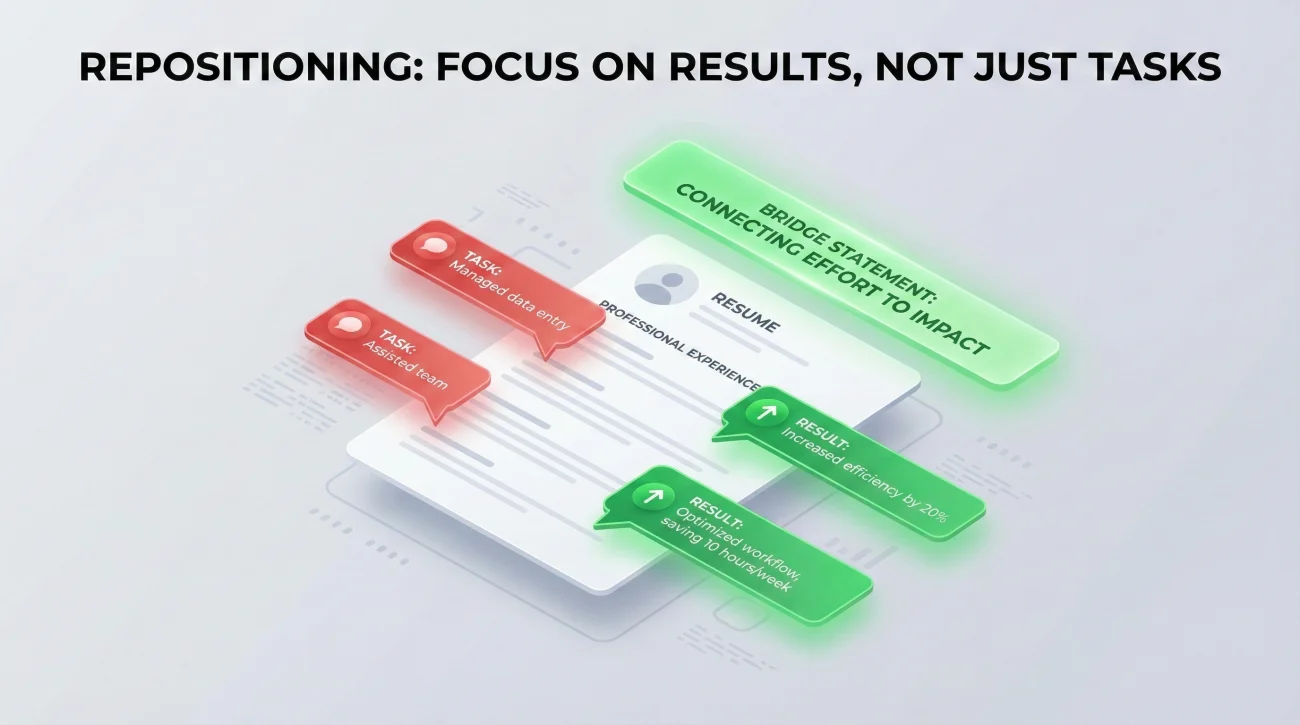
Rewrite your summary as a “bridge statement”
Instead of “Experienced [old role] seeking a new opportunity,” write a bridge statement that connects your strongest value to the new space.
Think: domain-agnostic strengths (execution, systems, growth, operations, customer outcomes) plus the direction you’re moving.
Replace task bullets with result bullets
Task bullets make you look interchangeable. Result bullets make you look expensive in a good way. Every role should show what changed because you were there.
Keep skills tight and relevant
Don’t dump every tool you’ve touched. List the skills that are directly used in the target role, then back them up with proof in your bullets or projects.
Networking for a Pivot: One Script, One Goal
Networking during a pivot is not begging for a job. It’s collecting reality. Your goal is to learn what the new industry actually rewards and what hiring managers dismiss. One good conversation can save you months of applying to the wrong roles.
A simple outreach script that works
Subject: Quick question about your path into [Industry]
Hi [Name],
I’m exploring a pivot into [Industry] and I’m trying to understand what actually matters for hiring in roles like [Target Role].
Your background stood out to me because [specific reason].
Would you be open to a 15-minute chat next week? I’m not asking for a job – just hoping to learn what skills/projects made the biggest difference for you.
Thanks either way,
[Your Name]
When to Resign for a Career Change Without Creating Panic

A resignation career change works best when you resign from a position of clarity, not desperation. If you can, don’t resign on the same day you decide to pivot. Resign when you have at least one of these:
- A credible adjacent role target and a resume that matches it.
- A proof asset (project, case study, portfolio, certification with output).
- A small network foothold (even one mentor or insider contact).
- A financial runway that buys you time to interview without panic.
When you do resign, keep the message clean and professional. Use a structure like: how to write a resignation email. If you want a simple “leave like an adult” baseline for tone and timing, keep this open too: resignation etiquette.
A Clean Exit Plan That Protects Your Reputation During the Pivot
Your pivot doesn’t just depend on your new industry. It depends on what your old industry says about you when someone checks references. That’s why your last two weeks matter. Not as a moral performance, but as reputation insurance.
Your practical exit checklist
- Document active work, owners, and next steps in one clear handover note.
- Close loops: status updates, key stakeholders, and deadlines that would blindside the team.
- Keep your resignation reason high-level and consistent. If you include a reason, keep it neutral: resignation letter with reason.
- Leave quietly helpful, not emotionally loud.
❓ FAQ
✅ Is a career change at 30 or 40 too late?
No. The challenge isn’t age, it’s positioning. A mid-career pivot works when you translate your experience into outcomes the new industry values and build proof that reduces perceived risk.
🧩 How do I avoid “starting over” when switching industries?
Choose an adjacent lane first, highlight transferable outcomes (not tasks), and build a small proof asset. You’re not restarting your work skills, you’re changing the context those skills operate in.
📄 What does a transferable skills resume actually look like?
It’s a resume where your bullets show measurable outcomes, your summary is a bridge statement, and your skills list is tight and relevant to the target role. It reads like you belong, not like you’re “hoping someone takes a chance.”
🤝 Do I need networking to pivot, or can I just apply online?
You can apply online, but networking accelerates the pivot because it gives you insider reality: what employers actually screen for, which adjacent roles work, and what proof matters most. Even one strong contact can change your trajectory.
📅 When should I resign if I’m changing careers midlife?
Resign when you have clarity: a target lane, a repositioned resume, at least one proof asset, and ideally some runway. If you resign too early, anxiety pushes you into random applications and weaker negotiating positions.
Final Thoughts
A career change at 30 40 is not a restart unless you present it like a restart. The pivot that works is calm, structured, and evidence-based: pick an adjacent lane, translate outcomes, build proof, then resign professionally with a clean handover.
You don’t need to be the youngest person in the new industry. You need to be the person whose experience clearly reduces risk and increases results. That’s not starting over. That’s bringing your value somewhere it can finally grow.
⚠️ Legal Disclaimer: The resignation templates, email samples, and professional guidance provided in this guide are for informational purposes only and do not constitute legal advice. Employment laws and contract requirements vary by jurisdiction and individual circumstances. Please review your employment agreement and consult your HR department and/or a qualified attorney to ensure compliance with applicable laws and policies.