
- Core risk: A short job gap can expose you to massive medical bills if coverage ends immediately.
- Why COBRA feels brutal: You pay the full premium plus a small admin fee once the employer subsidy disappears.
- 60 day decision window: You can delay enrollment, and if needed activate COBRA retroactively within the election period.
- Timing rule: If your plan runs to month end, resigning on the 1st or 2nd can buy an extra month of subsidized coverage.
- Cheaper bridges: Use ACA Marketplace or a spouse plan, and squeeze benefits before leaving with refills, checkups, and FSA spending.
The Most Dangerous Gap in Your Career
You have meticulously planned your resignation letter. You have negotiated your new salary. You have even calculated your PTO payout. But have you planned for the day you wake up without health insurance? In the US (and many countries with employer-based healthcare), your medical safety net is tethered to your employment. The moment you walk out that door, the net disappears – often faster and more expensively than you anticipate.
A single unexpected appendicitis surgery or a car accident during a 2-week employment gap can cost upwards of $30,000, effectively wiping out your entire emergency fund and signing bonus. Understanding health insurance cobra rules, the “election window” loopholes, and the strategic timing of your last day isn’t just administrative paperwork; it is a critical survival skill for your financial health.
Most employees assume they have only two bad choices: pay the exorbitant COBRA premiums or go uninsured and pray. In reality, there is a third option: mastering the timeline to get coverage for free or at a fraction of the cost.
What is COBRA and Why Does It Bankrupt People?
COBRA (Consolidated Omnibus Budget Reconciliation Act) is a federal law that allows you to keep your exact same employer health insurance plan for up to 18 months after you quit voluntarily or are laid off. It sounds great on paper – until you see the bill.
The Sticker Shock Mechanism:
While you were employed, your company likely subsidized a massive portion (70-80%) of your premium. You only saw the “employee contribution” deducted from your paycheck (e.g., $150). Under COBRA, the subsidy vanishes. You are legally required to pay 100% of the premium + a 2% administration fee.
| Plan Type | Your Cost While Employed | Your Cost on COBRA |
|---|---|---|
| Individual Plan | $150 / month | $700 – $900 / month |
| Family Plan | $450 / month | $2,200 – $2,800 / month |
The Verdict:
For most healthy people, COBRA is financially ruinous. However, it makes sense in two specific cases:
1. You have already met your annual deductible and have expensive ongoing treatments.
2. You are in the middle of a complex medical situation (e.g., pregnancy, cancer treatment) and cannot risk switching doctor networks.
The “60-Day Election Window” Hack
This is the most powerful loophole in the US healthcare system for job switchers. When you leave your job, you do not have to sign up (or pay) for COBRA immediately. The law grants you a 60-day election period to decide.
The “Retroactive” Safety Net Strategy:
COBRA coverage is retroactive. This means if you get hit by a bus on Day 59 of your unemployment, you can sign the form from your hospital bed, mail the check for the back-premiums, and the insurance company must pay your medical bills as if you never had a gap.
How to execute this hack:
- Step 1: Do Nothing. If your gap between jobs is less than 60 days (e.g., you start the new job in 3 weeks), do not pay for COBRA. Just keep the enrollment paperwork on your desk.
- Step 2: Live Your Life. Go about your business. Be careful, but don’t panic.
- Step 3 (If Sick): If a medical emergency happens, mail the check immediately. Coverage activates retroactively to Day 1.
- Step 4 (If Healthy): If you make it to your new job start date without incident, shred the COBRA paperwork. You just saved yourself ~$1,500 in wasted premiums.
Timing Your Resignation: The “First of the Month” Rule

When does your insurance actually terminate? This depends on your employer’s specific contract with the insurer, but there are two standard models:
- Termination Date Model: Coverage ends the exact day you leave (e.g., You quit Oct 15th, you are uninsured Oct 16th).
- End of Month Model: Coverage lasts until the last day of the calendar month you quit (e.g., You quit Oct 2nd, coverage lasts until Oct 31st).
The Strategic Move:
Always ask HR proactively: “If my last day is the 2nd of the month, does coverage extend to the 30th?”
If the answer is YES (which is common), never resign on the 31st. Push your last day to the 1st or 2nd of the new month. By working just one or two extra days into the new month, you effectively “steal” 30 days of employer-subsidized health insurance. This gives you a free 30-day bridge to find a new job without needing COBRA.
Cheaper Alternatives: ACA & Spousal Plans
If the “60-Day Hack” isn’t enough (e.g., you are taking a 6-month sabbatical), you need real coverage. Do not default to COBRA.
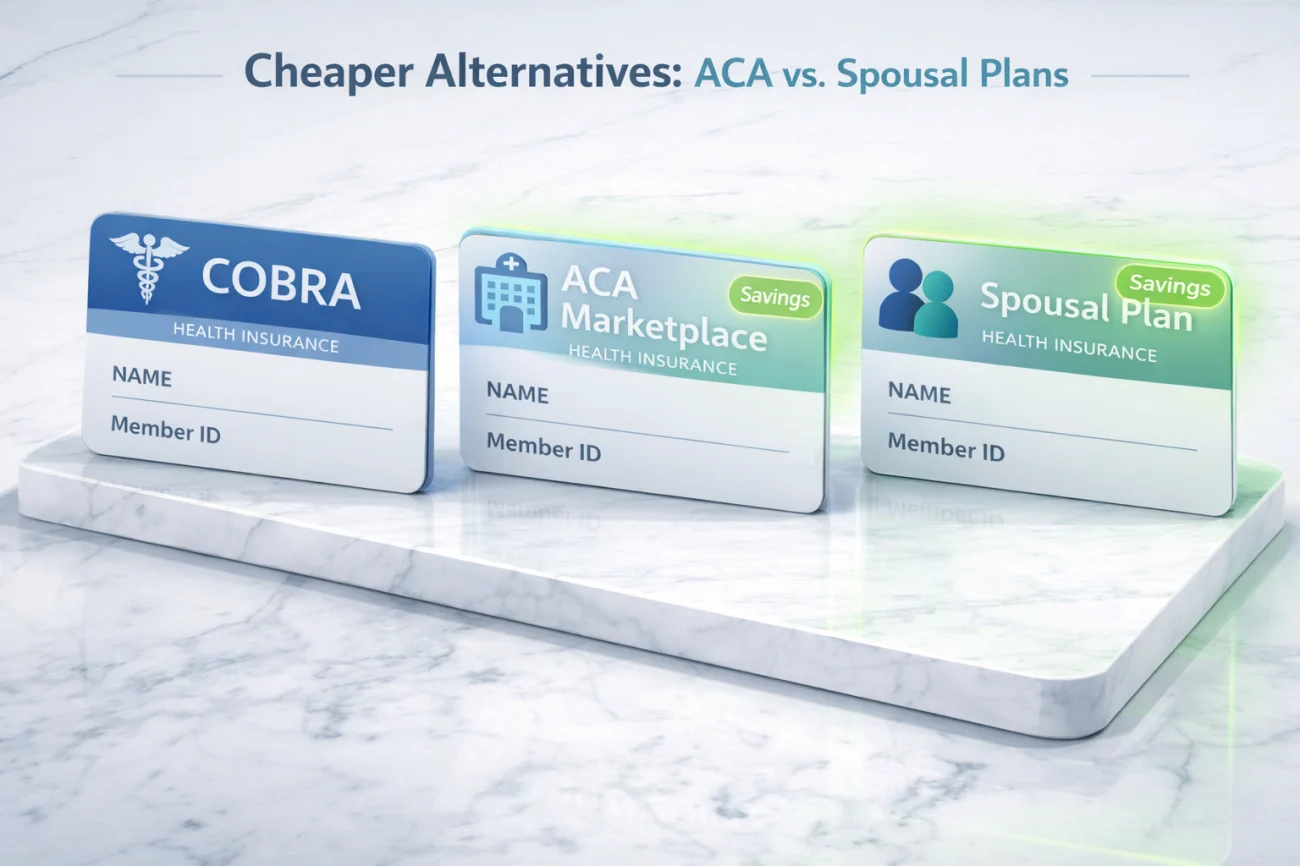
1. The ACA Marketplace (Obamacare)
Leaving a job is a “Qualifying Life Event” (QLE). This unlocks a special 60-day window to buy insurance on Healthcare.gov outside of the normal end-of-year enrollment period.
Why it wins: Since you are unemployed, your income for the month is $0. You may qualify for massive tax credits/subsidies, bringing a decent plan down to $50-$100/month. However, be warned: The deductible starts over from zero.
2. Spousal Plan Enrollment
If you have a spouse who works, your resignation is also a QLE for their insurance plan. You have 30 days (usually strict) to get added to their plan.
The Math: Adding a spouse usually costs ~$300-$500/month. This is still significantly cheaper than COBRA ($700+) but more expensive than a subsidized Marketplace plan. Compare the deductibles before switching.
The Pre-Resignation Medical Checklist
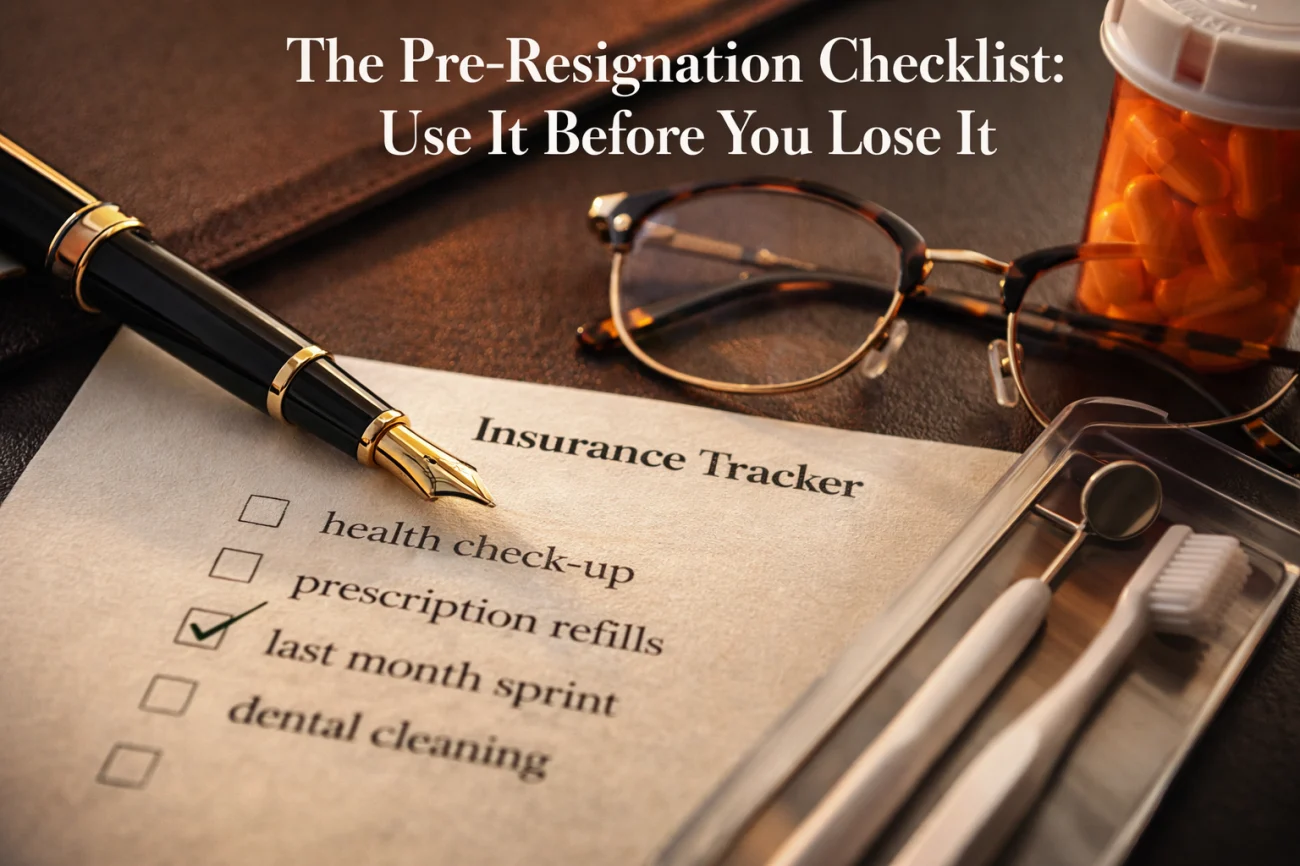
Before you hand in your notice, maximize the insurance you are still paying for. Squeeze every drop of value out of it.
- 🦷 The “Last Month” Sprint: Schedule your dental cleaning, eye exam, and physical. Get that lingering knee pain checked. Do it now.
- 💊 Refill Everything: Call your doctor and get 90-day refills on all prescriptions. Stockpile your meds so you don’t have to pay out-of-pocket during the gap.
- 👓 Use FSA Funds: If you have a “Use it or Lose it” FSA account, spend it. Buy glasses, first aid kits, or sunscreen. You usually lose these funds the day you quit (unlike HSA funds, which are yours forever).
❓ FAQ
💊 Does COBRA cover dental and vision?
Yes, usually. COBRA is an “a la carte” menu. You can choose to keep just the medical, just the dental, or everything. If you have expensive dental work planned, keeping just the dental COBRA (which is cheap, maybe $30/month) is a smart move.
👴 What if I retire early (before 65)?
You face a dangerous gap before Medicare kicks in at 65. COBRA only lasts 18 months. After that, you must use the ACA Marketplace. Plan these costs ($10k+/year) into your retirement budget; they are often the biggest shock for early retirees.
🤧 Can they deny me COBRA if I quit?
No. Voluntary resignation and involuntary termination (layoffs) both qualify. The only exception is if you were fired for “gross misconduct” (e.g., stealing, violence), which is a very high legal bar for companies to prove.
⏱️ How long is the gap for a new job?
Never assume coverage starts on Day 1. Most companies have a waiting period of 30, 60, or even 90 days. Ask your new recruiter explicitly: “What is the benefits effective date?” Use the 60-day COBRA hack to bridge this specific gap.
Final Thoughts
Health insurance is boring until you need it, and then it is life-changing. Do not let the excitement of a new job or the stress of a bad boss distract you from the risk.
By using the “End of Month” timing strategy and the “COBRA Election Window” hack, you can often bridge a 60-day employment gap paying absolutely zero dollars in extra premiums. That is the ultimate resignation bonus – keeping your money in your pocket, not the insurance company’s.
⚠️ Legal Disclaimer: ResignSmartly provides general informational guidance about resignation, workplace communication, notice periods, handovers, and career transitions. Content does not constitute individualized legal advice. Employment laws, contracts, workplace policies, and individual circumstances vary, so review the requirements that apply to your situation and consult an appropriate qualified professional when needed.