- Governance Protocol: Notify the right authority first (board chair vs CEO), then align with counsel on process and timing.
- Notice Window: Plan for a longer runway (often 60 to 120 days) so succession and continuity are not rushed.
- Transition Work: Document strategy, key relationships, and operational priorities so your successor can step in cleanly.
- Public Communications: Coordinate messaging and compliance (public companies may require an 8-K within 4 business days), never announce before governance sign-off.
- Templates And Edge Cases: Use role-specific letters (CEO, ED, CFO, COO, VP), and keep conflict, scrutiny, or M&A exits factual and non-dramatic in writing.
Understanding Executive Leadership Resignation
Executive departures shape organizational futures beyond typical employment transitions – your resignation affects strategic direction, stakeholder confidence, and leadership continuity across the entire enterprise. A professional executive resignation letter balances board notification requirements, succession planning needs, and the public communication strategy that protects both your reputation and organizational stability during leadership change.
Senior leadership resignations involve complexities that middle management never faces. You report to boards rather than supervisors. Your departure requires shareholder communication and sometimes regulatory disclosure. The announcement timing affects stock prices, media coverage, and organizational morale in ways that demand strategic coordination.
This guide provides templates for various executive scenarios – from CEOs and executive directors to vice presidents and senior directors, covering proper board notification protocols and succession planning considerations.
What Makes Executive Resignations Different
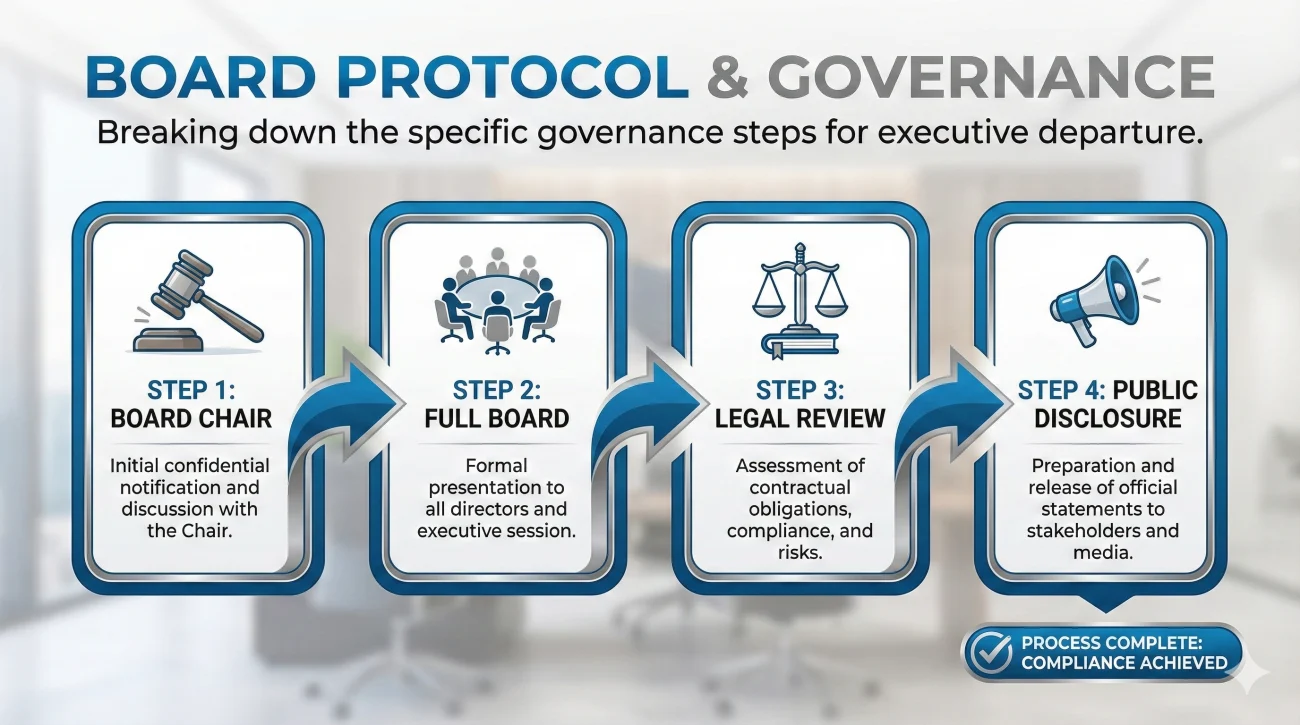
Board Notification and Governance Protocol
Your CEO resignation letter follows different procedures than standard employee resignations:
- 📋 Board chair first: Notify board chair before anyone else in the organization
- 🏛️ Full board notification: Formal resignation submitted to entire board of directors
- ⚖️ Legal review: General counsel often reviews resignation letter for disclosure implications
- 📊 Multiple audiences: Board, employees, shareholders, media each require tailored communication
Public Disclosure and Succession Planning
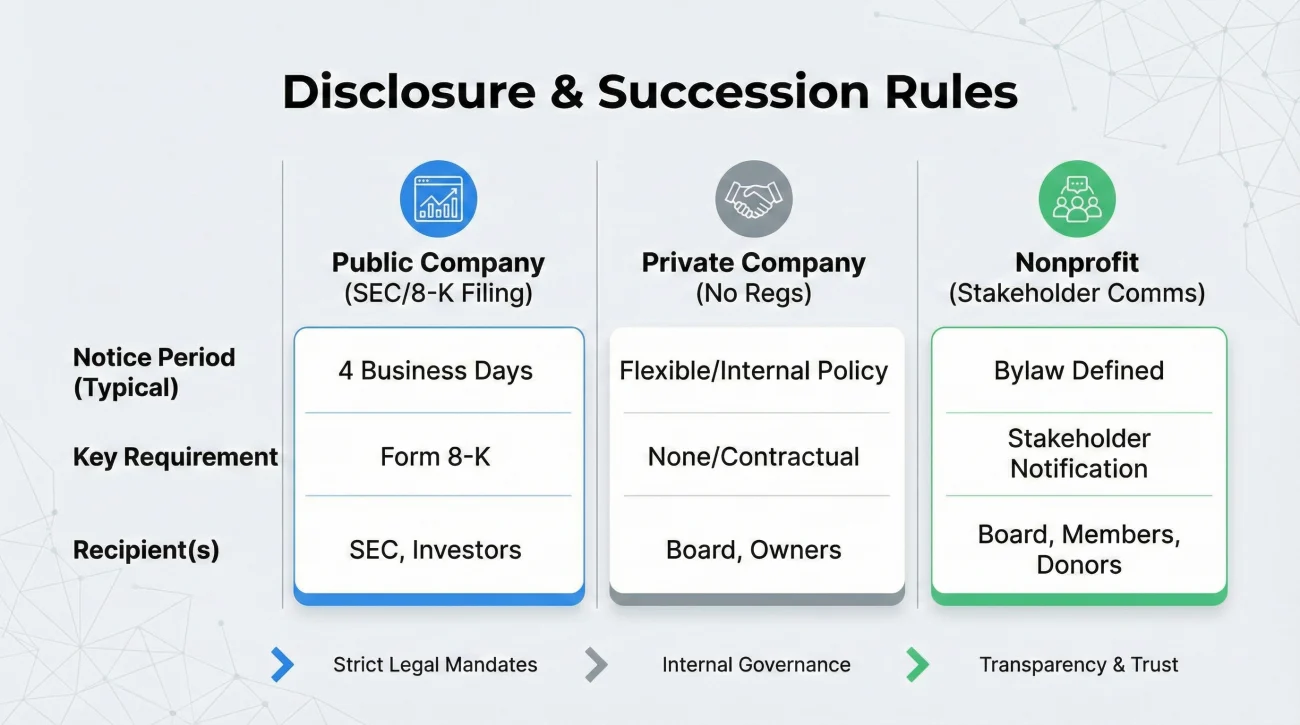
| Company Type | Disclosure Requirement | Notice Period |
|---|---|---|
| Public company (SEC) | Form 8-K filing within 4 business days | 60-120 days typical |
| Private company | No regulatory requirement | 60-90 days recommended |
| Nonprofit | Stakeholder communication per bylaws | 60-120 days for fundraising continuity |
| Government/public sector | Often public record immediately | Varies by jurisdiction |
Executive departures trigger succession processes requiring your participation – extended notice periods allow leadership search, interim arrangements may need your input, and strategic context documentation helps successor transition effectively.
CEO and Executive Director Resignations
CEO Resignation Letter
[Your Name]
Chief Executive Officer
[Your Email]
[Your Phone]
[Date]
[Board Chair Name]
Chair, Board of Directors
[Company Name]
[Address]
Dear [Board Chair Name] and Members of the Board,
I am writing to formally resign from my position as Chief Executive Officer of [Company Name], effective [Date].
This decision follows extensive reflection on my career goals and the organization’s strategic needs. [If applicable: “I have accepted the CEO position at another organization” or “I am transitioning to focus on other professional priorities.”]
To ensure organizational continuity, I propose the following transition approach:
- Remaining in role through [extended date] to support leadership search and succession planning
- Working with the board on interim leadership arrangements if needed
- Documenting strategic initiatives, stakeholder relationships, and organizational priorities
- Being available to brief my successor on company operations and strategic context
- Coordinating public announcement timing with board and communications team
Leading [Company Name] has been the defining achievement of my career. The strategic progress made, the team built, and the organizational growth accomplished reflect collective effort and board support.
I am committed to working collaboratively with the board to ensure smooth transition and continued organizational success.
Sincerely,
[Your Signature]
[Your Name]
Chief Executive Officer
Executive Director Resignation (Nonprofit)
[Your Name]
Executive Director
[Your Email]
[Your Phone]
[Date]
[Board Chair Name]
Chair, Board of Directors
[Organization Name]
[Address]
Dear [Board Chair Name] and Board Members,
After [X years] leading [Organization Name], I am writing to resign from my position as Executive Director, effective [Date].
This extended timeline allows the board to conduct a thorough search and ensures continuity of our mission-critical work. During my remaining tenure, I will focus on:
- Completion of the current fundraising campaign through [milestone]
- Documentation of donor relationships, program operations, and strategic partnerships
- Supporting the board’s search process and briefing finalist candidates
- Ensuring program staff continuity and stakeholder communication
- Coordinating announcement timing with major funders and community partners
Serving as Executive Director has been profoundly meaningful. The mission advancement, community impact, and organizational growth represent work I’m deeply proud of.
Thank you for your partnership and trust. I remain committed to [Organization Name]’s success through this transition.
Sincerely,
[Your Signature]
[Your Name]
Executive Director
For additional guidance on professional transitions, see our comprehensive resignation letter samples for different positions.
Vice President and Director Level
Vice President Resignation Letter
[Your Name]
Vice President, [Department/Division]
[Your Email]
[Your Phone]
[Date]
[CEO Name]
Chief Executive Officer
[Company Name]
[Address]
Dear [CEO Name],
I am writing to formally resign from my position as Vice President of [Department] at [Company Name], effective [Date].
This decision follows careful consideration of my career trajectory. I have accepted a [position] role at [Company] that aligns with my long-term professional goals.
I will ensure comprehensive transition of my responsibilities including:
- Documentation of strategic initiatives and departmental priorities
- Transition briefings with executive team on ongoing projects
- Coordination with [reporting executives] on leadership continuity
- Client/stakeholder relationship handoff where appropriate
- Support for interim leadership arrangements during search
Serving as VP of [Department] has been professionally rewarding. The team development and strategic achievements represent significant accomplishments.
Thank you for the leadership opportunity and your mentorship.
Sincerely,
[Your Signature]
[Your Name]
Vice President, [Department]
Senior Director Resignation
[Your Name]
Senior Director, [Department]
[Your Email]
[Date]
[VP/C-Suite Name]
[Title]
[Company Name]
Dear [Name],
I am writing to resign from my position as Senior Director of [Department] at [Company Name], with my last day being [Date].
I will work during my notice period to ensure smooth transition including:
- Documentation of team operations and strategic projects
- Briefing interim leadership on departmental priorities
- Transition of key stakeholder relationships
- Completion of [specific project/initiative] through [milestone]
Thank you for the opportunity to lead [Department]. The professional growth and strategic work have been valuable.
Best regards,
[Your Signature]
[Your Name]
Managing Director Resignation
[Your Name]
Managing Director
[Your Email]
[Date]
[CEO/President Name]
[Title]
[Company Name]
Dear [Name],
I am resigning from my position as Managing Director at [Company Name], effective [Date].
During my remaining time, I will focus on leadership resignation letter transition priorities including:
- Strategic planning documentation and ongoing initiatives
- Client relationship transition and account briefings
- Team leadership handoff and talent development continuity
- Financial forecasting and budget cycle completion
Leading this division has been professionally fulfilling. Thank you for the trust and opportunity.
Sincerely,
[Your Name]
C-Suite Officer Resignations
CFO Resignation Letter
[Your Name]
Chief Financial Officer
[Your Email]
[Your Phone]
[Date]
[CEO Name]
Chief Executive Officer
[Company Name]
cc: Board Chair, Audit Committee Chair
Dear [CEO Name],
I am writing to resign from my position as Chief Financial Officer of [Company Name], effective [Date].
To ensure financial operations continuity, I will focus my remaining time on:
- Completion of [current quarter/year-end] financial close
- Briefing of interim CFO on financial position and forecasts
- Documentation of banking relationships, investor communications, and treasury operations
- Transition of audit committee relationships and regulatory obligations
- Support for CFO search process if requested
Serving as CFO has been the highlight of my finance career. Thank you for the opportunity and partnership.
Sincerely,
[Your Signature]
[Your Name]
Chief Financial Officer
COO Resignation Letter
[Your Name]
Chief Operating Officer
[Your Email]
[Date]
[CEO Name]
Chief Executive Officer
[Company Name]
Dear [CEO Name],
I am resigning from my position as Chief Operating Officer at [Company Name], effective [Date].
I will ensure operational continuity through comprehensive transition including:
- Documentation of operational systems and process improvements
- Vendor and supplier relationship handoff
- Team leadership transition across operational departments
- Strategic initiative status and implementation roadmaps
Thank you for the opportunity to lead operations and drive organizational efficiency.
Best regards,
[Your Name]
Special Executive Resignation Situations

Resignation Due to Board Disagreement
When resigning due to strategic disagreements or governance conflicts, keep your director resignation letter professional. Avoid detailing disputes in writing – request private board session instead. State resignation clearly with transition offer, but don’t air grievances that become part of corporate records.
Resignation Amid Public Scrutiny
If resigning under negative circumstances, coordinate closely with legal counsel and board chair. Keep letter brief and factual. Avoid admissions or defensive statements. Focus on transition logistics. Public statement separate from resignation letter allows strategic messaging control.
Resignation Following Merger/Acquisition
Post-M&A executive departures often involve negotiated timing and transition services agreements. Your VP resignation letter should reference integration timeline and contractual obligations. Coordinate with acquiring company leadership on announcement and knowledge transfer.
❓ FAQ
⏰ How much notice should executives give when resigning?
Executives should provide 60-120 days notice depending on role and organizational needs. CEOs typically give 90-120 days for leadership search, VPs provide 60-90 days, and directors offer 60 days minimum. Public companies need time for disclosure and succession planning. Extended notice demonstrates executive professionalism and protects organizational stability during transition.
📋 Should executive resignations be submitted to the board or CEO?
CEOs submit resignation to board chair and full board. C-suite officers (CFO, COO, CTO) typically submit to CEO with copy to board chair. VPs and directors resign to their direct executive supervisor. Always consult general counsel about proper protocol and disclosure timing – public companies have SEC requirements, and premature announcements can create legal issues.
💼 What if the board asks me to stay longer than my notice period?
Board requests to extend transition are common for executives. Consider requests thoughtfully – extended transition can strengthen relationships and enhance reputation. Negotiate terms: consulting arrangement, retention bonus, clear end date. However, you’re not obligated to stay indefinitely. If new opportunity requires specific start date, explain constraints professionally. Board will understand competing commitments.
📰 How are executive resignations announced publicly?
Public companies must file Form 8-K within 4 business days disclosing executive officer departures. Board controls announcement timing and messaging – coordinate closely with communications team. Press release typically follows SEC filing. Private companies have discretion on announcements. Nonprofit executive directors coordinate with board on stakeholder communication. Never announce resignation publicly before board notification – this violates governance protocol.
🤝 Should I help recruit my replacement?
Board may request your input on successor search, which is professionally appropriate. You might: review candidate materials, meet finalists, provide role context to search firm. However, final decision remains with board – you advise but don’t select. Some executives prefer not participating to avoid perceived conflict. Discuss expectations with board chair. Offering to brief chosen successor on organizational context is professional standard and appreciated.
Final Thoughts

Executive resignations carry organizational weight extending far beyond typical employment transitions. Your departure affects strategic direction, stakeholder confidence, and leadership continuity in ways that ripple through the entire enterprise. A professionally crafted executive resignation letter balances board governance requirements, succession planning needs, and public communication considerations that protect both organizational stability and your leadership reputation.
The way senior leaders exit organizations becomes part of their professional legacy. Extended notice periods, comprehensive transition planning, and strategic coordination with boards demonstrate the same executive judgment that characterized your leadership tenure. How you resign often matters as much as what you accomplished while leading – boards remember executives who prioritized organizational continuity over personal convenience.
Notify the board properly, provide adequate transition time, document strategic context thoroughly, and maintain the professional standards that defined your executive service. Your leadership reputation extends beyond any single organization and shapes future board opportunities throughout your career.
⚠️ Legal Disclaimer: ResignSmartly provides general informational guidance about resignation, workplace communication, notice periods, handovers, and career transitions. Content does not constitute individualized legal advice. Employment laws, contracts, workplace policies, and individual circumstances vary, so review the requirements that apply to your situation and consult an appropriate qualified professional when needed.