- Core frame: Nursing resignations carry guilt and patient responsibility, so your goal is to protect care continuity and your license while leaving cleanly.
- Abandonment boundary: Resigning with notice and finishing scheduled shifts is legal, walking off mid-shift or no-showing is what creates abandonment risk.
- Notice reality: Many units expect 3 to 4 weeks because schedules and orientation cycles are long, and short notice can cost PTO payouts and rehire eligibility.
- Golden handover: Audit controlled-substance issues early, close charting and care plans, and leave a written “unit brain” guide for complex patients and dynamics.
- Exit logistics: Handle de-accessioning properly with Pyxis and EMR timing, badge and parking returns, benefits like COBRA, and use concise nurse templates for standard, PRN, safety, or relocation exits.
The Weight of the Badge: Resigning Without Compromising Care
In the corporate sector, a resignation is often a simple transactional exchange: you hand over a laptop, sign a form, and walk away. But for a nurse, the act of resigning is rarely that sterile. It is a decision often made after months of moral injury, burnout, or conflicting family needs, weighed down by a unique emotional gravity. You aren’t just leaving a job; you are stepping away from a “work family” forged in the high-pressure trenches of 12-hour shifts, Code Blues, and shared trauma. You are separating yourself from patients who see you as their lifeline and from colleagues who trust you with their licenses.
I have coached hundreds of healthcare professionals through this transition, and the common thread is always guilt. Nurses frequently tell me, “I feel like I’m abandoning the ship while it’s sinking,” or “How can I leave when the unit is already short-staffed?” This guilt is a testament to your dedication, but it can also cloud your professional judgment. It makes the administrative task of writing a nurse resignation letter feel like a personal betrayal rather than a necessary career move.

However, prioritizing your own career health, mental well-being, or family obligations is not an act of abandonment. It is a necessary step in sustaining a long-term career in an industry that demands everything from you. The challenge lies in the execution. Unlike a graphic designer who leaves an unfinished file, a nurse cannot leave an unfinished patient. Your departure carries the risk of “care gaps” – critical information about a patient’s hemodynamic trends or nuanced family dynamics getting lost in the shuffle.
This comprehensive guide is designed to help you navigate this delicate transition with your professional reputation and your nursing license intact. We will move beyond generic advice to discuss the strategic ethics of an rn resignation letter. We will cover how to calculate notice periods that respect unit complexity, how to execute a “Golden Handover” that ensures patient safety, and how to structure your exit to preserve your eligibility for rehire in an increasingly interconnected healthcare system.
Patient Safety vs. Professional Growth: The Ethical Balance
The concept of “patient abandonment” is a specter that haunts every nursing license. It is critical to distinguish between a legal resignation and actionable abandonment. Understanding this distinction is the first step in writing a resignation letter for patient safety and professional integrity.

Defining Abandonment in the Context of Resignation
There is a distinct, legal line between a professional resignation and patient abandonment. Submitting a formal nurse resignation letter to manager with appropriate notice is your legal right as an employee. Walking off the unit mid-shift, refusing a patient assignment without following the proper chain of command, or failing to show up for a scheduled shift without notice constitutes abandonment.
State Boards of Nursing take abandonment allegations seriously, often resulting in investigations and potential license revocation. To protect your license, your resignation strategy must include a clear, documented commitment to finishing your scheduled shifts. Your letter serves as evidence that you provided the facility with adequate time to replace you, fulfilling your ethical duty to the institution.
The “Four-Week Standard” in Nursing
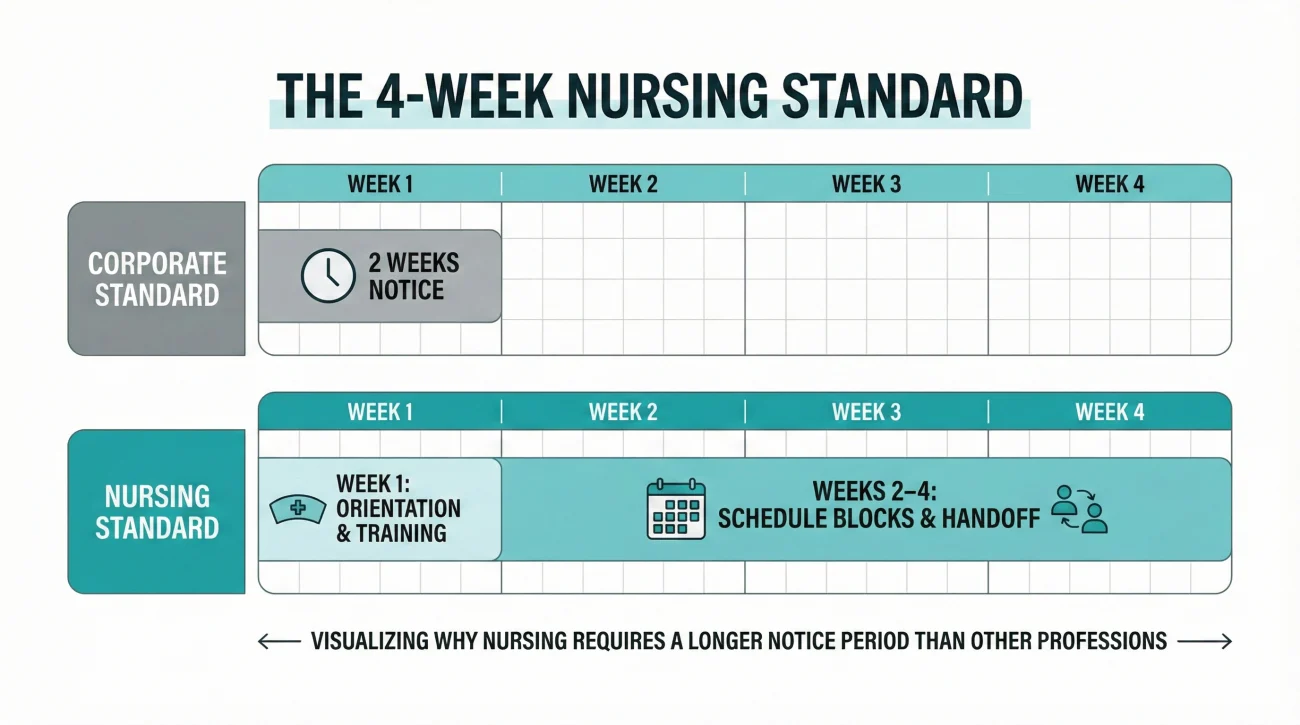
In the corporate world, two weeks is the standard notice. In healthcare, specifically for specialized roles like ICU, OR, or L&D nursing, a longer nursing resignation letter notice is often expected and sometimes contractually required. Why the difference?
- 📉 Orientation Time: It takes 12-16 weeks to fully orient a specialized nurse. A two-week notice leaves the unit in a significant lurch.
- 🗓️ Schedule Blocks: Nursing schedules are often built in 6-week blocks. Resigning with short notice disrupts the entire grid, forcing colleagues into mandatory overtime.
- 💰 PTO Payouts: Review your employee handbook carefully. Many hospital systems have policies stating that any resignation with less than 3 or 4 weeks’ notice forfeits the payout of accrued PTO (Paid Time Off).
The “Golden Handover”: Transferring Trust
Your legacy on the unit isn’t defined by how many difficult IVs you started, but by how safely you left. A comprehensive handover prevents medical errors after you are gone and solidifies your reputation as a “nurse’s nurse.”
| Handover Element | Standard Practice | The “Golden” Standard |
|---|---|---|
| Narcotics Count | Sign off with the charge nurse on the last day. | Audit your discrepancies with Pharmacy a week early to resolve any lingering flags. |
| Patient Charting | Complete daily notes. | Close all open care plans, resolve pending orders, and ensure all restraint documentation is perfect. |
| Knowledge Transfer | Verbal report to the replacement. | Written “Unit Brain” sheet for complex patients (e.g., specific wound care preferences, family dynamics). |
| Equipment | Return badge to security. | Clean out your locker, return borrowed reference books, and wipe down your wow/cart. |
Professional Resignation Templates for Nurses
These templates are designed to be concise, professional, and clear about your end dates to prevent scheduling conflicts. They strip away the emotion to focus on the logistics of the transition.
Standard Floor/Unit Nurse Resignation
Use this template for a standard departure from a Med-Surg, Telemetry, or general ward position. It serves as a solid hospital resignation letter covering all administrative bases.
[Your Name], BSN, RN
[Your Address]
[City, State ZIP]
[Your Email]
[Your Phone]
[Date]
[Unit Manager Name]
[Unit Name, e.g., 4 West Telemetry]
[Hospital Name]
[Hospital Address]
Dear [Manager Name],
Please accept this letter as formal notification of my resignation from my position as a Registered Nurse on the [Unit Name] unit, effective [Date]. My final scheduled shift will be [Date and Shift Time, e.g., November 20, 7:00 PM–7:00 AM].
I have made the decision to [brief reason: pursue an advanced degree / relocate to a new city / accept a position in outpatient care], but this was not an easy choice. Working with the team at [Hospital Name] has been a defining period in my career, sharpening my clinical assessment skills and teaching me the true meaning of patient advocacy.
To ensure a seamless transition for the unit and maintain patient safety, I commit to:
- Completing all assigned shifts on the current schedule without calling out.
- Ensuring all patient charting, care plans, and discharge summaries are up to date before my final clock-out.
- Assisting in the orientation of any agency nurses or new staff taking over my patient assignment.
Thank you for your leadership and the support you have provided during my tenure. I hope to stay in touch with the team.
Sincerely,
[Your Signature]
[Your Name], BSN, RN
License #: [Your License Number]
Employee ID: [Your ID]
Transitioning to PRN (Per Diem) Status
Many nurses don’t leave fully; they just leave full-time status. This letter is a request to change status rather than a full resignation, keeping your foot in the door.
Dear [Manager Name],
I am writing to formally request a transition from my current full-time status to Per Diem (PRN) status on [Unit Name], effective [Date].
I have thoroughly enjoyed my full-time role here, but due to [reason: beginning graduate school / family care obligations], I need to adjust my schedule. I value this team and the patient population deeply and wish to remain a part of the [Hospital Name] staff, helping to fill coverage gaps as my schedule permits.
I understand the PRN requirements involve [mention specific requirements, e.g., 2 shifts per month and 1 winter holiday]. I am fully committed to meeting these obligations.
Thank you for considering this request. I look forward to continuing to serve our patients in this new capacity.
Sincerely,
[Your Name], RN
Handling Complex and High-Stakes Departures
Not all resignations are amicable or planned. Sometimes you leave because the environment is unsafe, or your health is at risk. These situations require careful wording to protect your professional reputation while creating a paper trail.
Resignation Due to Safety/Working Conditions
If you are writing a resignation due to unsafe ratios or lack of resources, be very strategic. The resignation letter goes into your permanent HR file. It is often better to state “personal reasons” or “better alignment” in the letter, and save the specific safety complaints for an exit interview, a formal report to the compliance hotline, or The Joint Commission.
Dear [Manager Name],
Please accept this letter as my resignation from my position as Staff Nurse, effective [Date]. After careful consideration, I have decided to move to a position that better aligns with my current professional goals and practice standards.
This was a difficult decision, as I care deeply about the patients we serve. My priority remains the safety and well-being of the patients on this unit. I will fulfill my scheduled shifts through [Date] and ensure that all my documentation is meticulous to support the remaining staff.
I wish the team nothing but the best and hope for the continued success of the unit.
Sincerely,
[Your Name], RN
Resignation Due to Relocation
When life moves you to a new state, this letter clarifies that your departure is purely logistical. This is the “cleanest” type of resignation and easiest to explain to future employers.
Dear [Manager Name],
I am writing to formally resign from my position as [Role] at [Hospital Name], effective [Date]. My family is relocating to [State/City] due to a spousal job transfer, making my continued employment here impossible.
I want to express my deepest gratitude for the mentorship I have received on this unit, particularly regarding [mention a specific skill, e.g., cardiac care]. I am committed to making my departure as smooth as possible and will ensure a thorough handoff of all my primary patient responsibilities.
Thank you for the opportunity to be part of this incredible team.
Sincerely,
[Your Name], RN
The Logistics of De-Accessioning: More Than Just Keys

Nurses have access to controlled substances, sensitive HIPAA data, and secure areas. Your exit involves a specific “de-accessioning” process that must be followed to the letter to avoid future liability.
- 💊 Pyxis/Omnicell Access: Ensure your fingerprint or login is deactivated only after your last shift. Ask your manager to confirm the exact time of deactivation to avoid being locked out during a critical med pass on your final night.
- 🆔 ID Badge & Parking: Most hospitals require you to turn this in on your last day to Security or HR. Do not take it home as a souvenir; it is considered a security risk.
- 💻 EMR Access: Finish all charting before you clock out. Once you leave, you lose access to Epic/Cerner/Meditech immediately. You cannot come back later to “fix a note.”
- 🏥 COBRA & Benefits: Healthcare for healthcare workers is ironically complex. Ensure you have the paperwork for COBRA if you have a gap before your next job starts.
❓ FAQ
🚨 Can I quit without notice if my license is at risk?
This is considered a “nuclear option.” If you feel your license is in immediate danger due to consistently unsafe assignments, you can resign immediately, but you must do so carefully to avoid charges of abandonment. Never walk out mid-shift. Finish your shift, hand over patients safely, and submit your resignation effective immediately. Document everything that made the assignment unsafe (dates, times, ratios, acuity) to protect yourself in case of a board report.
🗓️ Is 2 weeks’ notice really enough for a nurse?
It depends on your goal. For “rehire eligibility” (the ability to come back to that hospital system later), many systems mandate 3 to 4 weeks for RNs. Two weeks is the polite minimum in the general workforce, but in nursing, it might burn a bridge or cost you your PTO payout. Always check your specific employee handbook or union contract first.
🩺 Should I mention staffing ratios in my resignation letter?
Generally, no. Your resignation letter is a permanent HR document that may be read by future employers conducting background checks. Complaining about ratios there won’t fix the problem but might label you as “difficult.” Address staffing issues in the confidential exit interview or via an anonymous compliance report where it can actually be investigated.
📝 Who do I give the letter to?
Give the primary signed copy to your direct Nurse Manager (Unit Manager). It is also professional to CC the HR department so the clock starts ticking on your notice period officially. Do not just leave it on a desk; request a brief, private meeting to hand it over personally. This shows respect for the relationship.
🤔 Can I use my nurse manager as a reference if I leave mid-year?
It is risky but possible. If you leave professionally – giving ample notice, finishing your shifts, and training your replacement – most managers will still respect your work ethic. However, if you leave short-staffed or with immediate notice, expect them to decline providing a reference. In that case, rely on Charge Nurses or Peers for references.
Final Thoughts
Resigning from a nursing job is an emotional and logistical hurdle. You bond with your “work family” in a way that few other professions understand. However, prioritization of your own career health is not a betrayal of your team; it is an act of self-preservation that allows you to continue being a caregiver in the long run.
By submitting a professional nurse resignation letter, honoring your notice period, and ensuring a flawless handover, you protect the patients you cared for and the license you worked so hard to earn. As you transition to your next role, remember that the nursing world is small. Leaving with grace ensures your reputation precedes you positively. For more guidance on professional exits in other fields, explore our resources on resignation letter samples for different jobs to navigate your career path with confidence.
⚠️ Legal Disclaimer: The resignation templates, email samples, and professional guidance provided in this guide are for informational purposes only and do not constitute legal advice. Employment laws and contract requirements vary by jurisdiction and individual circumstances. Please review your employment agreement and consult your HR department and/or a qualified attorney to ensure compliance with applicable laws and policies.